
Stay informed
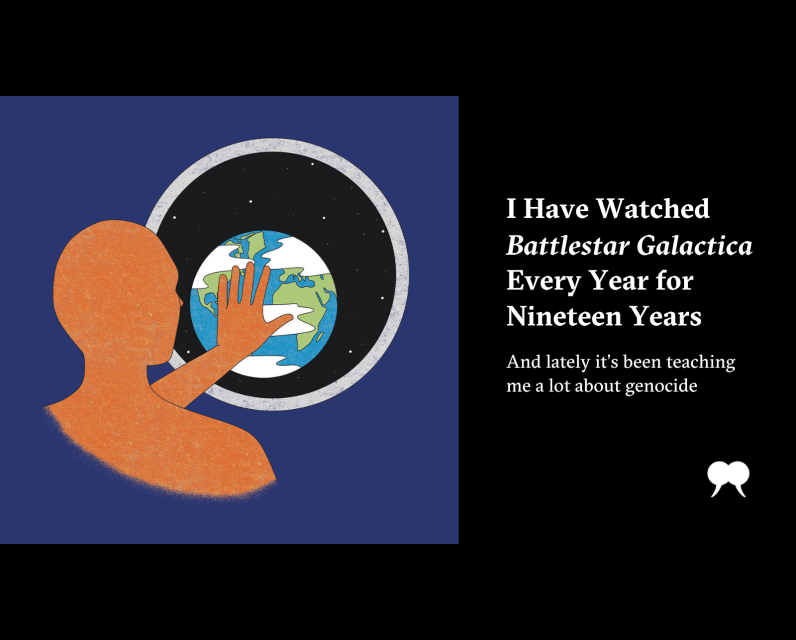
I Have Watched Battlestar Galactica Every Year for Nineteen Years
Four people gather around a desk surrounded by stars and darkness. There is eerie music playing. One of the men in the group wants to spread a virus that would eradicate an entire population of robots. Another says: “Genocide? So that’s what we’re about now?”
I was hooked. I was eleven, and the show was Battlestar Galactica, which depicts how machines called Cylons, who look like humans and were created by humans, destroyed most of human civilization. I began tuning in each week and was soon renting past episodes from the library or Blockbuster (this was 2006). When I had watched them all, I watched them again. I have watched the show in its entirety—over seventy episodes—every year for the past nineteen years. It has become a summer ritual.
There’s a lot to love about Battlestar Galactica, from its rich storylines to its self-actualized characters to the really awesome space-battle sequences. But when I tell people how much I love it, I giggle. I expect them to wonder, as I might in their shoes, why I’m into a silly space show, one with no substance. But, for me, Battlestar is so much more than entertainment.
At the time that I discovered Battlestar, I had been seeing news accounts of torture being used on people imprisoned at Guantánamo and Abu Ghraib. I could not understand how these kinds of things were allowed to happen or why other hit TV shows of the era, like 24 and Lost, seemed to sanction them. Even the brilliant programs that did engage with how 9/11 changed America—The Sopranos, The Wire, and The Shield—never really challenged the country’s actions. Battlestar did. As one scholar put it, the show asks the audience uncomfortable questions like, “What does it mean to be a human? What does it mean for a society to believe it is at war? Is it possible to be moral during times of profound crisis?”
At a moment when torture was being rationalized as a means of extracting confessions, Battlestar Galactica asked whether it really worked. In one episode, a character named Starbuck has crew members hold a Cylon’s head underwater in order to obtain information about the presence of a bomb. The fleet’s commander-in-chief, Laura Roslin, eventually intervenes. “You’ve spent the last eight hours torturing this man, this machine, whatever it is,” she says. “And you don’t have a single piece of information to show for it.”
At the end of season two, members of the Galactica crew find a planet that can sustain human life and they decide to settle there. Then the Cylons come and put the crew into a brutally violent occupation, which the crew, in turn, violently resists. Watching these four episodes in 2014, when I was studying journalism, made me think about what leads a person to violence and how important context is when reporting and understanding war or crime. This influenced how I approach my work as a journalist today.
Over the past two years, I have been reflecting on the first Battlestar episode that I watched nineteen years ago, “A Measure of Salvation.” Looking back at it now feels like looking back into the future. When the character Helo describes what the others propose doing as genocide, their reaction is immediately dismissive and angry. When protesters, students, and genocide scholars started saying what was happening in Gaza was genocide, government officials and many people in the media were similarly dismissive and angry. Lee Adama, the character in Battlestar who wants to spread the virus, uses dehumanizing language to describe the Cylons, calling them “things, dangerous things.” Then Israeli defence minister Yoav Gallant used even more dehumanizing language to describe Palestinians, declaring that “we are fighting against animals.”
That opening scene ends with one character saying: “We start destroying entire races, even mechanical races, we’re liable to tear off a piece of a man’s soul . . . . Posterity really doesn’t look too kindly on genocide.” Today, it feels to me like he’s talking about us.
The post I Have Watched Battlestar Galactica Every Year for Nineteen Years first appeared on The Walrus.
Unpublished Newswire


Comments
Be the first to comment