
Stay informed
Gaza Ceasefire Is at Risk, Former Canadian Ambassador Warns
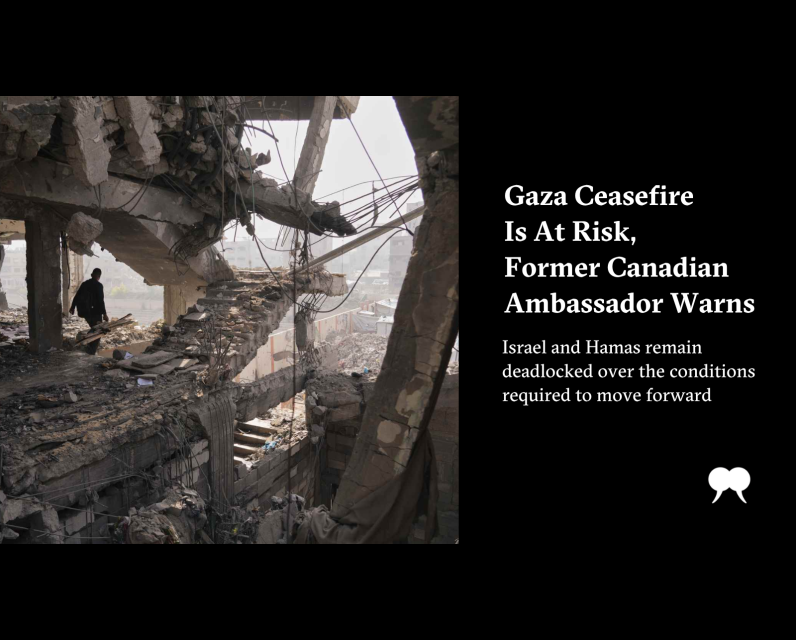
On October 9, Israel and Hamas agreed to a truce backed by the Donald Trump administration. The first phase of the peace plan, which includes the exchange of hostages and prisoners and calls for humanitarian aid to be allowed back into Gaza, is nearing its end. What comes next? I reached out to Jon Allen, who served as Canada’s ambassador to Israel from 2006 to 2010 and is now a senior fellow at the Bill Graham Centre for Contemporary International History, to talk about how the ceasefire is progressing so far and what to expect in the coming weeks.
Over the past two months, Israel has violated the ceasefire almost daily, killing and injuring hundreds of Gazans. What is the risk that the ceasefire might collapse?
The ceasefire has indeed been violated by both sides and on many occasions. Over 350 Palestinians have been killed and several Israeli soldiers wounded. There are also reports of Palestinians dying of cold due to exposure in and around Rafah. That said, it is, for the most part, holding, and the Trump administration, on the one hand, and Qatar, Egypt, and Turkey, on the other, are keeping Israel and Hamas’ feet to the fire in order to ensure that there is no return to a full-scale war.
In order to move onto the second phase of the peace plan, Hamas is required to disarm, and the Israel Defense Forces must begin to withdraw from Gaza. Do you foresee either side following through on these terms?
Hamas have always argued that they would not fully disarm until some form of Palestinian government was in place in Gaza and the IDF had begun to withdraw. But Israel has said that the IDF withdrawal will not happen unless Hamas is disarmed.
The Trump administration was aware of this ambiguity when it declared that both sides had agreed to the plan and is now trying to ignore this impasse and move directly to phase two, i.e., the presence of a multinational Arab/Muslim-led stabilization force, a Palestinian-led technocratic government to run day-to-day activities, and a high-level international board chaired by President Trump that would oversee the situation on the ground.
Nearly 2 million Gazans have been internally displaced. Before the ceasefire, hundreds had died from malnutrition. Most recently, a storm has caused flooding that’s reportedly killed at least fourteen Palestinians. The first phase of the plan stipulated allowing humanitarian aid into the territory. Has that been enough?
The humanitarian situation has improved somewhat, but remains dire as winter approaches. An insufficient number of trucks (less than the 600 per day guaranteed under the plan) are entering the Strip, and there continues to be a deficit of food and medicines. COGAT, the Israeli military unit that determines what can and cannot enter Gaza, has been preventing the delivery of tents and other equipment required to properly shelter the more than 1.5 million Palestinians in the south of the Gaza Strip, an area one-quarter of the size of Detroit.
What must be said is that innocent Gazans are no longer being subjected to a siege or the daily attacks, and they are no longer dying in the very large numbers that they were at the height of the war. The Trump peace plan deserves praise for that, but the United States must remain focused on its implementation if it’s going to ultimately succeed.
In terms of implementation, what will that look like?
It remains unclear whether and how phase two will unfold. The US, Arab states, and Turkey are working to convince various states, including Azerbaijan, Indonesia, Egypt, and the United Arab Emirates, to contribute armed troops to a stabilization force that will hopefully bring the rule of law back to Gaza and begin the process of disarming, or at the least decommissioning, the majority of Hamas’ heavy weapons. The Trump administration would then pressure Israel to begin its withdrawal while a Palestinian technocratic government begins carrying out the day-to-day activities of running Gaza.
The Trump administration and the president himself appear confident that the process is on track and will begin to be implemented in the new year. The United Nations recently adopted a Security Council resolution supporting the plan, which was a highly unusual use of the UN by this typically anti-UN administration. It’s also an indication that the majority of the international community wants the plan to succeed. Others are more skeptical.
In what ways?
Initially, it was thought that President Trump and former United Kingdom prime minister Tony Blair would co-chair an international board made up of world leaders that would oversee the military and civilian operations in the Strip. Recently, there have been media reports that some Arab states oppose Blair’s appointment, given his support for the US-led war in Iraq.
Most believe that neither Israeli Prime Minister Benjamin Netanyahu nor Hamas want to see phase two implemented. Netanyahu would prefer to continue to occupy a significant part of Gaza, at least until the upcoming Israeli election (which is scheduled to take place by October 2026), and avoid a Palestinian entity of any kind governing there. Any Palestinian presence would not be well received by his far-right wing ministers and coalition partners, Itamar Ben-Gvir and Bezalel Smotrich, both of whom would prefer to resettle parts of Gaza and eliminate Hamas completely.
For its part, Hamas, which has reasserted its iron fist over the parts of Gaza it controls, would prefer to retain its 47 percent and live to fight another day without relinquishing either its power or its arms.
Canada, among other countries, has recognized a Palestinian state. Does that recognition play any role in the coming stages of the Trump plan?
The recent recognition of Palestine by Canada and other Western countries—France, the UK, Australia, Spain, and others—will have little impact on phase two of the Trump plan.
Contrary to what the president has suggested, the plan is neither the deal of the century nor does it bring an end to a conflict that has been ongoing for 3,000 years. The conflict began only in the early twentieth century, when large-scale Jewish immigration to what is now Israel began. More importantly, the plan makes only vague references to the ultimate resolution of the conflict, Palestinian self-determination, and a Palestinian state, and ignores completely the ongoing settler violence and settlement expansion in the West Bank.
While the president has said separately that he will not allow formal annexation of the West Bank by Israel, he, or at the least his officials, are surely aware that de facto annexation is taking place on a daily basis, and the rule of law is under serious threat.
The official terms seem to fall short of describing what’s really happening: ceasefire, peace plan. Should we still be using them?
Yes; as I mentioned, a ceasefire is more or less in place. Both sides bear fault for the violations, but, as is almost always the case in conflicts between Israel and Palestinians, the Palestinians bear the brunt of the casualties.
It is not a peace plan if peace is understood as an end of conflict between Israel and Palestine. The focus of Trump’s plan is on Gaza and Gaza alone, and there are only vague references to a possible “pathway” to a Palestinian state.
What do you think it will take for such a pathway to be realized, in the context of Trump’s peace plan?
It will take time for the pain that both sides feel to begin to heal. It will take new and more dynamic leadership in Israel, in Palestine, and probably in the US as well. Bibi Netanyahu opposes a Palestinian state and has made that clear for years and many times this past year. Mahmoud Abbas, president of the Palestinian Authority, is eighty-nine, has no vision for the future of his people, and is no longer capable of making the compromises and bringing his people on board that will be required for an end-of-conflict agreement. Trump included the reference to self-determination at the demand of the Gulf states, Egypt, and Turkey. I doubt he believes in it.
So, no, I don’t think this plan will lead to two states, but I do believe it’s possible. The bottom line is that there are 7.5 million Jews and 7.5 million Arabs that are currently occupying the land between the river and the sea. Neither are going away. Another five or ten years of occupation will only beget more October 7s. A people cannot live under the conditions that Palestinians in the West Bank and Gaza are now subject to without rebelling. They have already lived it for almost sixty years.
Israelis and Palestinians will only be able to truly live in peace and security if they can find a way to compromise on their demands, set aside their respective senses of being victims, and suspend their narratives long enough to agree to separate and end the conflict.
Over the weekend, two shooters attacked a group of Jews celebrating Hanukkah on Bondi Beach in Sydney, Australia, killing at least fifteen. Can you see a possibility for peace, or a peace process, even amid the ongoing violence?
I call on all Jews and all Palestinians to eschew violence as a means to achieving political ends. The killings of innocent Jews in Australia, Canada, or Israel are in fact acts of antisemitism and terrorism and will only exacerbate the tensions and hatred that extremists on both sides exploit. Jews and Palestinians want peace and security for their children and themselves. Horrific acts like what took place in Sydney have no place in a civilized world.
The post Gaza Ceasefire Is at Risk, Former Canadian Ambassador Warns first appeared on The Walrus.
Unpublished Newswire


Comments
Be the first to comment