
Stay informed
My Sparkling and Surreal Experience As a Water-Tasting Judge
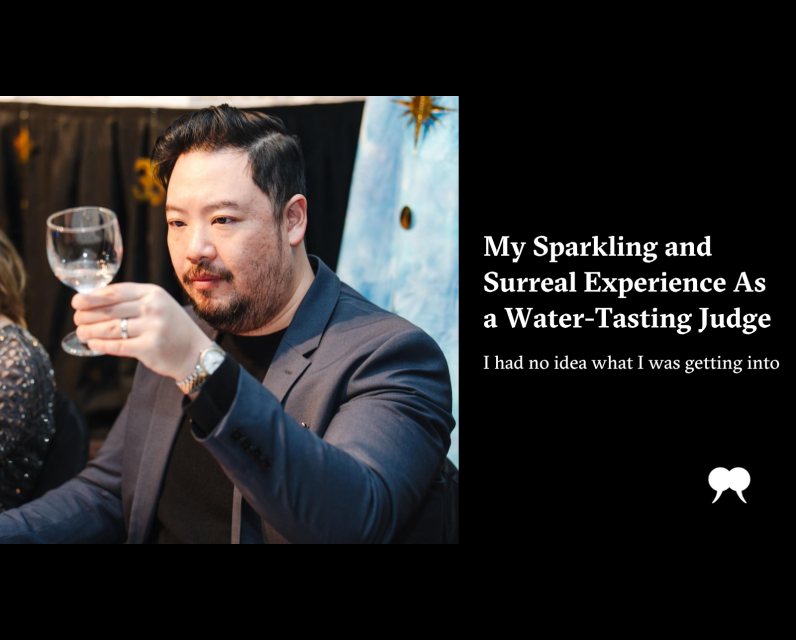
It’s a Saturday night in late February, and I’m in small-town West Virginia witnessing an unexpected stand-off. In the garden room of The Country Inn of Berkeley Springs are forty, maybe fifty people, crowded against each other. About 100 more spectators are watching from the perimeter. At the centre of the action are the gleaming prizes they’re vying for: unopened bottles of water, piled in the middle of the floor. Some have brought backpacks and tote bags, hoping to fill them with imported H2O from countries as far-flung as Tasmania and Turkey. All have signed the mandatory waiver absolving the event organizers should one incur injury.
These people aren’t here because of a water shortage. What I’m seeing is the “water rush,” the traditional finale of the Berkeley Springs International Water Tasting competition. For thirty-five years, this historic spring town, nestled in the Appalachian Mountains, has been the gathering place for the world’s most passionate drinking water enthusiasts, an annual event dubbed “the Oscars of Water.” Over the years, hundreds of water purveyors from dozens of countries have competed in several categories, including Purified Bottled, Bottled Carbonated, Bottled Non-Carbonated, and perhaps most coveted of all, Municipal.
The awards attract employees from regional public water utilities and bottled water company reps, people who work with water for a living. But there are also water superfans. Mara Iskander and Reed McConnell, a couple in their early thirties, drove more than ten hours from Chicago to attend. On a recent trip to California, they were able to also sample the tap water in towns that had previously medalled at Berkeley Springs.
Travel Berkeley SpringsThen, there are the locals, for whom this is the marquee event of the winter. More than one has warned me the water rush can get a little rowdy. With this in mind, the contest’s long-time producer and co-host Jill Klein Rone addresses the rushees before the ceremonial countdown. There are fewer bottles to go around this year because shipping costs are up and fewer competitors have entered. She asks that people be considerate of each other: “Be nice, play fair. No pushing, no shoving.”
The countdown begins from five, the room joining in en masse. We reach “one.” The crowd lurches forward.
*Pop!!*
Immediately, the sound of breaking glass cuts through the din. “Everybody stop, please! Stop taking water!” Klein Rone pleads as water spills onto the floor. The shards need to be cleared away before they can resume. However, a few enterprising individuals use the impromptu timeout to stuff their coffers. “I said, stop taking water!” Klein Rone repeats emphatically.
We may be at the Oscars of Water, but this feels more like Black Friday at Walmart. What did I get myself into?
For those of us with reliable access to it, water’s ubiquity has made it mundane—the liquid equivalent of breathing, so essential we’ve learned not to notice it. Maybe not even appreciate it.
As a child, I almost exclusively drank bottled spring water from one of those big, old jug dispensers you associate with offices. My parents grew up in Hong Kong during the 1950s and ’60s, when people often boiled their water because of concerns over cholera and other waterborne illnesses. It’s an ingrained mentality they carried over with them when they first moved to Canada: you can’t truly trust the tap. Since moving to Toronto in my twenties and meeting my wife (a lifelong and ardent tap water devotee), I’ve been a convert. I fill up straight from the faucet.
But I’ve recently come to realize that I know embarrassingly little about how that water gets into our home and what people do to ensure that it’s as plentiful and safe as possible. Then, I found out about Berkeley Springs and figured this would be an opportunity to learn the ins-and-outs of the water business. I reached out to Klein Rone, hoping to get media accreditation to cover the event.
“How would you like to be a judge?” she asked.
I immediately agreed.
The judging panel often includes media personalities and travel writers to help draw attention to Berkeley Springs. Because, on one hand, this is very much an offbeat contest trying to boost local tourism during the winter months. People who sell and deliver water can use any wins for marketing. But throughout the years, Berkeley Springs has also brought in environmental researchers, sanitation specialists, and sustainability experts for panel discussions.
Travel Berkeley Springs“For me, it always comes back down to that: we must protect our water,” Klein Rone says. This means talking about water: how we’re getting it, how we keep it flowing, and, yes, even how it’s tasting. These discussions take on new urgency as rising global temperatures and population increases squeeze our freshwater supplies. Both the United Nations and the World Economic Forum have offered similar projections that, by 2030, global freshwater demand is expected to exceed supply by 40 percent, placing nearly half the world’s population under chronic water stress or scarcity.
In Canada, the idea we’re blessed with some limitless treasure trove of drinking water is something of a misconception: we do hold 20 percent of the world’s total freshwater supplies, but less than half of that is renewable. And climate change is already affecting our water systems in measurable ways. Prairie provinces are experiencing more frequent droughts, while Atlantic Canada faces increased flooding and saltwater intrusion. Mountain snowpacks that feed Western rivers are declining. Responding to more widespread wildfires and other extreme weather events are all having a taxing effect, especially on our aging water infrastructure.
Keeping municipal water a viable option is an uphill battle. Canada faces an enormous infrastructure deficit nationwide: estimates range from $150 billion all the way to a trillion dollars, and even those numbers may be conservative. Many water mains are operating well past their intended lifespan, and the consequences of neglect can be devastating. In Sage Mesa, British Columbia, residents are facing a $33-million repair bill for their aging, privately-owned water system serving over 200 people—potentially over $1,000 per month per household. The province says it has no role in funding repairs since the system remains privately owned, illustrating how ownership structures can trap communities between unaffordable costs and failing infrastructure.
No Canadian water made it into the top three of any category at last year’s awards. Why did this happen?
Municipal budgets, squeezed by decades of underfunding and rising demands, often force water operators to defer maintenance or limit preventative work. The high cost of stockpiling rare replacement parts and justifying long-term investments becomes a gamble with public safety. Maintenance gets deferred. The eventuality is situations like Calgary’s catastrophic water main break in 2024, which saw the rupture of an aged water main. This flooded streets and the Trans-Canada Highway, prompting a citywide emergency affecting 1.2 million people with use restrictions and boil-water advisories. Replacement parts had to be imported from San Diego.
While some cities have responded with steep rate increases or natural infrastructure solutions, like street trees and rain gardens, others rely heavily on new federal funding programs. These pressures make long-term planning and building system resilience increasingly difficult for the water that flows from your tap every day.
The most successful Canadian municipal water in Berkeley Springs contest history has been Clearbrook Waterworks District, from Abbotsford, BC. They’ve won gold in the tap water category on seven different occasions, the most of any municipality in the world. This essentially makes Clearbrook the Meryl Streep of the water world—a generational talent and perennial contender.
But despite Canada’s past successes, no Canadian water made it into the top three of any category at last year’s awards. Why did this happen? Does the taste and quality of water truly vary that much every year? What makes water from places like Clearbrook so different from the Toronto tap water I drink every day, which—and no disrespect—gets the job done but doesn’t feel like anything to write home about.
All ten judges take a training seminar to learn how to assess the water. Arthur von Wiesenberger, California-based beverage industry consultant and one of the world’s leading connoisseurs of drinking water, teaches us how to judge based on guidelines he developed.
The process is surprisingly methodical, like tasting wines or whiskey. First, assess the appearance. For example, algae can sometimes tint the water green, while sulfur might give it a yellowish hue, and iron can cause it to appear more orange. The ideal drinking water is free of colour and sediment.
“You’re really just looking to make sure it’s perfectly clear,” he explains. “You don’t want anything in the water.”
Next comes aroma—swirling the water to aerate it, taking short sniffs to detect any off-putting odours, like plastic or chlorine.
Then the tasting itself. “The way I taste water is by taking it in my mouth with a little bit of air. . . . You roll it over your tongue.” He explains the role of the thousands of taste buds on your tongue and palate. “Those taste buds pick up all kinds of different things: saltiness, sweetness, sourness, bitterness, umami.”
He describes having tasted samples that remind him of “Band-Aid water” or notes of “wet dog.” But how do you tell between a water that tastes “good” and one that does not? He says he looks for a well-balanced flavour profile, something round rather than too harsh or mineral-heavy. But, by and large, people tend to prefer water that’s similar to what they grew up drinking. And, depending on where they live, people grow up drinking vastly different kinds of water, in terms of both taste and quality.
Most municipalities, especially more populous ones, draw from surface water sources, like rivers, lakes, or reservoirs. River water often tastes earthy from sediment and organic matter. Lake water can develop noticeable algae-related flavours, particularly during hot summer months. Treatment plants add chemicals and coagulants that make undesirable particles and compounds stick together like magnets, then let them sink to the bottom of massive settling tanks. Next comes a series of filters, first through layers of sand and gravel, then through activated carbon (basically super-absorbent charcoal) to catch anything left behind.
Surface water is exposed to all kinds of contaminants, making the possibility of microbial risks higher. The City of Toronto’s four water treatment plants process more than 1 billion litres of water from Lake Ontario every day to provide enough for its residents. But it’s also the same body of water we run boats through and pump our waste water into. Taste isn’t the primary concern; safety is. So, disinfectants are added—typically chlorine, but ozone can be used as well. This eliminates pathogens but can leave behind that soupçon of swimming pool. In the United States, federal law mandates every municipal system add residual disinfectants.
This is the secret behind Clearbrook’s first class water: Clearbrook taps into a significant groundwater source, not surface water. Its supply comes from the Abbotsford–Sumas Aquifer, a shallow, glacial formation made of porous sand and gravel. As rain and snowmelt seep through this layer, the water is effectively filtered before ever reaching the wells. This natural purification means the municipality simply taps into the aquifer, draws untreated, fresh mineral-rich water, and sends it directly to homes—no chemical treatment required. “We don’t add anything to it and we don’t take anything out of it,” says Ryan Federau, Clearbrook’s head water technician and Berkeley Springs attendee.
The Clearbrook case is very different from large parts of rural Canada. Smaller systems serving fewer than 500 people struggle with aging pipes and infrastructure and accounted for 89 percent of boil-water advisories in 2023. Thousands more rely on private wells with no routine testing requirements. And, for many Indigenous communities, the challenges run far deeper. As of this past June, around thirty-nine drinking water advisories remain in effect on reserves, some persisting for years. These communities have long faced systemic barriers rooted in colonial policies, such as underfunded infrastructure and jurisdictional gaps between federal and provincial governments. Federal efforts have helped lift 148 advisories since 2015, but decades of neglect have made progress slow.
Still, Canadian municipalities boast decades of solid safety records. The vast majority of Canadians have access to clean, reliable drinking water. Internationally, Canada generally ranks quite highly in terms of water quality, compared to other countries.
But all it takes is one incident to sow doubt in the reliability of our public water, both locally and nationally. Think of Walkerton, Ontario, where at least seven people died and more than 2,000 fell ill from E. coli contamination in May 2000. Or the following year in North Battleford, Saskatchewan, where about 7,000 people suffered from vomiting, diarrhea, and high fever when the parasite cryptosporidium seeped into their water after a filtration system failed during routine maintenance. More than twenty years later, some residents still express hesitancy to drink from the tap. Faith in public water is exceptionally hard to maintain.
Even if the water supply remains stable and safe to drink, who controls it becomes more complicated, as consumer demand for bottled water directly strengthens the financial case for companies to secure control over groundwater sources, often at the expense of communities. Canada is an absolutely voracious consumer of bottled water. A 2023 report by United Nations University found that, on a per-capita basis, Canada ranks third in bottled-water consumption of the 109 countries studied.
In 2016, the issue of control played out dramatically in Ontario when Centre Wellington Township tried to purchase the Middlebrook well to protect its future municipal water supply, only to lose the bid to Nestlé Canada (at the time, the largest bottled water company in the country), which exercised a pre-existing right of first refusal. While Nestlé says it followed all legal protocols, environmental advocates and citizen groups argued that the behind-the-scenes nature of the transaction signaled a creeping trend toward water privatization, one that could erode public control over essential resources.
This also wasn’t the only controversy for the company in the area, as Nestlé also had water extraction rights for a well in nearby Erin, Ontario, which is Six Nations of the Grand River territory. The company pumped more than a million litres of water a day to sell to customers, while paying only a little more than $500 per million litres to the provincial government, with nothing going to the Six Nations.
This consumer-driven privatization creates a troubling cycle: the more people lose faith in public tap water and turn to bottles, the weaker public water systems become, politically and financially, while private companies gain more control over the sources.
As a newly minted official water taster, I take my seat on the makeshift stage, facing the rows of chairs set up for the event. To my surprise, many are already filled with onlookers preparing to watch us quietly sip water for the next hour. In front of me are blank scoring sheets, a tablet for inputting my final assessments, a bowl of plain crackers, and, most vitally, a flight of partially filled water glasses.
After Von Wiesenberger and Klein Rone give the audience a preamble of the history of the event and introduce the judges, both shout the catchphrase: “Let the waters flow!”
I reach for the first glass and hold it aloft. I inspect it closely for clarity, swirling it around the rim of the glass as if it were twenty-five-year-old sherry cask Macallan. I see no sediment, no haze, no indication of impurities.
Next, I stick my nose into the glass, trying to detect any standout scents. In all honesty, it just kind of smells . . . watery? I start to doubt my palate. Then I take a small sip, letting the water linger over my tongue and taste buds, really taking my time before swallowing. A subtle swirl of sweetness. A smooth, refreshing finish. This water is actually delicious.
I score it highly. As I reach for my second glass, I wonder if other waters will be this tasty. I quickly find out the answer is no. One sample had sickly overtones of burnt rubber. Another sample was slightly salty with a slick mouthfeel. Some people have to drink this every day?
Travel Berkeley SpringsAs the lone Canadian on the jury at Berkeley Springs, I had joked with the other judges that I could be the inside man that gives my home country an advantage. I would like to publicly maintain that I performed my duties with integrity . . . And it was a blind taste test anyways. In fact, I was just curious as to whether Canada would return to the winners’ podium this year.
But for the second straight year, no Canadian water takes a medal in any of the categories. The winning tap water goes to Emporia, Kansas, with waters from West Virginia, North Dakota, and California rounding out the top five.
I catch up with Federau after the announcement, as people get ready for the water rush. He’s sanguine about Clearbrook’s shutout. Accolades are great, but it’s the opinion of his customers—the trust of his very own neighbours—that actually matters to him.
And keeping that trust requires constant vigilance. I think back to something he mentioned to me earlier: “I sleep with my phone next to me and it could ring at any minute. If it does, I’m going out and I’m getting wet in a muddy hole.”
The next day, I make the long drive back to Toronto. On the way, I keep thinking back to how the contest ended and the chaos of the water rush. A room full of people literally surrounded by water all day long, suddenly scrambling for all they could get their hands on. Scarcity, even an artificial one in this case, can make scavengers of any of us.
In my haste to return home, I sustain myself with candy bars and a couple of gas station coffees. By the time I drop my bags in the kitchen, I’m terribly parched, a bitter astringency lingering throughout my mouth. I walk over to the faucet. A stream of cool, clear water fills my glass, like it always has. I bring the glass to my lips. But instead of gulping it down like I typically do, I pause for a second. And I give it a smell. Nothing discernible. I give it a small sip, letting it swish around on my tongue for a moment. Just a clean, refreshing sensation. Easy to drink. Easy to take for granted.
The post My Sparkling and Surreal Experience As a Water-Tasting Judge first appeared on The Walrus.
Unpublished Newswire

Comments
Be the first to comment