
Stay informed
Canadian miner's highly lucrative exit from the nuclear depression
We’re nearing year-end, and there’s much doom and gloom. Canada’s economy is falling behind its OECD peers while projected equalization numbers show all provinces from Manitoba east on the receiving end of federal transfers next year.
A conversation with Tim Gitzel — CEO of Saskatoon-headquartered Cameco, the world’s largest publicly traded uranium company, valued at nearly US$40 billion — is a positive reminder of what’s working.
“We just work hard and stay humble and we work together and cooperate and we don’t look for handouts,” Tim shares. “We try and stay humble, because we’ve lived through the depression — I say that in the nuclear sense.”
What’s the nuclear depression? It’s the decade following the 2011 Fukushima nuclear power plant disaster in Japan, the worst nuclear accident since Chernobyl.
“2007 to 2011, it was glory days,” he says, “everybody was building, we were producing, we were starting up new (uranium) mines, and then, bingo, March 11th, 2011, and the market went off the table. The price of uranium went from $73 US to $17… and we had all this oversupply.
“We went through 10 years, counting pencils,” he shares sombrely. “…We’re going to charge for coffee, because it was that tight. That made us really humble about our business.”
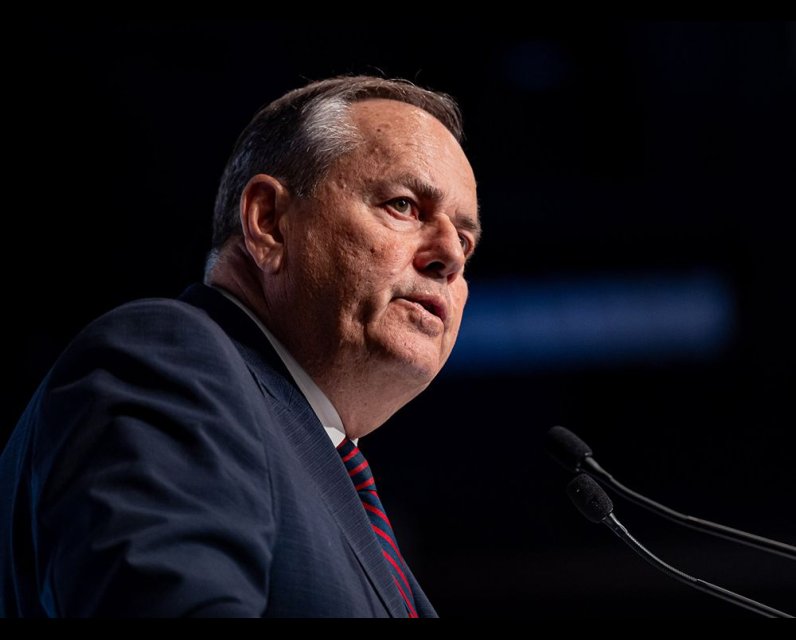
The stories told by this quiet-spoken, unassuming Saskatchewan-born CEO in his blue suit and tie almost sound too good to be true. Today, he’s now leading a vertically integrated nuclear company with uranium mines and projects in northern Saskatchewan, Wyoming, Nebraska, Kazakhstan and Australia. The company is the largest industrial employer of Indigenous people in Canada.
I detect a hint of fierceness in his tone; I heard the same, much amplified, in previous conversations with Saskatchewan’s premier, Scott Moe, talking of how he would pressure China and Ottawa to resolve market access for Canadian canola.
After a decade in the nuclear wilderness, Cameco now finds itself in the clean energy sweet spot. “In 2020, things were coming back around for nuclear,” he reports, “it was ‘climate change,’ ‘climate crisis,’ ‘climate catastrophe,’ ‘race to net zero,’ all of that was the language five years ago. And they said, ‘Well, what are we going to use for electric cars, electrification, decarbonization?’”
The nuclear renaissance, driven by AI data centres’ electricity demands and decarbonization, was further fuelled by Russia’s invasion of Ukraine.
“Then,” Tim explains, “it became energy security and national security.” Today, he reports, “there aren’t very many countries in the world that aren’t looking at the nuclear option, having some form of nuclear, whether it’s in the form of an SMR (small modular reactor) or large reactors.
“Here in Saskatchewan,” he continues, “we’re blessed with the largest high-grade (uranium) mines in the world. We have conversion facilities. We’re working on enrichment in the United States in Wilmington (North Carolina). We make fuel — fuel bundles, fuel rods —for the Candu fleet.”
And so, it was logical to say yes, Tim explains, when Bruce Flatt, CEO of Brookfield Asset Management, called him to ask if Cameco was interested in partnering with Brookfield Renewable to buy Westinghouse Electric Company, a major nuclear services provider. In a deal that closed in November 2023, Cameco acquired a 49 per cent stake for US$7.9 billion; Brookfield acquired a 51 per cent interest. (Incidentally, Prime Minister Mark Carney was the chair of Brookfield Asset Management when the deal with Westinghouse was struck.)
With operations on both sides of the Canada-U.S. border, Cameco has to figure out how to work with both governments. “October 28th, five weeks ago,” Tim shares, “we signed a big deal in the U.S. The U.S. government stepped up and put $80 billion on the table for new Westinghouse reactors in the U.S. You know, we’re just seeing AI and data centres and hyper scalers screaming for clean electricity, and everybody’s looking at each other and saying, ‘Yeah, we want to build, but who’s going to go first?’ And the administration down there just said, ‘OK, we’re going to kickstart this and really get it going.’
“That’s what we’re working on today, in fact this morning,” he reports, “putting that deal together. They want 10 reactors, 10 AP1000 Westinghouse reactors started by 2030. And so that’s a tall order in the nuclear business, and that’s just part of our business, so off we go.”
Back home, in Canada, Tim had a voice at the Canada-U.S. tariff committee put together by then-prime minister Justin Trudeau this year, he says, “when noise was coming over the border and we didn’t know how to react.
“It was kind of interesting,” he explains, “because I think there were two people from west of Toronto — Rachel Notley (Alberta’s former NDP premier) and I were there.”
It was “a whole different movie” sitting in those meetings, Tim reports: “You’ve got Unifor’s president and automobile parts manufacturers and steel — they are getting crushed, they are feeling it, their people are leaving, they’re shutting down — and they come to me and say, ‘How’s it going?’ I say, ‘Well, you know, we’re just kind of keeping our heads down and doing our business and our products are CUSMA-compliant and so there’s no more tariffs on ours. So … I felt a little bit awkward.”
Tim understands why differences remain, even today, between otherwise like-minded provincial governments, and that there are fears Canada won’t be able to get its act together. Nuclear projects can be a way to collaborate, he suggests: New Brunswick has nuclear and is looking for more; Alberta is serious about small modular reactors; and Cameco supplies almost all the fuel to the 17 reactors operating in Ontario.
“I can tell you every province and country are looking to maximize the (local) supply chain,” he says, “the jobs and benefits and materials from their own jurisdiction.” If you look at a new nuclear plant, in Ontario for example, Tim estimates 60 per cent of a new plant would be cement and rebar, all locally supplied.
Tim’s experiences leading Cameco through the aftermath of the Fukushima accident make him sensitive to what’s going on around him. He’s on the board of the Mosaic Company, a potash miner also headquartered in Saskatchewan, and now evaluating what to do when the Trump administration threatens to dial up U.S. tariffs on fertilizer.
“We think about it (tariffs) every day,” he concludes. “But, let me give you some numbers: The United States has 94 nuclear plants. They consume 50 million pounds of uranium per year and produce none. They need us.” Potash is in the same situation, he suggests. The U.S. needs what Canada can supply.
These are sunny thoughts as we head into the new year.
Our website is the place for the latest breaking news, exclusive scoops, longreads and provocative commentary. Please bookmark nationalpost.com and sign up for our daily newsletter, Posted, here.

Unpublished Newswire

Comments
Be the first to comment