
Stay informed

Burner phones, security warnings and no 'megaphones': How Carney's trip to Beijing struck a surprising new tone with China
BEIJING — In April 2025, Prime Minister Mark Carney was standing on the stage of the federal election leaders’ debate when he was asked to identify the greatest threat to Canada’s national security.
Without hesitation, Carney declared: “China.”
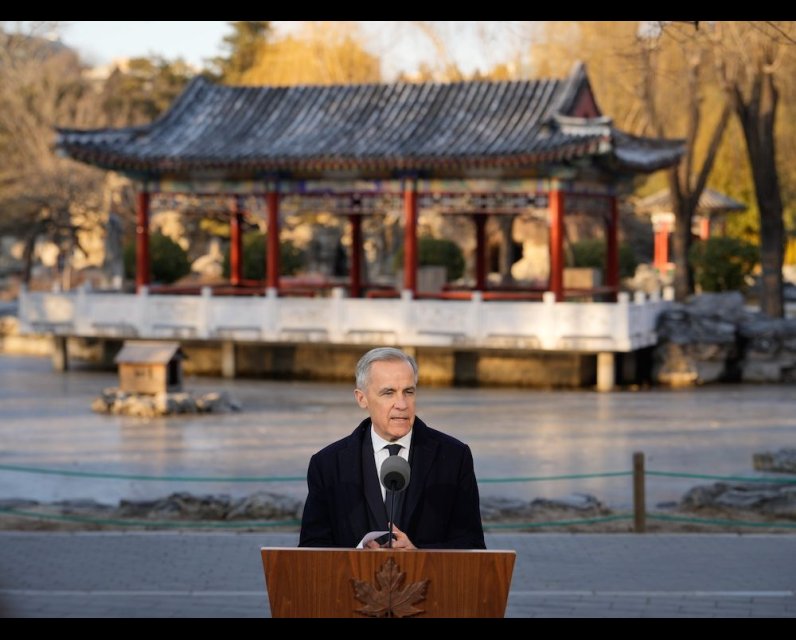
On Thursday, Carney stood at a podium in Beijing’s Ritan Park and beamed as he announced a new “strategic partnership” with China that aims to increase trade, communication and collaboration between both countries.
It also makes a strong push for Chinese EV investments in Canada with the eventual objective of having a manufacturing plant established in Canada.
If the swing in tone gives you whiplash, you’re not alone. So, what changed in those nine months?
It’s hard to tell.
Ask Carney if he still believes China to be the greatest threat to Canada’s national security and he’ll skirt the issue.
“The security landscape continues to change in a world that is more dangerous and divided. We face many threats,” Carney told reporters in response to that question during the press conference in Ritan Park.
“My responsibility as prime minister is to manage those threats by building resilience, building security,” he added. “The threat environment has increased, the risks have multiplied, so too has our resilience and our engagement.”
Ask any other Liberal minister to explain the change and they’ll stick to roughly the same script, almost to the point where one wonders if Carney regrets pointing the finger at China back in April.
The world is changing largely due to the “transformational” presidency of U.S. President Donald Trump, the Liberals will say. So, Canada needs to diversify its trading partners and China is a prime candidate because it’s a more predictable partner than the U.S. now, they’ll add.
Likely also on the Liberals’ mind is Trump’s National Security Strategy released in December that aims to restore “American preeminence in the Western Hemisphere,” the constant threat of new U.S. tariffs against Canada and statements by top U.S. officials declaring they want to draw away Canadian auto manufacturing.
Comments like those are pushing Canada to seek non-U.S. partners to boost its fledgling EV industry. China’s EV industry, largely considered a world leader in both manufacturing and technological advancement, became a prime candidate.
That’s despite concerns that the technology in the vehicles could be used by China to spy on users and pose a threat to foreign countries’ national security.
The Carney government says its taking precautions in its dealing with China, described by Canada’s national security agencies as the most sophisticated and able threat actor facing the country.
Carney said Canada discussed its expectations and “red lines” with the Chinese government last week with respect to foreign interference and other public safety issues.
He also promised that the government was going into this new “strategic partnership” with “clear eyes” and guardrails preventing China from investing in certain sensitive industries. He recently cited artificial intelligence and critical minerals as examples.
But will that be enough to prevent China from continuing to be the most sophisticated and prevalent cyber and foreign interference actor against Canada, as described by Canada’s national security agencies?
In the meantime, the public service’s concerns about security while in China were certainly obvious from the start of the trip.
One hour before Can Force One entered Chinese airspace Wednesday, all public servants and political staff were required to power down their usual work and personal devices and stash them in a Faraday bag.
While in Beijing, they all used “burner” devices, which were promptly returned as soon as the delegation’s plane left Chinese airspace Saturday.
There’s no need to use burners in Qatar and Switzerland — the next stops on the eight-day trip — showing that not all allies are on equal security footing.
Carney’s emphasis at the end of the trip was on the restoration of Canada’s trade, political and cultural relationships with China, which are emerging from eight years of deep frost.
After his meeting with President Xi Jinping, the prime minister proudly announced a new “strategic partnership” with the Asian superpower built on five pillars: energy, increased trade, international governance, public safety and security, and increased “people-to-people” ties.
Part of the deal was an agreement that China would drop many of its crippling tariffs on Canadian canola. In exchange, the federal government would exempt up to 49,000 Chinese EVs from 100 per cent tariffs this year all the while pushing for Chinese auto manufacturers to build production capacity in Canada.
“We are building a web of new connections with China to create new, transformative opportunities for Canadian workers, and more stability, certainty, and prosperity on both sides of the Pacific,” he told Canadian and Chinese reporters.
Truth be told, everything about Carney’s trip to China felt like a hard break from the Trudeau era. In fact, Carney seemed more inclined to implicitly criticize his Liberal predecessor than his Chinese hosts.
Instead of Justin Trudeau’s public insistence that China do more on human and women’s rights, Carney spoke occasionally of “values-based realism” and “differences.”
“We respect the differences in each other’s systems. It does mean that our cooperation is more focused, more limited,” he said.
“We don’t grab a megaphone and have the conversations that way,” he added in an obvious swipe at Trudeau. “We take the world as it is, not as we wish it to be.”
The China section of the Trudeau government’s 2022 Indo-Pacific strategy, written during the height of the “two Michaels” saga and presented by then-Foreign Affairs Minister Mélanie Joly (now industry minister under Carney), also appears to have gone by the wayside.
The document described the Asian behemoth as “an increasingly disruptive global power” that “increasingly disregards” international rules and norms.
“China is looking to shape the international order into a more permissive environment for interests and values that increasingly depart from ours,” reads the document.
And yet throughout the Beijing trip, the Carney government described China as a key partner in supporting multilateral institutions left in the lurch as a still-unclear “new world order” replaces the one previously led by the United States.
Gone are the words “disruptive” or “disregards” from the federal government’s lexicon on China, replaced by terms such as “partner” and “China’s strengths.”
Carney distanced himself from the Trudeau-era policy while in China.
“I wasn’t a member of the government at the time,” Carney told reporters about the 2022 policy Thursday. “I wasn’t there; it wasn’t my view.”
The world is changing quickly, becoming more unstable and dangerous, the Liberals note repeatedly. That’s why the government is reworking its foreign policy, its Indo-Pacific strategy and is set to release a new auto-sector strategy in February. And it’s happening on the fly.
As one senior government official told reporters on the plane out of Beijing:
“I’m just dealing with sh– as it starts.”
National Post
cnardi@postmedia.com
Our website is the place for the latest breaking news, exclusive scoops, longreads and provocative commentary. Please bookmark nationalpost.com and sign up for our politics newsletter, First Reading, here.

Unpublished Newswire



Comments
Be the first to comment