
Stay informed
Face It, One More Pipeline Won’t Save Us from Trump
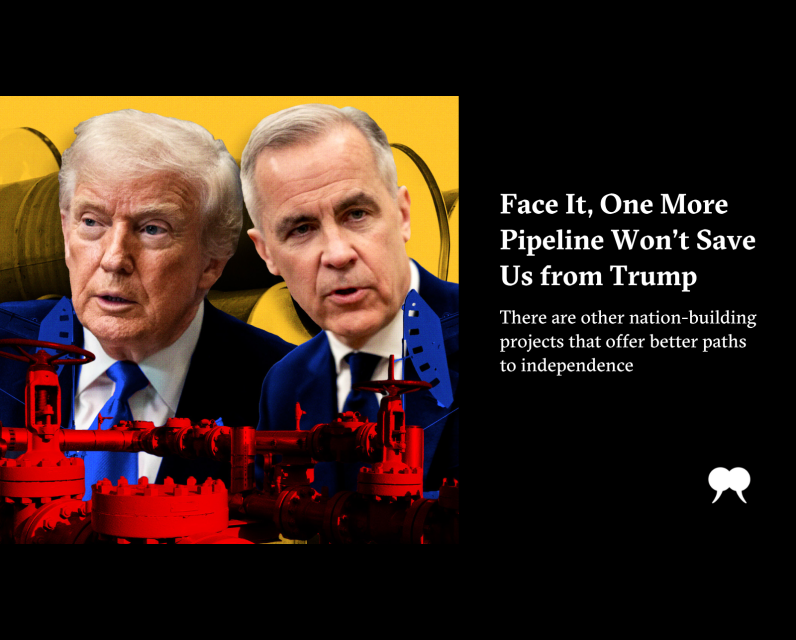
As day follows night, the United States’ intervention in Venezuela triggered Canada’s favourite response to international calamity: a call for more pipelines.
Not just any pipelines, of course. “Canada must immediately approve a pipeline to the Pacific Coast,” declared federal Conservative leader Pierre Poilievre in a letter to Prime Minister Mark Carney a few days later. He was late to the party—the demand had already been made by Alberta premier Danielle Smith and captains of the oil patch, as well as the Globe and Mail’s editorial board. “A new oil pipeline to the Pacific coast isn’t merely desirable,” opined the paper’s Sunday Editorial. “It is a national imperative.”
What these arguments prove is the vice grip pipelines have on our national imagination. They collapse a vast range of options for diversifying Canada’s economy and reducing our dependence on the US to a single question: Who else can we sell our oil to?
Worse, they buy into the false narrative peddled by the president of the United States: that Americans will have no trouble seizing and rebuilding Venezuela’s shattered oil infrastructure. The Donald Trump administration could have asked for no better spokesperson than Smith when she warned Carney that “renewed Venezuelan crude production, supported by United States investment, will ultimately increase the amount of heavy oil bound for US refineries and directly compete with Canadian production for limited refining capacity.”
History suggests otherwise. The past two times the US deposed the leader of an oil-rich nation—Iraq in 2003 and Libya in 2011—both went down in infamy for unleashing years of violent chaos that reduced oil production in each country. It took Iraq around seven years to restore production to pre-invasion levels, while Libya’s production still hasn’t recovered from the chaos wrought by US intervention.
Historical comparisons only go so far. But Venezuela’s current reality is even more devastating to the logic of Trump and Canadian pipeline enthusiasts alike. Unlike Iraq and Libya, whose dictators maintained at least a somewhat stable industry, Venezuela’s oil infrastructure is in such tatters that even the most optimistic experts agree it would take at least a decade and untold billions in sustained investment to resurrect it—if everything goes smoothly.
The blithe assumption that Venezuela will remain stable and obediently hand over its most valuable resource to an enemy it has passionately opposed for the past three decades would be laughable if it wasn’t a cornerstone of US foreign policy. America’s own oil companies, who aren’t exactly leaping into the Venezuelan void, clearly don’t believe it. Canadians shouldn’t either.
Speaking of history: Remember the pipeline Canada just built to diversify our oil markets? The Trans Mountain Expansion (TMX) pipeline project is making money now and was arguably a good investment. But it cost $34 billion, and that was along a pre-established route, twinning an existing pipeline. By contrast, any new pipeline to the north coast would have to break new ground across some of the most difficult terrain in Canada—several mountain ranges and densely forested watersheds where almost no roads or railways currently exist. That price tag would be astronomically higher than that of TMX. Who wants to make that kind of investment?
It would take years to build and decades to pay off, assuming global oil demand and prices stay high. That’s no less a gamble than Venezuelan stability. The price of oil dropped 20 percent over the course of 2025 and is hovering around $60 per barrel at the time of publication (just above break-even prices for Alberta’s bitumen), thanks to a global supply glut. The world is awash in cheap oil, and that’s before any possible influx of Venezuela’s bitumen.
In the past decade, oil has ricocheted between $25 and $114 per barrel. Just like geopolitics growing more volatile by the day, so is the price of oil. It’s this volatility that makes a big new pipeline investment for Canada such a risky bet. It would increase our national dependence on the price of oil, which, like American foreign policy, is something we have no control over.
That said, it’s absolutely true that America’s naked imperial aggression does present an existential threat. Trump is destroying the rules-based international order and replacing it with the law of the jungle. He’s moving so fast that news of Venezuela barely held the front page for a weekend; it was eclipsed almost immediately by America’s threats against Greenland, Cuba, and Colombia, as well as the state-sponsored murder of American citizens at home. Canada, the “fifty-first state,” needs to get ready—and fast.
But did any of this occur to Canadian Conservatives when Maduro was abducted? Hardly. Their immediate reaction—before pivoting to pipelines—was to applaud America’s imperial banditry. “Congratulations to President Trump on successfully arresting narco-terrorist and socialist dictator Nicolás Maduro,” Poilievre posted on social media. “Down with socialism. Long live freedom.” Making an early bold statement was Jason Kenney, the former premier of Alberta and a potential frontrunner to eventually replace Poilievre. “Amazing!” Kenney posted in the early hours of January 3. “Full credit it [sic] where it is due, to President Trump and the brilliant US military.”
You could see the broader implications for Canada and the world sink in, three days later, when the White House proclaimed its intent to annex Greenland. “This is nuts,” Kenney posted then.
Indeed, Mr. Kenney, it is. So is supposing that one more pipeline will inoculate Canada from whatever’s coming next.
Let’s broaden our imaginations instead. Let’s ask how else we might invest the tens of billions a new pipeline would cost. What other industries, partnerships, and long-term strategies are available to boost Canadian autonomy and decrease American leverage over us?
The person best poised to answer that question—Prime Minister Carney—has been thinking about this for a year now. He’s obviously not opposed to a new pipeline, as the memorandum of understanding with Alberta made clear. But he hasn’t used events in Venezuela to justify going beyond that MOU either; despite some consoling words about the long-term viability of Canada’s oil patch, the word “pipeline” hasn’t left his mouth at all.
In fact, there’s plenty of evidence that Canada’s pipeline obsession strikes Carney as a tiresome—albeit politically necessary—distraction. “It’s an easy conversation to have about a pipeline, because it’s one thing we can see,” he told a group of Bay Street executives at Canadian Club Toronto this past November. “But the reality is that there’s much, much more to the Canadian economy, and there’s much, much more to the future of the Canadian economy.”
In that chat, Carney laid out a vision for growing Canada’s clean electricity by 50 percent over the next decade or so. “We’re talking about $150 billion dollars of investment,” he said. That wasn’t just talk; Carney’s vision is embodied by several projects already being considered by the Major Projects Office. These include Wind West Atlantic Energy, a $60 billion wind energy and transmission line proposal in Nova Scotia that could send clean electricity throughout Eastern Canada, all the way to Quebec; or the expansion of Ontario’s Darlington nuclear power plant, which was added to the Major Projects Office in October with $3 billion in federal and provincial funding; or British Columbia’s North Coast Transmission Line, which also made the Major Projects Office in November. For an estimated $6 billion investment, that line will bring clean electricity to northern BC, where it could help power a vast network of critical-mineral mines, whose development is also on Carney’s to-do list.
These are just a few of the alternatives to a new pipeline that Canadians should encourage their leaders to focus on. They span the country. They generate money, jobs, and energy. They increase Canada’s independence. They also happen to align with the climate goals overshadowed by America’s lurch toward fascism.
Carney knows all this, no doubt. Let’s hope he acts on it too.
With thanks to the Trottier Foundation for helping The Walrus publish writing on climate change and the environment.
The post Face It, One More Pipeline Won’t Save Us from Trump first appeared on The Walrus.
Unpublished Newswire



Comments
Be the first to comment