
Stay informed


'Let’s be honest, sometimes it has been quite complicated': Outgoing Canadian ambassador to U.S. reflects on a tumultuous time
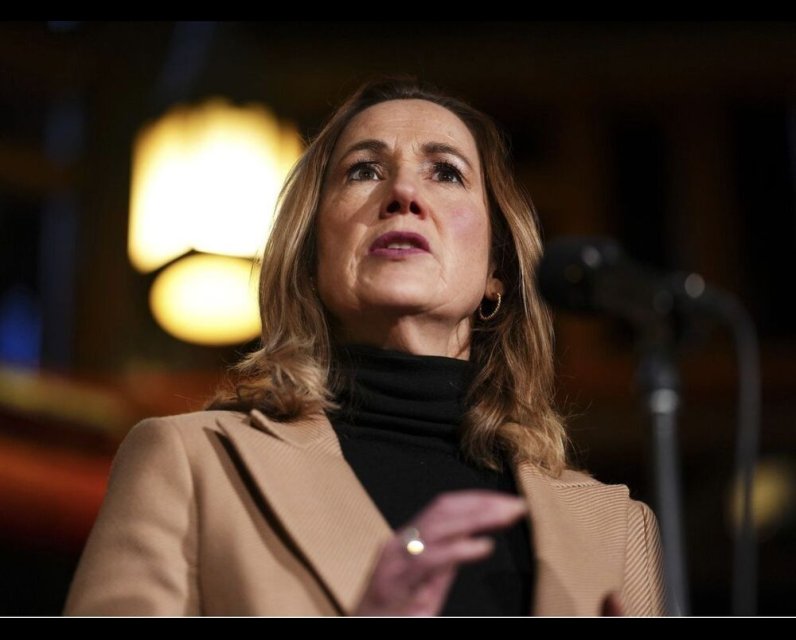
WASHINGTON, D.C. — As the first woman to serve as Canada’s ambassador to the United States, Kirsten Hillman has been described as a powerhouse of a diplomat by business, political, and diplomatic leaders from both sides of the aisle.
Before being appointed acting ambassador in 2019 and getting the top job in 2020, Hillman served as deputy ambassador from 2017 to 2019, contributing to the 2018 talks about replacing NAFTA with CUSMA. Hillman has been ambassador since U.S. President Donald Trump’s first term, helping navigate relations between the two neighbouring countries amid fraught — sometimes incendiary — tensions. Perhaps most notably, she worked to secure the release of the two Michaels, Michael Kovrig and Michael Spavor, who were detained by China in 2018, and she pushed to ensure supply chain continuity amid complicated COVID border disruptions.
Having announced her plan to step down last month after more than eight years in Washington, Hillman will soon head home, where she plans to end her 30 years of public service. She told Prime Minister Mark Carney of her intentions last spring, and she is excited to help with the transition to help her successor, Mark Wiseman, who takes the reins next month.
In the meantime, the National Post spoke with Hillman about her greatest achievements and to get her words of wisdom on U.S.-Canada relations and advice for her successor for the years ahead.
This interview has been edited for length and clarity.
Q: As the first woman in this role and in an era of tariff threats, annexation rhetoric, and the two Michaels crisis, did you ever feel like your gender made U.S. counterparts underestimate you at first — and how did proving them wrong change key moments in tense negotiations?
A: Wow … I’ve never been asked that before, well done. I would say this: I have spent almost all of my career as a lawyer and negotiator and, in many of those instances where I was either representing Canada internationally in a court or leading a delegation, I would be the only woman lead in my cohort of either co-counsel or other negotiators.
It is not new to me to be the only woman or one of the only women in a leadership role because my field has been very male-dominated for my entire career. And I do think that sometimes people can underestimate you, and I do think that that can be an advantage, but what I’ve noticed most of all is that as soon as you demonstrate that you are very capable, very competent, and that you’re in charge — of your team, of the decisions that are being made, whether it’s in the litigation or the negotiation — that sort of goes away fairly quickly.
So, possibly there had been some underestimations. I don’t think I’m honestly specifically aware of any that stood out to me — I don’t know what’s going on in other people’s heads. But I do feel that, because I am very much an expert in my field, that has always been a core strength of mine in this role here as ambassador. Being an economic expert for our country and being very technically expert. The other thing I would say is that being an ambassador of a G7 country in the United States, being the ambassador of the country that is economically the most tied to this country and geographically has the longest border with this country, brings a certain weight and authority in and of itself. So I’ve benefited from that.
Q: Reflecting on your tenure, what was the toughest file you managed, and what key lesson from it would you pass to your successor?
A: Golly, there’s more than one. I’m going to say there’s definitely more than one challenging file. I think right now it is challenging to be faced with a situation where some of the fundamentals of the benefits of Canada-U.S. economic integration — supply chain integration and the mutual benefits that we and our companies, in particular, have developed over years and years of working together — are more up for debate than ever. That is very challenging.
And it’s very challenging because it feels like we’ve had to learn how to articulate something that just seemed like a no-brainer to us for a very long time. So that’s been very challenging. And the volatility that has been part of this shift has been very challenging at a very personal level.
The work that we did with the U.S. government and the Chinese government to secure the release of the Michaels was extremely important to me, and it took a long time. It took much longer than any of us would ever have hoped, and it required putting an awful lot of effort into building trust and relationships between our three countries. So from a diplomatic perspective, that was a mountain to climb, and it was very, very important, very emotional, very challenging.
Ultimately, obviously, I’m proud of what we were able to do. I wish we could have done it much, much faster, but I’m proud of what we were able to do.
Q: Canada often frames the U.S. as its closest partner, yet you’ve spoken recently about Canadians feeling under economic attack. How did you balance voicing that frustration with keeping the relationship between the U.S. and Canada stable?
A: I have always found that no matter who one is dealing with — here in the United States or any other partner with whom you may have disagreements, even very strong disagreements — it’s very important to stick to the facts. It’s very important to just express the facts and not express judgment. Americans elected President Trump. He, his policies remain popular with some Americans. Some of them more than others, but they remain popular. That is a democratic choice of this country, and it is not for me to be second-guessing the choices of Americans.
But what I can and do say is, here are the implications of some policies or some decisions. Here is what American companies or American lawmakers in a particular region have said is happening in their communities. Here are some of the implications of going down this road, and here are the ways in which Canada makes the United States stronger and more resilient. And if we change some of these policies, here are the ways in which that resilience and strength could be diminished.
So, facts, facts, facts!
I find it’s very important … to express your position clearly and unwaveringly, but primarily through an evidence-based presentation.
Q: You’re leaving just before the CUSMA/USMCA review formally begins. Having helped steer the transition from NAFTA to CUSMA, what do you see as the two or three biggest risks for Canada going into this review? For your successor here in Washington, are there any red lines Canada simply can not cross, and where is there genuine room for trade concessions?
A: I think it’s important to recognize that the review that’s coming out for the CUSMA isn’t, so far — I mean, I suppose anything can happen — but it’s not going to look like what we did in 2018. This isn’t an opening up of the entire treaty, going chapter by chapter, changing language, changing rules. It’s not a comprehensive renegotiation. It is a review, and as a review, each three countries have consulted with their stakeholders publicly and have received a lot of feedback on what folks feel was working well and where they think some changes or adjustments might be warranted.
Sometimes you create rules, and you say they’re going to operate in a certain way, and in fact, they don’t quite achieve the goals that you are hoping for. So they’re going to be talking about that. The other thing that I think is very important is that in all three countries, including here in the U.S., these consultations led to overwhelming support for that treaty, and for good reason. For example, here in the U.S., merchandise exports to Canada have grown 20 per cent since 2020, when CUSMA came into force. So this, this growth is obviously important to the United States and important to all of us.
So, I think that the risk here would be not listening to those constituencies for whom we have created this treaty. We have crafted this treaty, all three countries, in order to bring prosperity, economic benefit, stability, and reliability.
To our three countries, and in order to make our trading block more competitive vis-à-vis other regions in the world, it’s vital that — this goes back to being data-driven — we know why we need this agreement, what and who we did it for, why, and what they value in it.
First and foremost, we need to do no harm to that. Then, where we can, we need to improve upon areas where, as I say, perhaps it just needs to be brought up to date. The world is changing fast … so it makes sense to make sure that it remains fit for purpose.
As for my successor, Ambassador (Mark) Wiseman, he will come in as ambassador, and as ambassador, he will need ot build these relationships. That is the core of the role. The ambassador’s role is to build strong relationships in the administration, but also on the Hill and across the country.
There are a lot of people across (the U.S.) who have a lot of influence over how our two countries interact and so building those relationships out — the business community too and civil society. But my number one piece of advise is build, build, build those relationships and make sure you don’t stay just in DC. Get out across the country and build these partnerships and relationships and lines of communication across the country.
Q: What do you see as the single most important file your successor needs to get right in their first year?
A: There’s a lot going on — there’s no one file. But I think that the number one task, the value-add of this organization, not just the embassy and all the people working here, but our consulates across the country — why we’re here is to bring Canadians and the government information that is firsthand. I’ve had a conversation with so-and-so from the administration, Senator so and so from the Hill, governor such and such, and I have learned this. Either here’s a challenge or a difficulty we want to try and resolve, or here’s some advice that they’ve given us, or here’s a priority that we could help advance.
That is the bread and butter of what this entire network does, and to be able to do that effectively strengthens the number of ties that we have across this country, the number of people who understand in a very practical and real-world way why having an effective and strong relationship with Canada is important for them. Ultimately, the depth of that understanding always pays dividends.
This always has a positive impact on the larger macro policies. It doesn’t always solve them. It doesn’t always make them perfectly smooth. But the more voices that we have speaking up for the value of an effective and strong relationship with Canada, the better always.
So the embassy and the network and the ambassador at the lead of all of that is a very, very important daily function for everyone to be pursuing.
Q: Looking ahead, what emerging security file — Arctic, critical minerals, defence industrial base, cyber, something else — do you think is most likely to surprise politicians on both sides and why?
A: Wow, that’s interesting. I think that the drive of technology and the impact of AI, and these very fast-evolving technologies that are in every aspect of our lives — I think it’s very hard for us to fully understand where and how that is going to impact every aspect of public policy.
I think there are things that we see coming, but where it’s hard for us to see things coming is probably in these areas of technology that are just advancing so fast that maybe nobody fully understands what’s coming next.
Q: Please share your thoughts on Greenland and the challenges that President Donald Trump’s threats of tariffs pose, and what the threats against Greenland and Denmark could mean for Ottawa in terms of sovereignty and security.
A: I think that Canada, on this topic of territorial sovereignty and security — for ourselves, for Greenland, for Ukraine — we are completely consistent. Our prime minister is completely consistent. The people of Canada are completely consistent. Our policy and our position is that territorial sovereignty and integrity is the domain of the citizens of Greenland, in this instance. But the same is true for Ukraine and that we will always stand by the citizens of Greenland and the country of Denmark to support their ability to make decisions about their own sovereignty and integrity. I think that Canada, Canadians, the prime minister, our government have been very, very clear about that, and I don’t expect that to change.
Obviously, with respect to Greenland, our position won’t change. And with respect to Canada and our own territorial integrity, that’s not on the table. We couldn’t have been more clear in that regard since day one. So there, there’s no wavering here.
Q: Throughout your tenure, U.S. annexation rhetoric spiked twice — first under Trump 1.0, then again last year. How did you counter it privately with counterparts while publicly downplaying it to avoid escalation?
A: Privately, you can always be a little more straightforward, and as I’ve said, Canadians and the Canadian government and the prime minister are not interested in engaging in this discussion. We’re not interested, and we don’t appreciate this being brought up. Canadian policy and the Canadian position, and how we communicate it have been clear and consistent. In public, we say that perhaps more softly, but clearly nonetheless. Very clearly. And in private, especially with our allies, in particular, our Republican allies, we just say, look, we have so many incredibly positive things to be working on. We have so much that we can contribute to our objectives for Canadians and your objectives for Americans. Let’s focus on that. Let’s focus on all this good work at hand and move on.
Q: Is there anything else you would like to mention or anything about your tenure you hope people remember?
A: I would say I’m a very big believer in teams, and I have had the great privilege of leading a team here in the United States. The embassy team, the network of Consulates General, and the people that they work with across our country. I am often the spokesperson and often the person who tries to consolidate and lead what we are doing across the country. But every single one of those people is committed every day to doing their best for Canada by making this relationship — let’s be honest, sometimes it has been quite complicated — the best that it can be. There was COVID and trade disputes, but we’ve gone through all sorts of issues between our two countries, and this team has and continues to just perform remarkably. So, I am deeply proud of that, but also deeply honoured to have had the privilege to lead such a remarkable group of people.
National Post
Our website is the place for the latest breaking news, exclusive scoops, longreads and provocative commentary. Please bookmark nationalpost.com and sign up for our newsletters here.

Unpublished Newswire



Comments
Be the first to comment