
Stay informed
More than 7 in 10 Canadians want Alberta and Quebec to stay in the fold, poll finds

There is talk of referendums on separation in both Quebec and Alberta, but a new poll from Angus Reid found that, outside of those provinces, more than seven in 10 Canadians would vote that they stay in Canada.
Asked how they would vote on a hypothetical question of separation, 79 per cent of Canadians said they would choose to keep Alberta within Confederation, while 71 per cent said the same about Quebec.
There were regional differences, with Ontarians most likely to be in the “stay” camp. In that province, 84 per cent said they would vote to keep Alberta in Canada, and 76 per cent would vote yes for Quebec. There was also strong support on both coasts, with 83 per cent of those in British Columbia and Atlantic Canada saying they wanted to keep Alberta Canadian, and 73 per cent saying the same about Quebec.
The biggest dip in the numbers was in Saskatchewan, where just 62 per cent said they would vote to keep their neighbouring province of Alberta in the fold, while only 51 per cent said they wanted Quebec to stay. Second lowest was the would-be breakaway provinces themselves, where 58 per cent of Albertans would choose to keep Quebec in Canada, while 72 per cent of Quebecers would vote to have Alberta stay.
Canadians also worry that the economies of both the newly separated province and the rest of Canada would be harmed by the divorce. Asked if Canada’s economy would be better or worse off if Alberta left, 41 per cent said consequences would be more negative than positive, while another 40 per cent said it would have an overwhelmingly negative effect.
For Quebec, 42 per cent chose more negative than positive, and 20 per cent said overwhelmingly negative. Only eight per cent in each case thought the effect on the nation’s economy would be overwhelmingly positive.
Shachi Kurl, president of Angus Reid, called the results “a tale of two separation narratives.”
“In Alberta the narrative is very much about Alberta’s role economically in Confederation, versus what many Albertans feel is a sense of grievance in that role in the overall Canadian economy is not recognized or acknowledged,” she said. Quebec, she noted, also has “deep-seated, deep-routed narratives around culture, language, identity, etc.”
But even within the provinces themselves, there was doubt as the effects of separation. In Alberta, just 36 per cent felt the economic effects would be overwhelmingly positive (17 per cent) or more positive than negative (19 per cent). In Quebec, those numbers were even lower, at six per cent and 18 per cent.
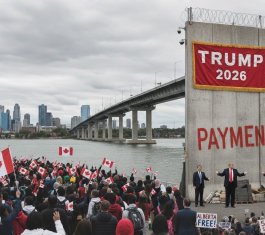
Perhaps of greater concern was the notion that the American government might use some form of persuasion on a newly separated province to make it join the union. Sentiment here was more intense on the question of Alberta, where 45 per cent of Canadians thought the U.S. would definitely exert political pressure on Alberta, while 44 per cent expected there would be economic pressure, and 27 per cent believed some sort of military pressure was inevitable.
For Quebec, those numbers were lower, but even there Canadians were certain there would be political (25 per cent), economic (27 per cent) or military (18 per cent) pressure on a newly independent Quebec. Even more respondents felt these pressures were probable, if not definite.
Kulr was not surprised by these numbers. “It speaks to where Canadians, regardless of what they think about the future of Canada, are right now … having watched everything’s that come out of the Trump White House in the last year-plus.”
She added that annexation or some other closer tie with America is not always seen as a negative.
“There are a lot of Albertans — clearly not the majority, but a significant segment — who actually don’t think that would be such a terrible thing.”
But she added that the potential of U.S. pressure amounts to “the big wet blanket that is smothering a significant amount of oxygen away form the Quebec national sovereigntist movement at this moment, because it wouldn’t just be the question of economic servitude but also cultural vulnerability.”
In other words, Quebecers may see themselves as a minority swimming in a sea that is English Canada. “But what would it look like being an independent Quebec swimming in a sea of English North America?”
The survey was conducted from Feb. 2-6 among a randomized sample of 3,010 Canadian adults. A probability sample of this size would carry a margin of error of plus or minus three per cent, 19 times out of 20.
Our website is the place for the latest breaking news, exclusive scoops, longreads and provocative commentary. Please bookmark nationalpost.com and sign up for our daily newsletter, Posted, here.

Unpublished Newswire


Comments
Be the first to comment