
Stay informed
Unpublished Opinions

'We will defend our allies when it makes sense,' Mark Carney says of Iran conflict
CANBERRA — Prime Minister Mark Carney says Canada will “defend our allies” when it comes to Iran, not ruling out future military participation.
He also stands by his decision not to call for a de-escalation in hostiles when he initially threw Canada’s support behind the U.S strikes, with he and his ministers spending the days since underscoring that the tensions must begin to lower.
“In terms of war, there are likelihoods, there are possibilities, you have to plan for the worst, but there are no certainties, in conflict,” he told reporters outside of Australia’s parliament, citing how the conflict has since expanded, involving the Gulf states.
“It is a very volatile, it’s (an) extremely complex situation, it’s getting more complex as time goes on, but we absolutely stand by the fundamental principle that Iran should not be allowed to have a nuclear weapon and to continue to be a serial violator of international law.”
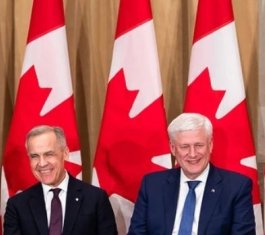
Carney appeared alongside Australia’s Prime Minister Anthony Albanese, after addressing its parliament and confirming a new critical minerals deal as he seeks to shore up allies to diversify away from the U.S.
Both prime ministers, in the hours after reports that the U.S. and Israel had launched assaults on Iran, issued separate statements declaring their countries’ support of the U.S.’s decision, citing it was needed to stop Iran’s ambition to develop a nuclear weapon.
Carney has said Canada was not informed of the attacks in advance and that he did not see a role for Canada to play militarily in terms of U.S. action.
Asked specifically whether that would remain the case should the hostiles expand or continue, the prime minister said, “one can never categorically rule out participation.”
“We will stand by our allies when it makes sense.”
He drew a distinction between the offensive launched by the U.S. and Israel and defensive actions.
“We will always defend Canadians,” Carney says. “We will always stand by and defend our allies when called upon.”
His comments come as reports from the Middle East that Iran fired a missile at Turkey, which was shot down by NATO.
Under Article 5 in the alliance, an attack against one member county is considered an attack against the others.
Albanese told reporters that a de-escalation was needed in Iran’s retaliation, including when it comes to the Gulf States.
Carney has faced criticism over Canada’s initial position when it came to the U.S. strikes, reports of which landed as he arrived in India as part of a nine-day trip to drum up new support for trade with Canada, which included stops in India and Australia, with Japan as his next destination.
He has faced criticism from at least one of his MPs as well as Lloyd Axworthy, a former Liberal cabinet minister from the 1990s, for offering Canada’s full-throated support for the U.S. strikes, given concerns about their legality.
Over the past few days, the prime minister has further clarified his position, citing the evolving nature of the conflict.
He said Canada took the position it with “with regret,” adding that its initial support for the U.S. strikes was not a “blank cheque.”
Carney, along with Foreign Affairs Minister Anita Anand and Defence Minister David McGuinty who travelled with him at different points of his trip, have all emphasized that Canada wants to see the situation de-escalate.
McGuinty has also called for a ceasefire. The prime minister said “necessary conditions” would have to be met and that a de-escalation would first need to happen.
The prime minister, speaking to reporters the day before in Sydney, also said that it appears at first blush the strikes were “inconsistent” with international law.
Asked why he did not include a call for de-escalation in his initial statement voicing support for the strikes last weekend, Carney cited how
“Look, it was the very beginning. We made a statement, Australia made a statement within hours of the beginning of the hostilities.”
The evening before at an event hosted by a think-tank Carney acknowledged there was some level of predicability that the conflict may widen.
Pressed whether in hindsight he ought to have called for de-escalation in its initial statement, Carney said “no.”
National Post
Our website is the place for the latest breaking news, exclusive scoops, longreads and provocative commentary. Please bookmark nationalpost.com and sign up for our politics newsletter, First Reading, here.

Comments
Be the first to comment