
Stay informed
Unpublished Opinions


The surprise fight for the trademark of a notorious outlaw biker club with a deadly history
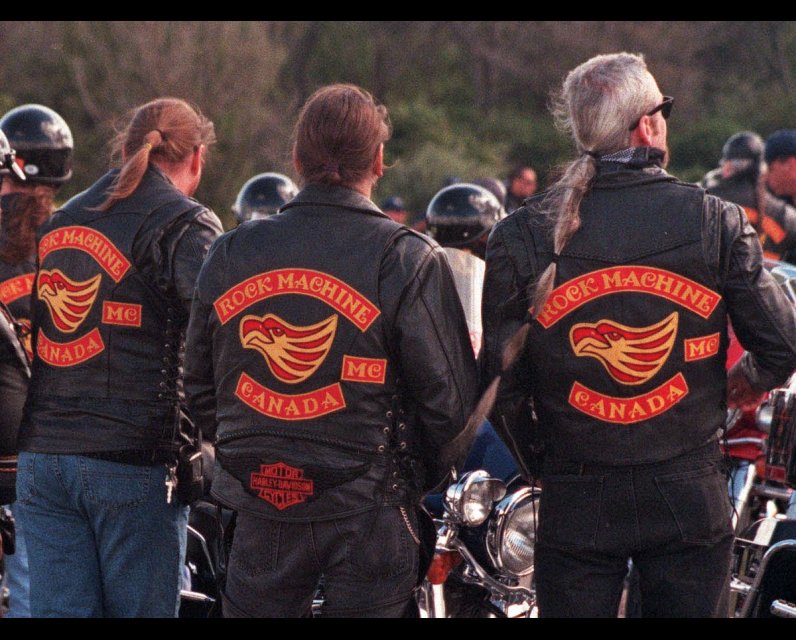
A fight for ownership of the trademark for an outlaw motorcycle club’s patch — a logo notorious from a biker war that killed more than 160 people — has been settled by federal bureaucrats at the Canadian Intellectual Property Office.
In a strange clash of corporate rules meeting biker culture, the mother of a former national president of the Rock Machine Motorcycle Club faced a hostile takeover of her right to the logo by a law firm representing a client the lawyers wouldn’t name.
The Rock Machine name and logo is recognizable to many people of a certain age, particularly in Quebec. The patch was worn on the backs of the losing side of a devastating underworld power struggle with the Hells Angels Motorcycle Club that shockingly stretched from 1994 to 2002 with a staccato of shootouts, assassinations, bombings, arsons, mass arrests, and screaming headlines.
The patches are the “colours” that members of all outlaw biker clubs wear on their backs as a symbol of their affiliation and a projection of their club’s power.
The Rock Machine’s patch was submitted for trademark protection in 2010 by Sylviette Brown, of York Region, north of Toronto.
Records show that a Google search by an official with the Canadian Intellectual Property Office (CIPO) revealed accounts of gangs, turf wars, arsons and murders, but it was nonetheless accepted as a registered trademark in 2012.
The trademark granted for the Rock Machine logo — in the distinctive form of most outlaw club patches — features a stylized bird’s head with a predator’s beak and a beady eye. Above the bird it says “Rock Machine” and below it says “Nomads.” On the right it says “MC,” short for motorcycle club, and on the left is a diamond shape around “1%” which is a symbol designating it as an outlaw club and not a general riding club.
In 2024, lawyers from Shift Law, who are intellectual property specialists in Toronto, challenged the trademark, claiming it had not been used commercially in years, and asked that it be cancelled.
“We were acting on a client’s behalf, but I’m not at liberty to disclose information about my client,” said Rebecca Kupfer, a lawyer at Shift. “An expungement proceeding was commenced on the belief that the trademark wasn’t being used by the current owner.”
The expungement was to “clear the way for my client,” Kupfer said. “My client does have some pending trademark applications that are similar.”
Brown, the trademark’s owner, is the mother of Shawn (Bad Dog) Brown, a veteran biker who was once national president of the Rock Machine long after the Quebec war ended.
The Browns said they know who is behind the move for the trademark.
“It’s the American chapters of the Rock Machine. They want to come to Canada to sell goods and open up again, to restart in Canada,” Sylviette Brown told National Post in an interview.
She said representatives of the Rock Machine in the United States contacted her about her trademark before the legal challenge.
“Before they went to Shift Law, they contacted me and they wanted for me to sort of grant them the authority to use my trademark in Canada, and they might give me a little percentage of that, blah, blah, blah, whatever, I wasn’t interested,” she said.
After the legal process started, the club contacted her again with a better offer, she said.
“This time they offered me $10,000 for me to sell it to them.” She said she still refused. She wants the Rock Machine logo to stay in Canadian hands and off the streets, she said.
“Don’t ever think for a minute that our reason to keep the trademark alive is to restart a club at our end, because we have no intention of it,” she said.
Shawn Brown, who is known by the nickname Bad Dog, and whose name is usually spelled incorrectly in media accounts as Sean, said he and his mother want to keep the rights to the bird logo that he claims he designed as a boy.
He said he did an original sketch of a mythical bird’s head back in the 1980s and showed it to family members in Quebec.
“It was based on a drawing I did, absolutely, that I got inspired from a totem pole. Some of my family was deeply involved with the Rock Machine at the time,” Shawn Brown said. “I was showing it to people, and they just loved it.”
The original Rock Machine shut down around 2001 after waves of arrests, members defecting to the Hells Angels, or patching over to other clubs, most notably the Bandidos Motorcycle Club, another large U.S.-based club with chapters in several countries.
The Bandidos, in turn, self-destructed in Canada in 2006 when one faction murdered eight dissident members in an attack known as the Shedden Massacre.
Afterwards, some former Bandidos and other bikers reformed a new iteration of the Rock Machine around 2008. That’s when Shawn Brown held the reigns until another split.
In late 2010, the Rock Machine’s Canadian website issued a rare news release declaring that Bad Dog, their national president, had been kicked out after a chapter by chapter vote.
“They were recruiting members that didn’t even have motorcycles, just street punks right off the street,” Shawn Brown said in an interview this week. “Are we gonna take street punks or are we not gonna take street punks? And my position was no, their position was yes.”
He said he and several friends were looking at other clubs to join but racist policies were an impediment. While Shawn Brown is white, several of his biker buddies are Black.
“I had a bunch of Black members here in Ontario and they weren’t going to accept them, so the hell with them. Having guys (with me) that are Black, nobody’s going to take us in.
“It was just too much drama. Too much drama going on in the 1% world,” he said. “I’ve given it up completely.”
Still, he maintains affection for the Rock Machine design, he said.
“I want it to remain Canadian. I didn’t want to see the Americans get their hands on it. It shouldn’t be controlled in a foreign land. America is already trying to make us the 51st state, they don’t need to scoop up all our motorcycle clubs as well.”
The Rock Machine has since stumbled in Canada but found some success abroad, including chapters in the United States, Australia, and Europe. A request for comment sent to some of the clubs was not responded to.
A near constant in that rocky history is their logo.
“An outlaw motorcycle gang (OMG) patch or their colours are typically their most prized possession and is meant to be protected,” said Scott Wade, an outlaw biker specialist who recently retired from the Ontario Provincial Police.
“They’re not like the old Rock Machine,” he said, comparing the modern iteration to those who went to war with the Hells Angels in Quebec. “They are a less organized OMG. There have been chapters and members scattered across Ontario and Canada and the USA and Australia … however they don’t pose a threat of competition to the Hells Angels MC.”
The trademark complaint filed by Shift Law forced the Browns to prove to CIPO’s Trademarks Opposition Board that they have been using the trademark commercially.
Brown said she had been using the bird’s head — without the lettering — in her farm business.
In its February decision, the trademark board ruled Brown hadn’t proven commercial use of her trademark.
“We were successful in exactly what we intended to do,” Kupfer said. “We commenced the proceeding to have the registration expunged by demonstrating that the current owner was not using the trademark.”
The Browns said they will appeal the decision.
• Email: ahumphreys@postmedia.com | Twitter: AD_Humphreys
Our website is the place for the latest breaking news, exclusive scoops, longreads and provocative commentary. Please bookmark nationalpost.com and sign up for our newsletters here.

Unpublished Newswire


Comments
Be the first to comment