
Stay informed
Unpublished Opinions


Carney and other G7 leaders oppose U.S. pause on Russian oil sanctions
OTTAWA — Prime Minister Mark Carney said Canada disagrees with the U.S. decision on Thursday evening to pause U.S. sanctions on Russian oil to mitigate soaring energy prices amid the Iran conflict.
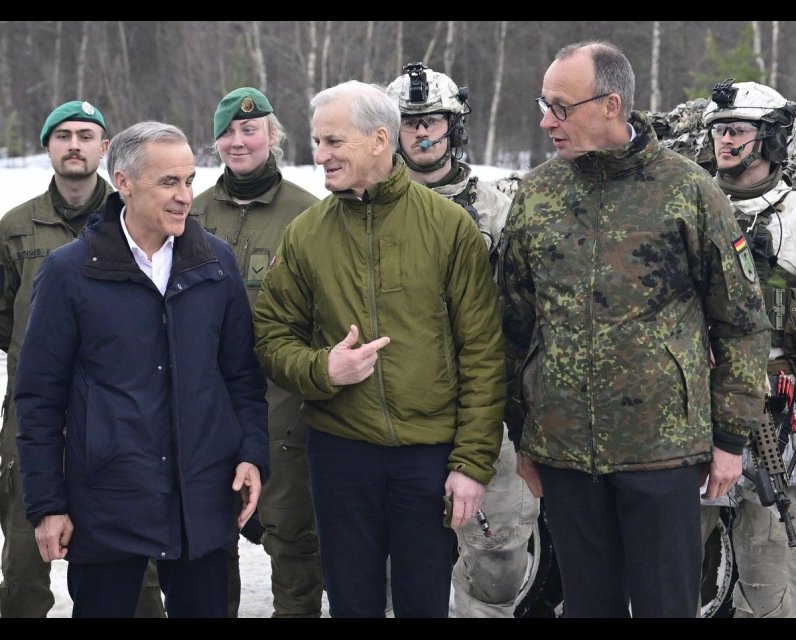
“Canada’s position is to maintain sanctions on Russia, maintain sanctions, including on the shadow fleet, which is moving this oil,” said Carney, during a press conference in Bardufoss, Norway, on Friday.
“There has been very tight cooperation between Russia and Iran, at great cost to the people of Ukraine, and a great threat to peace and security in Europe,” he added.
Carney was joined by German Chancellor Chancellor Friedrich Merz and Norwegian Prime Minister Jonas Gahr Støre, to observe a NATO’s Cold Response exercise, with 25,000 troops from 14 different nations taking part, to demonstrate NATO’s Arctic capabilities.
The three leaders are among the six G7 leaders who disagree with the U.S. decision.
“As you all know, we had video conference with the G7 leaders on Wednesday, and six out of seven were clearly of the opinion that we should not release the sanctions against Russia,” said Merz. “And we were a little bit surprised that we heard this morning that the American government decide differently.”
On Thursday evening, the U.S. Treasury Department announced a pause on sanctions imposed on Russian crude oil and petroleum products loaded on vessels from March 12 until April 11, in an effort to ease oil price pressures. The U.S. sanctions have been in place since March 2022, following the Russian invasion of Ukraine.
The Iranian conflict which has entered its 14th day, has led to the closure of the Strait of Hormuz, a key shipping lane that transports 20 per cent of the global liquified natural gas supply and 20 per cent of global oil output.
Oil and gas production has been reduced in Qatar, Kuwait, the United Arab Emirates, Iraq and Saudi Arabia.
On Wednesday, 32 member states of the International Energy Agency announced the release of 400 million barrels of oil from their emergency reserves, which represents a third of of all strategic reserves.
“The conflict in in the Middle East that began on February 28, 2026, has impeded oil flows through the Strait of Hormuz, with export volumes of crude and refined products currently at less than 10 per cent of pre-conflict levels,” the IEA said in a release on Wednesday.
“This is forcing operators across the region to shut in or curtail a substantial amount of production.”
The conflict has caused the most significant shock to the global oil market in its history. On Monday, the price of Brent Crude briefly hit US$120 a barrel, before falling back to under US$100. On Friday, despite efforts to stabilize the market, the price per barrel hovered just above US$100.
The Norwegian prime minister told reporters that it’s important to keep the pressure on Russia.
“It needs to be consistent, and it needs to be felt from the Russian side so that they will come to the negotiation table, accept the ceasefire and accept the just and durable peace,” he said.
Asked whether they will make their disagreement known to U.S. President Donald Trump, Carney said there will be several more meetings between G7 partners on the topic.
“We all have direct lines into the president, and we’ll use them,” said Carney. “There is value in having broader G7 discussions.”
Carney added that Gulf states have “shown enormous restraint and heroism” to ceaseless attacks by Iran on their civilians and civilian infrastructure.
National Post
Our website is the place for the latest breaking news, exclusive scoops, longreads and provocative commentary. Please bookmark nationalpost.com and sign up for our newsletters here.

Comments
Be the first to comment