
Stay informed
Unpublished Opinions
800 days in death's shadow: The hellish work of Israel's physical anthropologist
When Hamas terrorists invaded southern Israel on Oct. 7, 2023, Ran Gvili, a 24-year-old Israeli police officer on medical leave with a broken shoulder, nonetheless rushed to help. He helped evacuate Nova festival survivors, then fought at Kibbutz Alumim, near the Gaza border, where he fell in battle.
His body was taken into Gaza, one of 251 hostages, living and dead. Getting all the hostages back became an obsession for Israelis in the months and years that followed.
By this January, Gvili’s body was the final hostage.
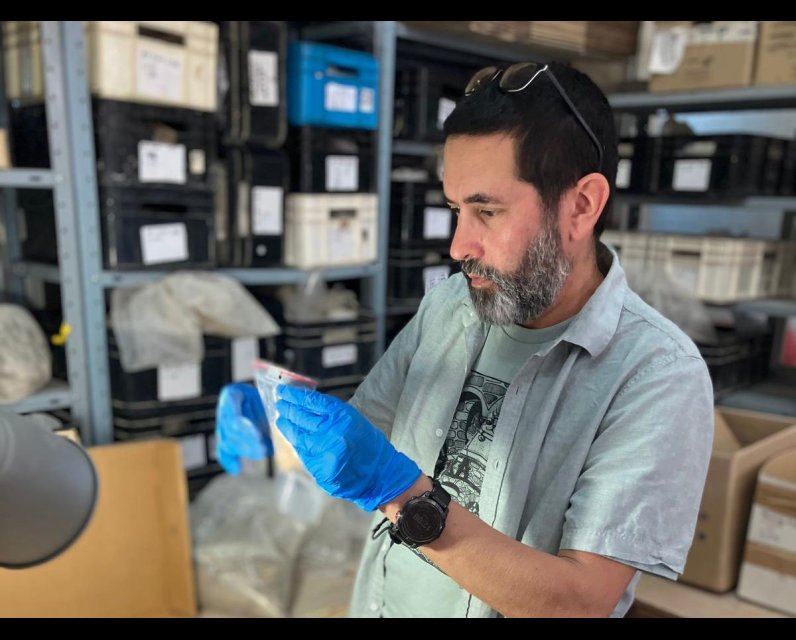
“There was a lot of pressure to find him in Gaza. We worked, you know, night and day, under fire. It’s in the middle of Gaza,” Dr. Alon Barash, a physical anthropologist and anatomy professor at Bar Ilan University’s Azrieli Faculty of Medicine, said of the search for Gvili.
A Palestinian Islamic Jihad operative who had moved Gvili’s body told Israeli military during an interrogation he was buried at the Al-Batash Muslim cemetery in the Tuffah area, east Gaza City. The IDF and Military Rabbinate exhumed around 250 bodies from Al-Batash, eventually locating what were believed to be Gvili’s remains on Jan. 26, 2026.
But the IDF needed to be sure. It was up to Dr. Barash to confirm. He helped oversee and validate the broader forensic process that turned that field match into a fully corroborated, official identification.
Drawing on Gvili’s enlistment X‑rays and civilian dental files, his team re‑examined the exhumed jaw under controlled conditions, tooth by tooth, then cross‑checked those findings with full‑body CT imaging and DNA samples taken from bone and teeth.
Only once at least two independent methods aligned did Barash sign off, allowing the IDF to notify Gvili’s family he had been found.
For Barash, it was the culmination of nearly 800 days of work in death’s shadow – a moment that felt “almost personal,” he said, because he already knew Gvili’s story, his wounds, even the clothes he’d been wearing when he fell.
Dr. Barash had been serving in a senior IDF role dealing with identification of war and terror victims. About a week after the October 7 attacks, Barash was called to the Israeli forensic medical facility, Abu Kabir, in Tel Aviv because, as he describes “they ran into a wall,” unable to identify certain body parts.
What followed has been an incredibly difficult task, he said.
“It’s the most important thing I’ve ever done in my life. And there’s no way I’m going to refuse doing it,” he said. “I am called whenever there’s only bones or there’s very few remains.”
Marking the 900th day after the Hamas-led attacks, March 25, Barash is expected to speak via video link to a Toronto event led by Canadian Friends of Bar-Ilan. He will tell them about how he worked day and night, with little rest, analyzing and identifying, as part of the task of bringing closure to families waiting for answers about their missing loved ones.
“It was very emotional,” he said. “This is very difficult, talking to the family of somebody who just perished. They always ask the same questions: ‘Are there any missing parts? Did he suffer?’ And for me to give them some comfort, you know, that’s most important. And it comes with a psychological price for me, but I’m more than willing to pay that price.”
He described the ravaged kibbutzim as “one big crime scene,” with bone fragments found within a belt of devastated kibbutzim and towns along the Gaza border, covering hundreds of square kilometres.
“We didn’t even know if this was somebody we were looking for, or a terrorist’s remains, or remains from 200 years ago. And that was very complicated. And I think mostly it was very disturbing and very difficult to handle. And this went on for months and months.”
Even prior to the Hamas-led attacks, he had already applied his anatomical expertise as a forensic anthropologist to the Israeli Defense Forces team.
He had previously helped identify bodies after an explosion killed 10 soldiers. “From the field, they would send us whatever they could find,” he said. “I remember I opened the bag, and there was something that initially I thought it was a stick, like a tree branch or something like that. It was a spinal cord. And that’s what’s left of that person. And nothing else. And maybe three, four people in Israel could have identified it as a spinal cord. I teach about the spinal cord.”
He’s seen bodies soon after their last breath, phones still in hand; they had died looking at a family photo one last time. “Of course, this work gives me a perspective about the fragility of life,” he said.
His identification work has broader implications, beyond war and the Mideast. Last December, Barash’s keen eye helped identify the location of Itamar Schlesinger, who disappeared in the Carmel Mountains area after an automobile accident, in September 2023. Search and rescue teams had sent Barash hundreds of images over the course of two years, all of which he recognized as animal bones.
“On that particular day, out of, I don’t know, like 80 to 90 photos that I was sent, one picture was something that looked out of the ordinary to me,” he said. “And I told them, ‘This looks suspicious.’ It’s a very small fragment. I told them to send it for a DNA analysis. And it was him.
“What would have happened if I, you know, just flipped the picture, and said, ‘Oh, this is nothing?’ We would never know.”
The broader lessons from his terror-related forensic work, he said, could be used in any catastrophe – such as tsunamis, wildfires, or explosions – where DNA, fingerprints, or dental records might not be available.
“This is really something that I want to put effort into, the next few years, to see if we can contribute, and not just to Israelis. Unfortunately, this is a worldwide concern.”
Our website is the place for the latest breaking news, exclusive scoops, longreads and provocative commentary. Please bookmark nationalpost.com and sign up for our newsletters here.

Unpublished Newswire

Comments
Be the first to comment