
Stay informed
Unpublished Opinions


Canadians overwhelmingly favour federal intervention over alleged news theft
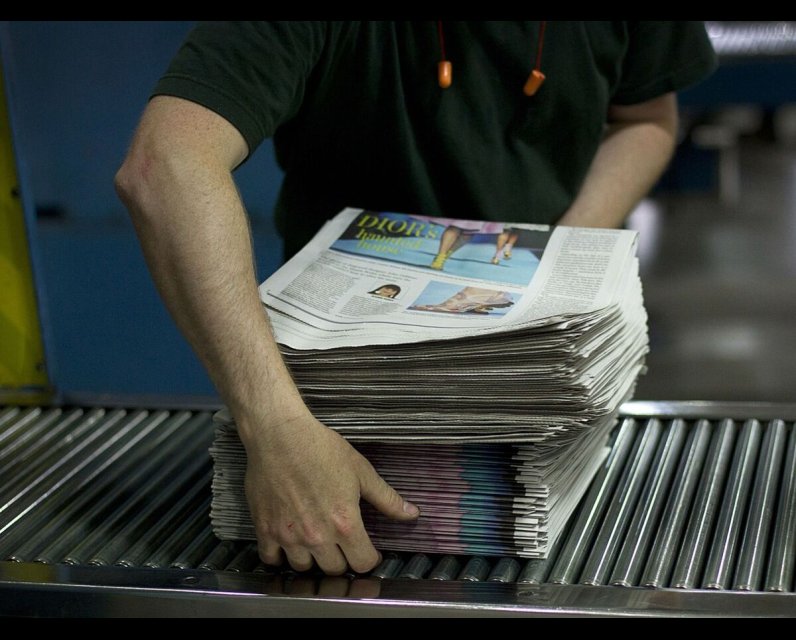
A new survey commissioned by industry advocacy group News Media Canada found that more than seven in 10 Canadians think the federal government should move to prevent artificial intelligence companies from allegedly taking and repackaging news content without permission or compensation.
The online survey conducted by Totum Research asked more than 2,400 adult Canadians: “AI (Artificial Intelligence) companies are allegedly taking news content from publishers without permission or compensation and repackaging it. Do you agree or disagree that the Government of Canada should do something to prevent these AI companies from doing this?”
It found that 44 per cent strongly agreed with that statement, while another 27 per cent said they somewhat agreed with it, for a total of 71 per cent in favour. Only six per cent somewhat or strongly disagreed with the notion, while a further 23 per cent said they were neutral on the topic.
Paul Deegan, president and chief executive officer of News Media Canada, told National Post he was “pleasantly surprised” with the public’s support.
“But I think Canadians are concerned, just in terms of seeing all of the misinformation and disinformation out there,” he said. “I think they’re concerned in terms of the viability of news, and obviously if our content is being taken essentially for free by these AI companies.”
Deegan said there are three major inputs for an AI company — electricity, computing power and information.
“And there’s really no better information in terms of high quality than fact-based fact-checked news content,” he said, adding: “They’re paying for two of them. The question is, shouldn’t they be paying for the third, meaning news?”
Deegan said there are several steps the government can take to protect Canadian news sources from the threat of AI.
“First, the Minister of Industry should direct the Competition Bureau to conduct a market study into the state of competition with respect to search and AI, with a view to separating Google’s crawler into separate crawlers – one for AI and one for search,” he said.
He explained that Google regularly scrapes the web for content for both Google searches and AI content. As it stands, a company that wants to block Google from using its content for AI also renders itself invisible to searches.
“You’re essentially de-indexing yourself from search,” Deegan said. “In other words, you won’t be discoverable.”
Second, the federal government should clearly indicate that the Copyright Act will not be amended to include a text and data mining exception. Several jurisdictions such as Australia have done this.
Others, including Canada, have not. But Deegan noted that Culture Minister Marc Miller came close when he was asked last month if the use of copyrighted materials for AI training violates copyright law.
“Intellectual property reform is a complex issue that goes over and above artificial intelligence, and it is a multi-year process,” he said. “So it’d be irresponsible in any context to stand here and say nothing’s going to happen. But the current copyright law does and should protect those that have created material, and people need to be compensated properly.”
Finally, Deegan said, Public Services and Procurement Canada and the Treasury Board should work together to ensure those on the government’s list of interested AI suppliers commit to principles of transparency, consent, and attribution with respect to all copyright-protected news content.
He noted that one company on the list, Toronto-based Cohere, has been given funding by the government even as it is the target of a lawsuit from a number of media companies accusing it of “massive, systematic copyright infringement, as well as trademark infringement.”
The survey was conduct in December and January. Respondents came from across the country and represented both official languages. There was a 50/50 male/female split, with roughly half of respondents between age 35 and 64, and the rest evenly split between younger and older. The margin of error was plus or minus two per cent, 19 times out of 20.
Our website is the place for the latest breaking news, exclusive scoops, longreads and provocative commentary. Please bookmark nationalpost.com and sign up for our newsletters here.

Comments
Be the first to comment