
Stay informed
Unpublished Opinions

As Newspapers Shutter in Newfoundland, a Student Publication Steps Up
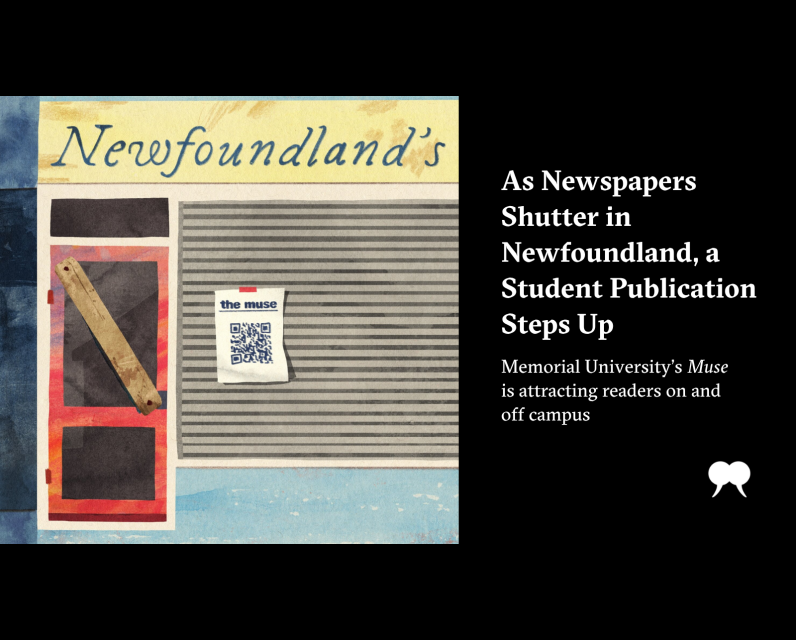
Local papers from every corner of Newfoundland and Labrador have folded over the years: the Charter in Placentia, the Packet in Clarenville, the Coaster in Harbour Breton—the list goes on. In 2017, many of the province’s remaining papers were purchased by Nova Scotian publishing company SaltWire Network Inc., including its last remaining daily newspaper, the Telegram. SaltWire entered creditor protection in 2024 shortly before being acquired by American-owned media conglomerate Postmedia. That same month, the Telegram shifted from daily to weekly distribution, and Postmedia announced layoffs of 30 percent of the paper’s staff. In 2023, independent paper Wreckhouse Press, based on the west coast of the island, won gold at the Atlantic Journalism Awards for its reporting on Hurricane Fiona. Ten months later, it published its final issue.
Establishment networks, like the CBC, NTV, and VOCM, and online outlets, like The Independent and allNewfoundlandLabrador, keep the news ships sailing across broadcast, radio, and digital. But St. John’s, the province’s capital, has not been immune to the bleed, seeing the closure of alternative outlets like the Scope, which folded in 2013, and the Overcast, which had a run from 2014 to 2019.
In January, in its seventy-fifth year, Memorial University of Newfoundland’s student paper the Muse released its first print issue in nearly a decade. The one-off issue is a celebration not only of the history of student journalism at Canada’s easternmost university, the paper’s editor-in-chief John Harris tells me, but of its recent resurgence as a source for news both on campus and across the city of St. John’s. In an industry defined by decline, the Muse has found room to grow.
A student-run paper at a university without a journalism school, the Muse is not built to compete in the marketplace. But with a modern approach to a twenty-first-century problem, it has begun to fill the gap.
Daniel Smith, a labour organizer in St. John’s, hasn’t been a MUN student since 2008. After graduating with an environmental studies degree, the student paper left his media diet without much thought. He tells me, however, that as options wane in today’s provincial media ecosystem, he looks to the student paper more and more for coverage he’s not seeing elsewhere. He’s one of many in St. John’s reading the Muse more often. The paper’s success is a product of both its coverage of topics beyond the scope of university affairs and its ability to reach a wide audience through its social media platforms.
When Harris took over as editor-in-chief, he made it a priority to increase the Muse’s social media presence. Flying under the radar of Meta’s news ban (as many student papers across Canada have managed to do), the paper relaunched on Instagram and Facebook in 2024 and has amassed more than 10,000 and 8,000 followers on those platforms, respectively. With over 12,000 followers on TikTok, the Muse has a larger following than the student papers of Canada’s fourteen largest universities by student population combined. The only outlet in the province with a comparable TikTok following is NTV, while the CBC’s NL bureau does not have an active account.
Social media has figured heavily in the Muse’s coverage of Palestine, an area in which student journalists have been particularly meticulous. The outlet published video interviews with Newfoundlanders Sadie Mees, Devoney Ellis, and Nikita Stapleton as they sailed toward Gaza as part of the freedom flotilla aboard the Conscience. It’s shared videos from protests on campus and in the downtown streets of St. John’s and articles about community town halls calling for a Canadian arms embargo and Memorial University’s divestment from companies with ties to Israel.
In July 2024, six days before the CBC, the Muse reported that MUN’s board chair Glenn Barnes had forwarded an email he received from alumna Becky Winsor to her father. The email was associated with a pro-Palestine campaign Winsor was participating in. “I am telling parents that I know just what their kids are doing,” read the email, according to the Muse’s reporting. Shortly after the story broke, Barnes was placed under investigation by the university for the privacy breach, and by August, he had resigned.
Even on topics well covered by other outlets, like municipal and provincial politics, Harris says there is often a perception that the Muse is the only one on the beat. Many younger people will often miss stories on the morning radio and evening news. “They assume that, because it doesn’t come up on their social media feed, that it doesn’t exist,” he says. Here’s where the student paper steps in. Harris says that after St. John’s municipal election last year, several people told him they made their decision at the ballot box based on the Muse’s reporting.
The paper also tries to keep up with arts and culture coverage, which is often the first thing to go amid media cuts. Reporting on sponsor-clad events and industry trends carries on while coverage of smaller, local artists gets lost in the shuffle. “The Muse is one of the places that comes up the most when I’m seeing articles about arts and culture in the province,” says Emma Cole, managing producer at Capacity Theatre Company. Earlier this year, the Muse’s Rebecca Jennings wrote about Capacity’s production of Dolly’s House, a modernized, queer adaptation of Henrik Ibsen’s A Doll House. From musical gigs around town to the recent release of a literary journal called toothcut, the Muse has become a prominent, if not exclusive, source for reporting on independent art in the province.
The Muse’s one-off print issue, released earlier this year, is a culmination of the assertive return its student journalists have made. Throughout the issue, the paper makes a case for its own existence with articles about the feminist history of the publication, an interview about its 1990’s heyday with former editor-in-chief and current NTV anchor Michael Connors, and a piece about the importance of print journalism from the perspective of Craig Wescott, who edits one of the province’s last remaining newspapers: the Shoreline.
The Muse alone will not replace what’s been lost in Newfoundland and Labrador’s media ecosystem. In rural and urban areas alike, it will take something bigger to entirely fill the gap. But for every story told, every interview recorded, every student journalist who shows up to report between classes and exams, the gap gets smaller. The Muse will not be a perfect replacement. But it’s begun to make a dent.
The post As Newspapers Shutter in Newfoundland, a Student Publication Steps Up first appeared on The Walrus.
Comments
Be the first to comment