
Stay informed



The Last Thing Mark Carney Needs Is Trudeau-Era Rhetoric
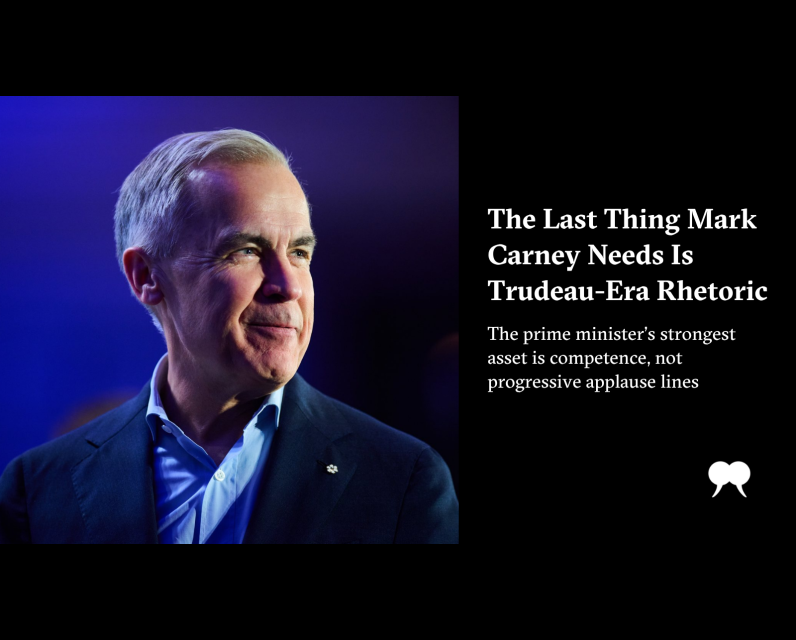
I’m trying to figure out what Prime Minister Mark Carney thought he was doing at this year’s Global Progress Action Summit.
The Global Progress Action Summit is an annual gathering of Canadian Liberals, United Kingdom Labour figures, United States Democrats, and assorted compatible figures from other countries. Carney spoke at this year’s summit on Saturday in Toronto, which took place the day after former US president Barack Obama gave a speech for Canada 2020, the Canadian organizers of the Global Progress Action Summit. This was, in turn, the day after the Public Policy Forum’s annual Testimonial Dinner and its affiliated Canada Growth Summit. Which is why, if you work in Ottawa, you might have had a hard time getting calls returned that week.
The prime minister read from his prepared remarks after a few minutes of impromptu nervous-jokey preliminaries of the sort he often indulges when he knows a lot of the people in a room. He also half-apologized for speaking French to a room of mostly anglophones, which is also something he unfortunately can’t seem to stop doing.
Then he said this, reading from remarks in French. “Today, I want to talk to you about the rupture in the world. Our response, at this time, must be to resist any temptation to preserve or restore elements of the past. We prefer to build anew. New infrastructure, new energy systems, new trade relationships, and new institutions. This is what the new progressive politics could be.”
I’m wondering how this sort of writing made it past quality control. The best that can be said for it is that it means nothing. I’m pretty sure the Carney government will continue trying to preserve supply management, the CBC, the St. Lawrence Seaway, federalism, the monarchy, and other elements of the past.
This is the sort of prose that reads better in all uppercase. “RESIST ANY TEMPTATION TO PRESERVE OR RESTORE ELEMENTS OF THE PAST, the sign over the dingy entryway to the Ministry of Love read. WE PREFER TO BUILD ANEW.”
It’s reminiscent of Justin Trudeau discerning an “opportunity for a reset” during the COVID-19 crisis of 2020, or Michael Sabia, in a piece the Globe published ten days after the COVID-19 lockdown began, urging governments to “leave their orthodox thinking behind and, most of all, avoid the trap of incremental, piece-by-piece action that is so often the reflex of bureaucracy.”
Having forsworn any temptation to preserve or restore elements of the past, Carney delivered an ode to Canadian history. “Canada was built by Indigenous peoples and voyageurs who mapped a continent and built trading networks coast to coast to coast before the Americans had even left St. Louis,” he said. “After the Second World War, Canadians built new neighbourhoods for hundreds of thousands of returning veterans, new universities, the St. Lawrence Seaway, the Trans-Canada Highway. We inspired the world at Expo 67.”
Should those elements of the past be swept away? Apparently not. As I say, none of it meant anything. So, there’s no real need to reconcile this other part of his speech—where he said Canada, “like Mexico, remain[s] open to deeper integration, including options for fortress North America in selected sectors”—with North America’s status as an element of the past.
A meaningless speech may be the least of Saturday’s problems. I also wonder why a sitting Canadian prime minister would show up at a conference featuring senior opposition politicians from Germany, Finland, Sweden, and Italy, as well as the United States.
Like you, I don’t much care whether it gets up Donald Trump’s nose that Carney appeared downcard from Pete Buttigieg the day after Carney’s wife interviewed Barack Obama. But I hope Finnish prime minister Petteri Orpo has a sense of humour about Carney sharing the day with Finnish Social Democrat leader Antti Lindman, who called for Orpo to resign three weeks ago. I hope Swedish prime minister Ulf Kristersson isn’t in a huff about the Toronto visit of Magdalena Andersson, who used to have Kristersson’s job and would like it back.
In Italy, Democratic Party leader Elly Schlein probably can’t beat Georgia Meloni in an election by herself, but before her trip to Toronto, she was trying to field a unified opposition leader who could get the job done.
At least Germany was represented by Lars Klingbeil, the finance minister in that country’s coalition government, as well as by Wolfgang Schmidt, chief of staff to Chancellor Friedrich Merz’s rival and predecessor Olaf Scholz.
“We actively take on the world as it is, not wait for a world we wish to be,” Carney said in a speech at Davos earlier this year. That’s not necessarily incompatible with appearing at a conference with leading opposition figures from five North Atlantic Treaty Organization countries. No Global Progress Action Summit ever changed a vote, so perhaps nobody will mind. Just as nobody would mind, surely, if Giorgia Meloni and her conservative colleagues from Finland and Sweden ever joined Pierre Poilievre in Florence for a conference on “rupture in the world.”
Pollsters are saying different things about Carney’s popularity. Liaison Strategies says it’s really high but drooping, whereas Abacus says it’s at a new high. They actually barely disagree: Liaison has Carney’s net personal approval at plus twenty-four, Abacus at plus twenty-six. Strong enough numbers to withstand some spotty speechwriting and a head-scratching choice of company at a weekend conference.
Voters cut Carney a lot of slack. Why? I think because he has looked more interested in doing the job than in getting re-elected to it. There doesn’t seem to be a provincial premier he can’t work with, no company or association he finds beyond the pale. He almost never uses the word “Conservative” outside the House of Commons, which clearly messes with Poilievre’s head more thoroughly than if Carney baited him nonstop. He ignored advice from no end from Liberals who wanted him to delay a quick by-election after hapless Pierre Poilievre lost his old seat. “No games,” he said instead. “Nothing. Straight.” It turned out to be a popular stance.
The country is coming through a brutal half-decade of picking sides, egged on by Trudeau and Poilievre, and while picking sides shouldn’t be eliminated from politics—at some point, everyone has to vote—it’s pleasant to be reminded that it shouldn’t be the only thing.
The corollary is that this Liberal leader should be wary of seeming to prefer team to results or of rekindling the early 2020s game of telling people how to be proper Canadians. The temptation to preserve or restore elements of the past—Indigenous people, voyageurs, universities, political pluralism—is entirely healthy and shouldn’t be swept away simply because you need an introductory paragraph for your speech at a meeting of opposition leaders from NATO member states.
Perhaps Carney wanted to flash progressive gang colours because he feels a debt of gratitude to the founders and key players of Canada 2020. I would argue that his electoral success has brightened their 2020s more than a paragraph of goofy Newspeak ever could.
Perhaps he wanted to shore up his progressive flank because one of the few members of Parliament in the Commons who’s been trying to move away from him instead of toward him, Steven Guilbeault, says Carney’s planned streamlining of infrastructure project reviews is “worse than what [Stephen] Harper did.” I would argue that’s a debate best won on the merits, not by mimicking the worst of progressive rhetoric.
I’ve been rereading Walter Bagehot, the British essayist whose book The English Constitution, published in the Confederation year of 1867, sought to illuminate the way the British govern themselves. Here’s an excerpt. Government performs two kinds of functions, Bagehot wrote, “dignified” and “efficient.” The “dignified parts,” he wrote, are “those which excite and preserve the reverence of the population.” The “efficient parts” are “those by which it, in fact, works and rules.” The dignified functions give the state its authority; the efficient parts use that authority to govern. To Bagehot, the genius of the British system was that the Crown took care of the dignified functions and left the efficient functions to the elected government.
We could still argue about how early this happened, but by mid-2024, it had become clear that little about Trudeau’s government was either dignified or efficient. The “reverence of the population” was subjected to an endless series of are-you-with-us-or-against-us loyalty tests, which were greatly exciting to people who were in the business of being on the right side and exhausting for the rest of us. As for efficiency, well, perhaps I needn’t belabour the point.
Dominic LeBlanc and Steven MacKinnon released two discussion papers last week, one on “strengthening . . . trade and transportation” and the other on “getting major projects built.” What’s clear on their face is that the two papers propose sweeping change. They represent an attempt to take government’s “efficient functions” seriously. A government that focuses on that task needn’t congratulate itself on resisting any temptation to preserve or restore elements of the past. Whatever on Earth that means.
Originally published as “Dignified, efficient, and whatever this is” by Paul Wells (Substack). Reprinted with permission of the author.
The post The Last Thing Mark Carney Needs Is Trudeau-Era Rhetoric first appeared on The Walrus.
Unpublished Newswire

Comments
Be the first to comment