
Stay informed


Montana Tucker's journey from pop singer to Jewish advocate
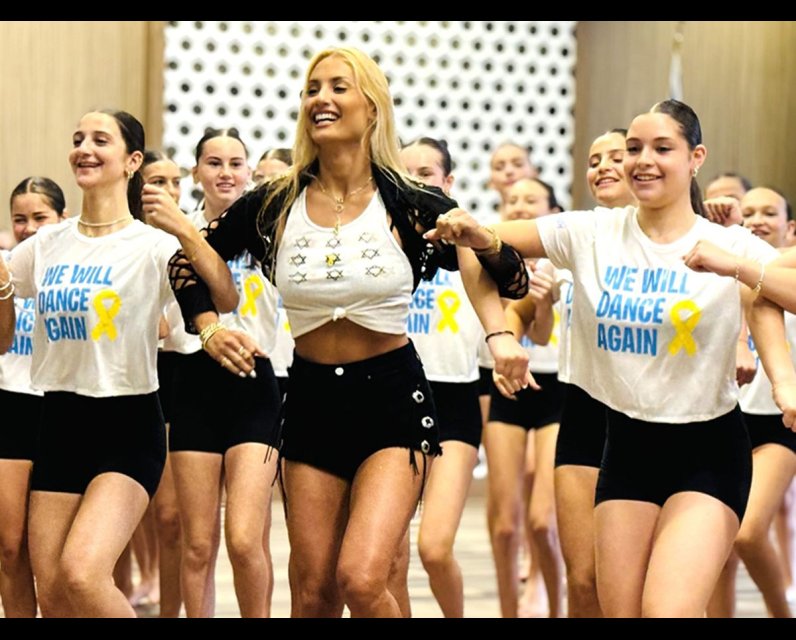
Singer/choreographer Montana Tucker began dancing backup for Ashanti at 13, and performed at the Super Bowl by 14. But her trajectory shifted dramatically with her 2022 docu-series How To Never Forget, in which she retraced her Holocaust-survivor grandmother’s footsteps through Auschwitz.
After the October 7 attacks, Tucker pivoted fully from entertainment to advocacy, travelling to Israel seven times and producing The Children of October 7th, a documentary featuring child survivors. The shift has come at a cost — she has lost hundreds of thousands of followers for her outspoken pro-Israel stance — but Tucker remains undeterred, and retains a social media following of more than 14 million.
On Sunday in Toronto, a group of elementary and high school dancers will join Tucker on stage for We CAN Dance Again, a live performance produced by StandWithUs Canada. Last year, 75 young dancers from across the city filled the stage performing “Am Israel Chai” (the nation of Israel lives) alongside Tucker.
Dave Gordon interviews Tucker, now 33, for the National Post:
Why is this StandWithUs Canada initiative important to you?
After October 7th, I had a hard time combining my worlds. What was going on in Israel, with Jews around the world, was so hard, and so dark, and so heavy, and so sad, and I always associated dance with being uplifting, and I felt like nothing was uplifting about what was going on after October 7th. I thought to myself: everybody went to the Nova Music Festival to dance, to listen to music.
(Hostage) Mia Schem got this tattoo, We Will Dance Again, and I think that’s the story of the Jewish people, right? No matter how many times we fall, we get up, we bring our joy, we share our joy, we share life, we value life, we value love over hate. I think that is the power of dance; to dance as a universal language that unites people of all walks of life.
I went to Israel eight different times since October 7th to be on the ground, to interview survivors. I went into Gaza, as well, to interview Gazans. So, for me, it’s always been important to just share the truth, real, raw, authentic stories. After October 7th, the amount of hate that I received – hundreds of thousands of people unfollowed me. Brands say they can’t work with me anymore.
People who I considered friends that I would collaborate with, wouldn’t collaborate with anymore, flat out, because of my support for Israel. It was really hurtful in the beginning. If people would really look into the truth, or look into what I’m posting, they would see what I’m trying to do. So it was really hard in the beginning. But it has brought me so many other opportunities of where I’m supposed to be, and who I’m supposed to be connected with, and who I’m supposed to work with.
Out of all the loss, and the hardship that it has come with, I would do it a million times over, because I believe, what is the point of having a voice? What is the point of having a platform if you’re not speaking out for what you believe in?
So, for me, it’s my responsibility, my duty as a grandchild of Holocaust survivor, to do this. To me, there’s no other option. So, yes, it’s come with a lot of risk, but I would do it a million times over.
What advice might you have for others online, handling antisemitism?
There’s these keyboard warriors that hide behind their phones, and they just attack everybody. Most of the people would never say that to anyone in person.
Also, there are a lot of bots online where it’s not real people that attack any post that mentions Israel or mentions Jews or Jewish. But some social media has a feature where you can hide words.
So, if people are commenting certain things on your page that are hateful, you can hide those keywords so they won’t be able to comment anymore. You can restrict people. You can block people.
I wear a Magen David at all times. We’ve got to stand strong and proud of who we are. Don’t be part of spreading the hate. Just keep spreading the love. Keep spreading the truth.
What are some key things that you do to make your message spark with the next generation?
Everything that I have been doing, even before my real advocacy work, has been to inspire the next generation. If you look at my dance videos, I do a lot with younger kids.
A lot of content geared towards the younger generation, because they’re, in my mind, most important. They’re our future generation, and they’re our future leaders. And most of our younger generation is getting their information, their news, anything that they know, off of social media.
So people say social media gets such a bad rep, which I understand it could be a scary place, but also we have to meet kids where they are, and they are on social media. So for me, when I started off as just an entertainer online, I always tried to have powerful messages within my dance videos, whether it’s an anti-bullying dance video, or a dance video about body image, or a dance video just to unite people.
If there was a message you want to send to non-Jewish allies, what would it be?
When my non-Jewish friends support me in any way, shape, and form or followers that message me saying, ‘I’m not Jewish, but I support you and I’m here and I have your back,’ that means the world.
I think we all need to be more understanding and empathetic towards people, and towards each other. I just hope that we can all set our differences aside, whether it’s a political difference or a religious difference. I just hope that we can all really hear each other, and understand each other, and come together. We’re stronger together.
This interview was edited for brevity.
Our website is the place for the latest breaking news, exclusive scoops, longreads and provocative commentary. Please bookmark nationalpost.com and sign up for our newsletters here.

Unpublished Newswire


Comments
Be the first to comment