
Stay informed



Canada’s First Openly Gay Judge on the Most Memorable Same-Sex Weddings He Conducted
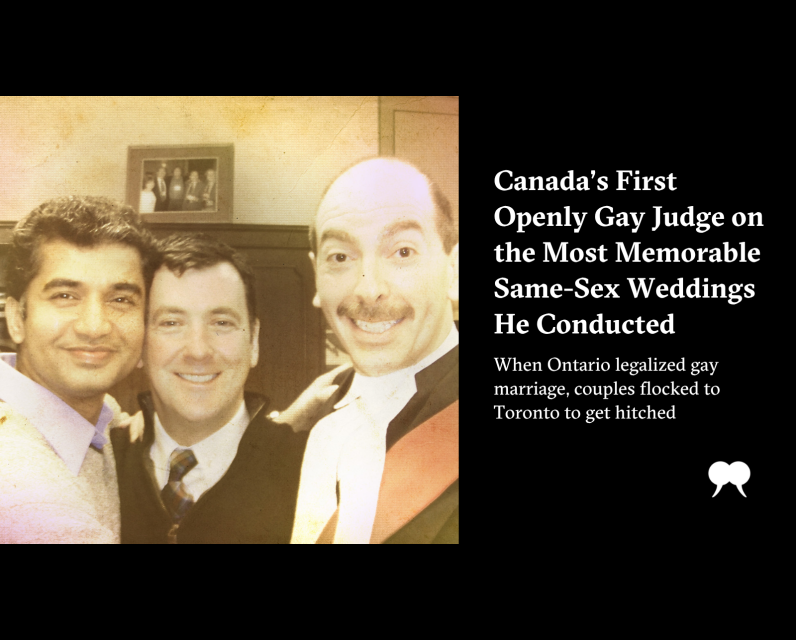
When I was growing up, the notion that two people of the same sex might one day get married was not only unheard of, it was unthinkable. Until I was almost thirty years old, homosexuals were a despised minority with almost no legal protections. I’m extremely fortunate to have lived through a monumental and relatively rapid evolution of legal and social reforms culminating in the legalization of same-sex marriage. And I’m even more fortunate that, during my judicial career, I had a front-row seat to some of the most historically significant developments in what many human rights lawyers refer to as “the last civil rights movement.”
Homosexuals in Canada have travelled a long and difficult road to equality. During the 1950s and ’60s, the Royal Canadian Mounted Police monitored the activities of individuals suspected of being gay. Homosexuals were banned from working in government, law enforcement, and the military. Homosexuality was a criminal offence punishable by life imprisonment. The last Canadian sent to jail simply for being gay was Everett Klippert, an auto mechanic from the Northwest Territories. In 1965, he was given an indefinite life sentence as a “dangerous sex offender” even though all his sexual activities had been with consenting adults. The Supreme Court of Canada upheld his sentence in 1967, describing his incarceration as “preventive detention.”
Homosexuality in Canada was decriminalized in 1969. Then prime minister Pierre Trudeau famously said, “There’s no place for the state in the bedrooms of the nation.” Despite the passage of these amendments, Klippert wasn’t released from prison until 1971.
The Stonewall riots of June 1969 in New York City are widely considered to have launched the gay liberation movement in North America. In 1977, Quebec became the first province in Canada to include “sexual orientation” in its human rights code, making it illegal to discriminate against gays in housing, public services, and employment. And in 1978, the Canada Immigration Act finally eliminated the long-standing ban prohibiting homosexuals from entering the country.
In 1992, the Ontario Court of Appeal ruled that Captain Joshua Birch had suffered illegal discrimination when he was discharged from the Canadian Armed Forces for disclosing that he was gay. This led to a decision lifting the ban on homosexuals in the military, allowing them to serve openly and live on base with their partners.
In 1993, in the case of Canada v. Mossop, the Supreme Court ruled that the denial of bereavement leave to a gay partner was not discriminatory. But two years later, in Egan v. Canada, the court ruled that sexual orientation is a prohibited ground of discrimination under the Canadian Charter of Rights and Freedoms. Finally, homosexuals in Canada were constitutionally protected from discrimination. That was the state of the law when I was appointed to the bench in April 1995 as a judge of the Ontario Court of Justice.
Several months after my appointment, my dear friend and colleague Justice James Nevins, with whom I presided at the same courthouse for many years, delivered a landmark ruling in the Re K. adoption case, permitting same-sex couples to adopt children. When I congratulated Jim on his brilliant and insightful application of constitutional equality principles to same-sex couples, he replied, “Well, Harvey, getting to know and becoming friends with a gay colleague like you helped me to understand the real-life implications of the legal issue I had to decide.”
That comment made me realize, in a very profound way, that having diversity on the bench itself was truly important for judges to have a better understanding of the issues they faced. I understood that, for many of my colleagues, I was the face and voice of the gay community. And I took that responsibility seriously.
Numerous judicial colleagues told me that, prior to my appointment, they hadn’t known any openly gay people, and that their comfort level increased after getting to know me and my partner, with whom I’d begun living prior to becoming a judge. I always made a point of bringing my partner to every judges’ conference and to all social events with my colleagues so that they’d see for themselves that same-sex couples were no different than any other couple.
And, as time passed, I was called upon by numerous colleagues to help them and their spouses adjust and respond appropriately when their children came out. I was happy to be known by my colleagues as “the gay judge,” giving personal advice, speaking on panels, and organizing a judicial education program on same-sex rights, because I considered it my privilege and responsibility to serve as a positive ambassador for the gay community.
In 1999, the Supreme Court rendered another landmark decision, M. v. H., ruling that same-sex couples are entitled to the same treatment under the law as opposite-sex couples. As a result, we began seeing same-sex couples coming to family court to apply for spousal support upon separation, in the same way that heterosexual couples litigated.
Same-sex marriage became legal in Ontario on June 10, 2003, making the province only the third jurisdiction in the world, after the Netherlands and Belgium, to legalize same-sex marriage. Over the next year, through a series of court decisions, same-sex marriage became legal across Canada, culminating in a landmark ruling (in Reference re Same-Sex Marriage) by the Supreme Court on December 9, 2004. In contrast, same-sex marriage didn’t become legal nationwide in the United States until June 26, 2015.
Interestingly, not everyone in the lesbian and gay community agreed that we should be advocating for the right to get married. Many people argued, “Divorce rates are skyrocketing. The institution of marriage is an abysmal failure. Why would gay people want to be part of a failed institution? Why are we aiming so low?”
My answer was simple. Being truly equal means having the right to make the same decisions and mistakes as everyone else. No one was being forced to get married. Marriage isn’t for everyone. But now everyone had the choice, and I felt that was important.
The legalization of same-sex marriage changed my life dramatically. Because Ontario doesn’t have a residency requirement, gay couples from everywhere in the world now had the opportunity to come to Ontario to be married. Of course, the question of whether such marriages were legally recognized in their home jurisdictions depended on the law where they lived. But even if they knew their marriages wouldn’t be valid at home, that didn’t stop them from travelling to Toronto just to experience the sheer joy and elation of getting married.
A few days after same-sex marriage became a reality in Ontario, I was asked by several members of the Toronto gay community if I’d be willing to officiate at weddings. I immediately answered, “Sure, just give people my work email address, and I’ll make arrangements for them to come to the courthouse and get married in my chambers.” I figured it would be fun to conduct the occasional wedding, which would certainly be a pleasant diversion from the daily misery of family court proceedings, in which declarations of love are nonexistent.
At that time, very few churches, other than the Metropolitan Community Church and the Unitarian Church, were willing to conduct same-sex weddings. And besides, a lot of couples wanted a civil ceremony, not a religious one. The only other option for a civil ceremony was to go to city hall, which charged a fee. Judges aren’t permitted to charge a fee for carrying out a judicial duty, so couples could save money by getting married at the courthouse.
These were the early days of the internet, and I was incredibly naive about the impact of giving out my email address—and even more so about the volume of demands for wedding officiants from same-sex couples around the world. Suddenly, my email address was on every website that advised gay and lesbian couples about how to get married in Toronto. In two weeks, I received 8,000 emails, causing the courthouse server to crash!
It’s hard to describe my emotions the first time I officiated at a wedding for a gay couple: two lawyers who’d appeared in my court many times. As tears streamed down my face, I thought of all the gay and lesbian couples who’d come before me who hadn’t lived long enough to see this day arrive.
And most of all, I was extremely grateful to be a judge during such a monumentally important time in our community’s history and to be in a position to make the institution of marriage a reality in their lives.
On the set of Harvey Brownstone Interviews. I’ve been a talk show junkie my whole life and always dreamed of hosting my own interview program once I retired from the bench. What started out as a post-retirement hobby evolved into a full-time career.My life revolved around my commitment to being available to conduct wedding ceremonies for as many couples as needed me. In addition to presiding in court full time, I conducted five wedding ceremonies per day in my chambers: one before court started, one during morning recess, one during lunch hour, one during afternoon recess, and one after court ended. I don’t know exactly how many marriages I officiated at, but they numbered well over a thousand.
My colleagues were astonished by the sheer number of couples pouring into the courthouse. And on rare occasions when I was held up in court or unwell, a few of them filled in for me so that no couple would ever be turned away. Although I never heard a word from my chief justice or anyone in senior management, my fellow judges at the courthouse were very supportive and appreciative of the service I was providing to the gay community.
I got to share countless unforgettable moments with numerous interesting and highly accomplished people. These included one of Canada’s national heroes—Brian Orser, the figure skater who was 1987 world champion and a two-time Olympic silver medallist—who married his husband, Rajesh, in my chambers in 2009. That same year, popular radio host and Canadian jazz singer Adi Braun married her wife Linda in their beautiful garden. And in 2016, former Queen’s University law school dean and current president and vice chancellor of the University of Alberta, Bill Flanagan, married his husband, Senthuran, in a memorable outdoor ceremony at the University of Toronto.
Most of the couples I married were from the US. I kept in touch and became friends with many of them. I was particularly touched by the dozens of courageous couples who made their way to Toronto from such places as Afghanistan, Turkey, Iran, Russia, Singapore, and other countries where homosexuality was illegal and punishable by lengthy terms of imprisonment or, in some cases, death. Tears still come to my eyes when I think of how many couples told me they could hardly believe they were being married by a judge, which, for many people, was a symbol of the “establishment” that had persecuted our people for so many years. I felt like an ambassador, proudly showing them how progressive, compassionate, and inclusive we were here in Canada.
Most of the couples arrived at the courthouse by themselves, with no friends or family to share their joy or act as witnesses. Many said they were estranged from their families, who didn’t approve of their lifestyles. My secretary, court clerk, and other court staff gladly stepped in to serve as witnesses and help create a festive ambience. Still, it deeply saddened me that these couples were alone for one of the most important and joyful days in their lives, with no one else who loved them in the room.
Every wedding ceremony was unique. Most couples had given a lot of thought to making their weddings reflective of their unique personalities. Some wanted me to read a specific poem (“The Art of Marriage” by Wilferd E. Peterson was very popular). Some wanted a certain song played (“I Knew I Loved You” by Savage Garden was a favourite). Some couples came in drag, paying tribute to their favourite celebrities (I lost count of how many Cher, Bette Midler, Diana Ross, and Barbra Streisand impersonators I met). Many couples brought their dogs with them as ring bearers. And one couple wanted to be married in the nude—but that’s where I drew the line. I sent them to the nearest nudist colony.
One of the highlights of my life was officiating at the 2007 wedding of Edith Windsor and Thea Spyer, a prominent New York couple who’d been together for forty-two years.
My involvement in this marriage began with a phone call in April of that year from New York activist Brendan Fay, at whose marriage I had officiated in 2003. He told me about Edith, affectionately called “Edie.” She was the first female executive at IBM. Her partner, Thea, was one of the most successful and respected psychotherapists in New York. Edie and Thea had decided to come to Toronto to get married, and Brendan wanted to know if I would officiate. Before I could say yes, he interjected, “But Harvey, there’s a catch.”
Brendan explained that the situation was urgent. Thea, a quadriplegic in the final stages of multiple sclerosis, had just been informed by her doctor that she had less than three months to live. It was her dying wish to marry Edie, who was the love of her life. And as same-sex marriage wasn’t yet legal in New York, they felt their best option was to get married in Toronto.
Because of Thea’s condition, she was ineligible for travel insurance. And because her personal care needs were so demanding, the prospect of spending any time in Canada was out of the question. As it was, they’d have to travel with a private nurse and a team of support workers. Therefore, the plan was to fly to Toronto, have the marriage take place in a hotel room at the Toronto airport, and immediately fly back to New York.
Brendan asked, “Harvey, I know this is highly unusual, but would you be prepared to meet us at the Toronto airport and marry them there?” Of course, I said yes.
On May 22, 2007, I packed my judicial robe into a suit bag and drove to the airport. I arrived at the hotel early and asked to speak to the manager. When I told her what was about to take place at the hotel, her eyes lit up. “These people are going through so much just to get married,” she said. “We just can’t let it happen in an ordinary hotel room. Let me give you one of our meeting rooms so everyone will be more comfortable. And we’ll decorate the room with the floral arrangements from the lobby. We’ll also provide complimentary champagne for the couple and their guests.” The bland, sterile room quickly became a colourful, warm, flower-bedecked space.
Several minutes later, the couple and their entourage entered the room. Edie, a petite blonde woman in her late seventies, with a radiant, charismatic smile and dressed in a white silk pantsuit sporting a white rose corsage, approached me and shook my hand.
“You must be Harvey,” she said warmly. “I’m Edie Windsor. And this is my partner, Thea.”
Next to her in a large wheelchair sat Thea, a stoic-looking woman with short and greying brown hair, wearing a tuxedo-style black pantsuit with a red rose corsage pinned to the lapel.
“Nice to meet you,” she said. “Thank you for doing this.”
With American LGBTQ+ rights activist Edith Windsor and her partner of forty-four years, Thea Spyer, after officiating at their wedding in 2007. Their union would pave the way for the legalization of same-sex marriage in the US.I was introduced to their team of about twelve friends and caregivers. I then noticed two individuals, one carrying a large video camera on her shoulder, clearly filming the event, and the other carrying a large boom microphone. Edie, noticing my look of curiosity, explained, “Harvey, I hope you don’t mind, but they’re making a documentary about us, and they want to film our wedding. So, get ready, you’re going to be a movie star!”
This was by far the most poignant and emotional wedding ceremony I’ve ever performed. For most couples, a wedding signifies the beginning of a life together. But for Edie and Thea, their wedding denoted the culmination of a long and happy life already lived. The words “till death do us part” took on a whole new meaning and brought a flood of tears to everyone. It was an unforgettable moment, captured forever in the critically acclaimed 2009 documentary Edie & Thea: A Very Long Engagement.
This wedding, far from being a simple event in the life of a couple, unexpectedly took on monumental proportions and changed the course of history. Following Thea’s death, Edie was hit with an estate tax bill of over $350,000. Had they been a heterosexual married couple, Edie would have been exempt from this tax. But because the Defense of Marriage Act (DOMA) restricted the definition of marriage to being only between a man and a woman, Edie was required to pay the tax. She sued the federal government, the case ultimately reaching the Supreme Court, which, in June 2013, struck down the restrictive definition of marriage in DOMA as being unconstitutional. This landmark ruling opened the door to marriage equality throughout America.
What I remember best is how, following the ceremony and the champagne toast, Edie and Thea spoke about their struggles living a closeted life, their activism following the Stonewall riots, and the jubilation they felt to have finally overcome the last hurdle: marriage. She touched my heart deeply when she said, “We are particularly gratified to have been married by Canada’s first openly gay judge.”
Adapted and excerpted, with permission, from Without Prejudice: My Life as a Gay Judge by Harvey Brownstone. Copyright © by Harvey Brownstone, 2026. Published by ECW Press Ltd.
The post Canada’s First Openly Gay Judge on the Most Memorable Same-Sex Weddings He Conducted first appeared on The Walrus.
Unpublished Newswire
Comments
Be the first to comment