
Stay informed
Unpublished Opinions



With Guilbeault gone, McKenna says Liberals 'who actually talk about the climate crisis' need to speak up
OTTAWA —The departure of Steven Guilbeault, the Liberals’ face of climate, has sparked a question among fellow progressives.
Is there a home for those who swing centre-left and who believe in unapologetically championing the environment under Prime Minister Mark Carney?
Green Party of Canada Leader Elizabeth May, who back in the fall offered her vote to ensure what was then a minority Liberal government did not fall in exchange for Carney pledging his support for the country’s international climate targets, pondered that aloud on Wednesday, after saying she spent the day before trying to convince Guilbeault to stay.
She did not reveal the contents of their conversation except to say that she “mostly cried.”
“With the loss of Jonathan Wilkinson and Steven Guilbeault and now apparently Nathaniel Erskine-Smith, is there room for anyone who cares about climate in the Liberal caucus?”
May, who considers Guilbeault a friend, said she is “heartbroken” because he is such a “strong voice” for the environment and a person of “great integrity and courage.”
She grew emotional when she hinted that she does not recognize Carney from the time he spent as the United Nations envoy on climate before entering politics.
“I wonder who Mark Carney is,” she said. “And I think my friend Steven Guilbeault is probably wondering when did Carney change? When did the Liberal platform become a Conservative platform?”
For his part, Carney has pointed to his past role at the United Nations when asked about his commitments to the environment in light of an agreement he struck last November with Alberta Premier Danielle Smith to pave the way for the construction of a new oil pipeline to the West Coast, in exchange for the country’s largest oil producing province increasing its industrial carbon tax.
Guilbeault, whom Carney had appointed to serve as heritage minister after last year’s election, resigned from cabinet the day that agreement was signed and has since spoken out about what he sees as the rolling back of key climate policies meant to reduce Canada’s emissions, from a weakening of the industrial carbon tax and cancelling of a scheduled cap on oil and gas emissions, to scrapping a national electric vehicle mandate and signalling an openness to repealing parts of the oil tanker moratorium off British Columbia’s northwest coast.
The prime minister has defended the changes by saying he wants to advance an approach that focuses less on regulation and restriction, but more on creating conditions to see more major infrastructure get built, including clean technology.
He also has sought to strike a balance on his election pledge of transforming Canada into an “energy superpower” and support for conventional energy projects, like a new oil pipeline to the West Coast, by tying its approval to the construction of a multi-billion dollar carbon capture and storage network pitched by a group of oilsands companies to produce “decarbonized oil.”
Environmentalists are not sold. Keith Stewart, senior energy strategist at Greenpeace Canada, an organization Guilbeault once worked before entering politics, says he believes his departure ought to serve as a wake-up call for the Liberal party, accusing Carney of prioritizing oil and gas companies “over what’s good for regular Canadians.”
“The Liberal party, should have a rethink of the direction they’re heading in when they can’t keep Steven Guilbeault,” he said upon learning of his impending resignation.
Will Greaves, Liberal MP for Victoria, said there were many across caucus and the party who “believe deeply in climate change” and seeing that reflected in government policy.
As for the balance Carney was trying to strike, he called it “an exceptionally difficult” one.
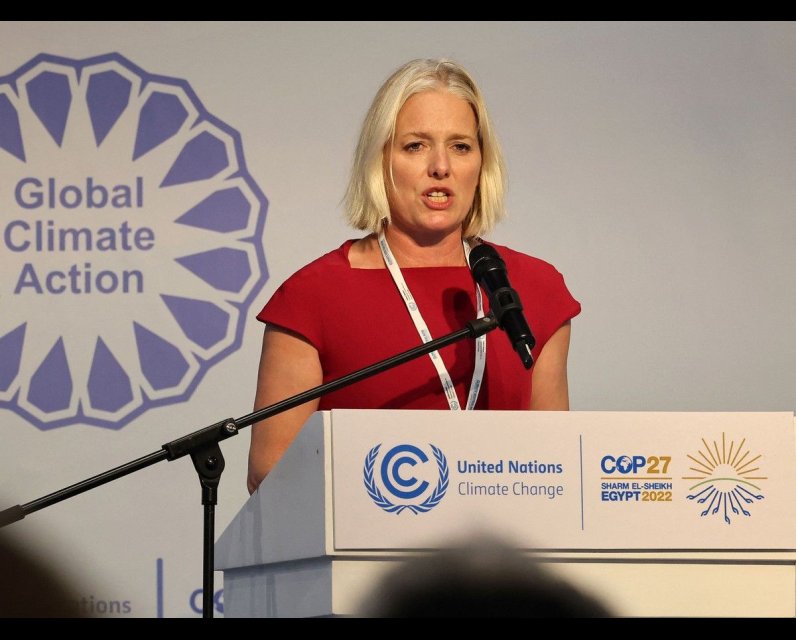
Catherine McKenna, who like Guilbeault, had served as an environment minister under former prime minister Justin Trudeau, entered the House of Commons on Wednesday to offer her support to her former colleague.
She said she knows the difficulty of the job, particularly in light of facing off against “oil and gas companies” as well as the supportive politicians and lobbyists.
McKenna, who left politics in 2021, called the climate “the most important issue we face.”
“He’s worked really hard,” she said of Guilbeault. “It’s his day, and I think it’s really important that we have people in the Liberal party who actually talk about the climate crisis and how we’re actually going to reduce our emissions because that’s the test.”
Bloc Québécois Leader Yves-François Blanchet, who has known Guilbeault, a prominent environmentalist since the early 2000s, said he was “not entirely surprised” to see him announce his resignation.
“I must say we knew for a long time that Steven was not very comfortable” with the government’s positions on the environment, the Bloc leader added.
Blanchet said Guilbeault’s resignation will send a clear signal across the world that Canada is going backwards on the environment.
“He is the very and absolutely clear example that will be understood in Quebec, in Canada and abroad that the government of Canada has dropped the ball concerning climate and environment for the benefit of the oil and gas industry and that there will be a price to be paid,” he said.
NDP Leader Avi Lewis said Guilbeault’s departure is a clear example that the Carney government will suffer consequences from not making climate issues a priority.
Lewis said he did not try to recruit Guilbeault because his party has a policy against floor-crossing but that he is welcome to run under the NDP banner in a byelection.
Liberal MPs and cabinet ministers on Wednesday downplayed the significance of the party’s most recognized environmentalist exiting politics as a sign that the climate was any less of a priority under Carney, although several underscored the importance of the government striking a pragmatic approach.
“I think our prime minister’s showing you can do development, you can do major projects and you can care for the environment,” Toronto Liberal Rob Oliphant said.
He said though Guilbeault and Carney “may have a difference of opinion,” he believes that in the long term Canadians will see Carney’s commitment to the environment.
National Post
Our website is the place for the latest breaking news, exclusive scoops, longreads and provocative commentary. Please bookmark nationalpost.com and sign up for our politics newsletter, First Reading, here.

Unpublished Newswire


Comments
Be the first to comment