
Stay informed
Unpublished Opinions



My Family Has Four Queer Parents Raising Three Kids Together
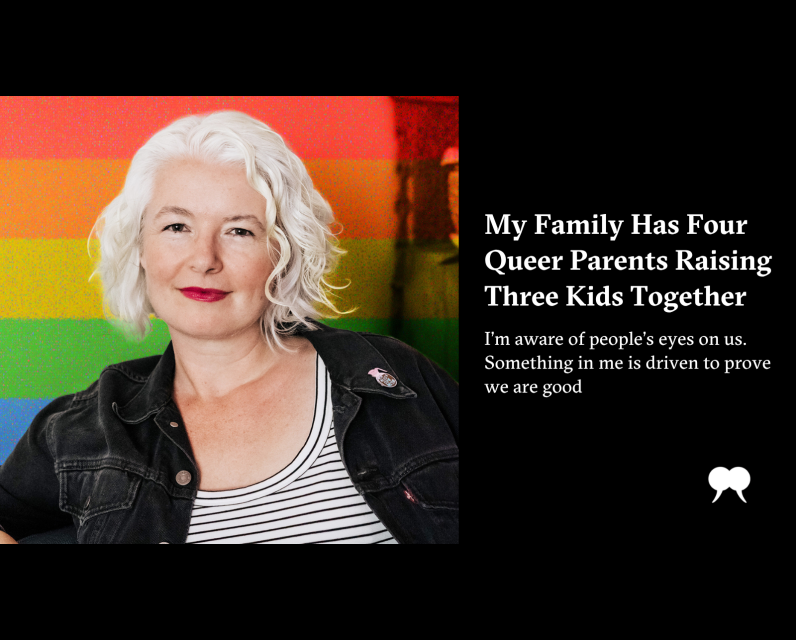
When I tell straight people about my family, I often say, “We’re two couples raising three children together.” If you squint just right, our family bears a passing resemblance to a blended family, except we all live together and no one had to break up for it to form.
We live openly as a four-parent family and have supportive relatives, friends, teachers, and child care providers. We are unfailingly kind, polite, and grateful to them—always grateful. It is genuine: we feel thankful when people are nice to us and don’t treat us like freaks. When someone refers to Nic or Mars as my partners, I correct them. “I only have one partner, Riley,” I say. “Nic and Mars are my co-parents.”
I emphasize this distinction because I don’t want people to think we are all fucking each other. The idea makes me uncomfortable, not just because it’s an inaccurate way of characterizing our relationships but because it feels like too much queer sex to associate with our family.
Queer sex—particularly the kind that happens outside of monogamous relationships, especially if it involves BDSM—is a risky activity to associate with children. I rewrote that sentence three times before I allowed myself to say “children.” I kept wanting to qualify it—“parenting and children,” “care of children”—but the truth is, those are all ways of putting something between queer sex and children. By telling our family’s story in ways that emphasize how normal we are, I’m playing into rhetorics of respectability that harm us and others.
I don’t want to be like straight people, but I want them to like me.
It’s also a way of narrativizing our experiences that distances us from polyamorous families where the adults do have sexual and romantic relationships with each other. As a queer, polyamorous person, this distancing feels both self-contradictory and like a betrayal of communities I consider myself part of.
To prevent strangers or acquaintances from imagining what goes on in our bedrooms, I grip a shred of respectability until it becomes a wedge. I don’t want to be like straight people, but I want them to like me. I want them to think I’m safe enough to be around children. I want them to think their children will be safe with me.
I don’t want them to take my children away.
In 1975, Minnie Bruce Pratt left her husband to live openly as a lesbian. She had two young sons. When she asserted her sexual independence, “the world looked at me and saw an unfit mother,” Pratt wrote in 1993. “Suddenly, my husband had legal grounds to take my children away from me and never let me see them again.”
As an out queer woman, she was subject to felony charges under North Carolina’s “crime against nature” statutes. Her lawyer told her, “You don’t have a dog’s chance in court.” Pratt lost custody of her sons, Ben and Ransom, to her ex-husband. Her divorce settlement forbade her from having her children in her home if she lived with another person, and she could only take them out of their home state if they were going to visit her mother. Pratt used to drive fourteen hours each way on three-day weekends to see them.
Pratt’s story is notable to me because she is one of my femme literary heroes and because it exemplifies the consequences of an era when same-sex sexuality was construed as “antithetical to parenting.” Historians and legal scholars have demonstrated how, between the 1960s and 1990s, queer parents in the United States and Canada frequently lost custody of their children, if they were allowed to see them at all. As more LGBTQ+ people began coming out of the closet and leaving heterosexual marriages, they often found themselves in the impossible position of choosing between living authentically and maintaining relationships with their children.
The US legal regime “centred on the assumption that same-sex sexuality was inherently dangerous to children.” It was feared that queer parents would pass on their deviant desires to their offspring and that their children would face stigma and psychological damage. Queer people—especially gay men—were stereotyped as pedophiles. One judge said he would “not permit ‘children to be placed in a home where the felony of sodomy is committed at least twice a week.’” Some parents who were allowed to retain custody or visitation rights were barred from seeing their children in the presence of their same-sex partners and prohibited from participating in queer community activism or social events. Others were required to sign affidavits consenting to regular psychiatric examinations testifying to having repudiated their sexual orientation.
In Canada, the queer parents who won custody of their children did so by “leaning into a politics of respectability” and discretion. Parents who were open, proud activists or involved in the queer community were more likely to lose child custody or access. The first reported Canadian case in which a lesbian mother was awarded custody of her child was K v. K (Alberta, 1975). Halyna Freeland, the feminist lawyer who acted on Mrs. K’s behalf, later wrote that the judge commented favourably in his decision on how discreet the mother was about her lesbianism. Freeland added that she believed the mother would have lost custody “had the father not been found completely incapable of caring for the child.” A year earlier, in Case v. Case, a lesbian mother in Saskatchewan lost custody of her two children because the judge ruled that her gay rights activism would be harmful to them. The line between “good” and “bad” lesbian mothers hinged in part on acting straight and on a promise to raise their children to be heterosexual.
“It’s wonderful to be able to look back and say you have led the life you wanted to lead.”
Pratt loved her children fiercely and refused the idea that lesbianism made her a bad mother. Her sons, then aged ten and eleven, helped her print and assemble her first chapbook, The Sound of One Fork (1981). Eight years later, Firebrand Books published Crime Against Nature, Pratt’s award-winning poetry collection about her experiences as a lesbian mother deemed unfit to parent. In the titular poem, she wrote, “I didn’t write this story until now when [my sons] are too old for either law or father to seize or prevent them from hearing my words.” Sodomy was still illegal in half of US states when Crime Against Nature was published. Although ruled unconstitutional in 2003, these laws are still in effect in twelve states, including North Carolina.
In her afterword to the 2013 edition of Crime Against Nature, Pratt wrote, “When my children were taken from me, I said, ‘I have nothing left to lose.’ I meant that the system of ownership and bigotry had almost killed me with grief. If I was not to die, then I was going to have to live—to fight to change everything.”
In a 2021 interview, Pratt encouraged young people to be brave. “There’s a place for you,” she says. “It’s wonderful to be able to look back and say you have led the life that you wanted to lead.”
She died in 2023 with her family at her side.
“Best interests of the child” is a legal test used to inform decisions about which caregiving and custody arrangements will best protect a child’s safety, security, and well-being. Mothers were historically given preference over fathers in child custody disputes. With the emergence of no-fault divorce in the 1970s, “best interests of the child” became the standard instead of maternal preference. This disadvantaged lesbian mothers exiting straight marriages, whose queerness marked them as unfit to parent.
What’s in a child’s (or children’s) best interests is determined on a case-by-case basis, with courts often interpreting “best” against heteronormative and mononormative standards, with Black and Brown, disabled, trans, sex-working, and poor parents subject to even greater scrutiny. Historically, judges were often concerned with whether gay parents would raise gay kids. Parents “who could, and were willing, to pass as straight were seen as acting in the best interests of their child[ren],” while those perceived as militantly queer were assumed to be harmful.
Judges were often concerned with whether gay parents would raise gay kids.
When the American Psychological Association declassified homosexuality as a mental disorder in 1973, “courts no longer had a categorical basis for casting homosexual parents as inherently unfit.” Instead, judges required evidence of harm. Queer parents relied on expert witnesses to help prove their case, though they, at first, grappled with a lack of supporting evidence demonstrating their fitness to parent. This catalyzed the creation of a body of research intended to show that children raised by LGBTQ+ parents would suffer no ill effects.
“An academic consensus quickly developed that there was ‘no difference’ between children raised by queer parents and those raised by heterosexual parents,” writes historian Erin Gallagher-Cohoon. These studies emphasized that the children of LGBTQ+ parents were likely to grow up straight and gender normative, which was presented as a positive outcome.
US marriage equality cases subsequently marshalled this evidence, submitting lists of approximately 150 studies showing that children of queer parents fared as well as those raised by straight people. “Movement leaders also selected a disproportionate number of mothers and fathers to serve as plaintiffs in their cases,” writes legal scholar Marie-Amélie George, explicitly excluding “less mainstream movement members, like flamboyant drag queens and sexual nonmonogamists, who drew attention to the ways in which members of the LGBT community defied convention.”
My children’s birth certificates are printed on small rectangular sheets of polymer watermarked with blue and brown maple leaves. They list each child’s name, date, and place of birth, as well as the names and birthplaces of their parents. My name isn’t on any of them. We aren’t related by blood, marriage, surrogacy, or adoption. Yet I was part of my daughter’s conception and have cared for all three children since birth. They have never asked to see paperwork proving the legitimacy of our relationship.
Queer kinship has a more capacious relational imagination than the state. In British Columbia, where I live, it is possible—thanks to queer and polyamorous people’s legal advocacy—to list more than two parents on a birth certificate. When our daughter was born, you could name up to three parents as long as they were tied to the child by marriage, adoption, or shared biogenetic materials like eggs or sperm. This ruled out my co-parent Nic and me. After consulting with a lawyer, we chose to put Riley and Mars’s names on our daughter’s birth certificate, though we understood that even this was stretching the bounds of what was legally allowable at the time.
In 2021, a BC Supreme Court judge ruled in favour of a polyamorous triad’s request to register their two-and-a-half-year-old child’s unrelated other mother as his third parent. While this precedent was in place by the time our twins were born, we again opted to name only Mars and Riley as parents on our children’s birth certificates.
Just because it is possible to designate multiple parents doesn’t mean it’s easy. We didn’t want to become another legal test case and were reluctant to spend thousands of dollars in legal fees contorting our family into a shape legible to the judicial system. This left Nic and me with tenuous legal status as our children’s parents. It was a risk we were willing to take.
In British Columbia, it is possible to list more than two parents on a birth certificate.
Our family sat comfortably around the margins of the law until our daughter started school. Until then, the durability and legitimacy of our bonds had not been tested by death, health crises, breakups, or homophobic relatives. Our whiteness, non-disabledness, and class privilege protected us from the scrutiny of the family policing system.
Enrolling Sasha in kindergarten forced our hand, as we soon realized only Riley and Mars would be officially recognized as our daughter’s parents at school. We didn’t want to chance having two parents unable to act on her behalf—it could be dangerous in an emergency and would limit our ability to act as her advocates with teachers and administrators. This prompted Nic and I to pursue guardianship of Sasha and her younger siblings. The alternative, step-parent adoption, seemed to us like a more legally complex, expensive, and invasive process.
“Does it matter to you that you still won’t be your kids’ legal parents if you become their guardians?” asked the queer family lawyer who helped us with the process.
“No,” said Nic.
I nodded in agreement. “We know we’re their parents,” I said.
I sometimes worry that our children will feel othered by our family’s differences. When Sasha first started kindergarten, I was anxious about her looking put together for school: a nice-enough outfit, no holes in her pants, hair tidy and under control. I thought it would prove to her teachers that we took good care of her. I thought it would help them to see her, and us, as worthy of their regard.
My anxiety about Sasha’s appearance became a minor source of friction between my co-parents and me. They tended to have a more relaxed attitude about how the kids looked, while I hid the ripped leggings in the back of the closet and bought colourful scrunchies in an effort to entice Sasha into ponytails.
I am the only person in our family who grew up poor and was raised by a single mother. Perhaps this is why I have a heightened awareness of other people’s eyes on my family. Perhaps this is why something in me is driven to prove that we are good.
I want my children to know the history of where they came from and what is at stake for our family, without carrying the weight of my nightmares for what could happen if we aren’t careful enough. I want them to grow up proud of being loved by so many people, to trust that they will always be cradled by many hands.
Excerpted from Staying Power: On Queerness, Inheritances, and the Families We Choose by Zena Sharman (2026), with permission from Arsenal Pulp Press.
The post My Family Has Four Queer Parents Raising Three Kids Together first appeared on The Walrus.
Unpublished Newswire



Comments
Be the first to comment