
Stay informed
Unpublished Opinions


Can Doug Ford win over America? Or will he do more harm than good?
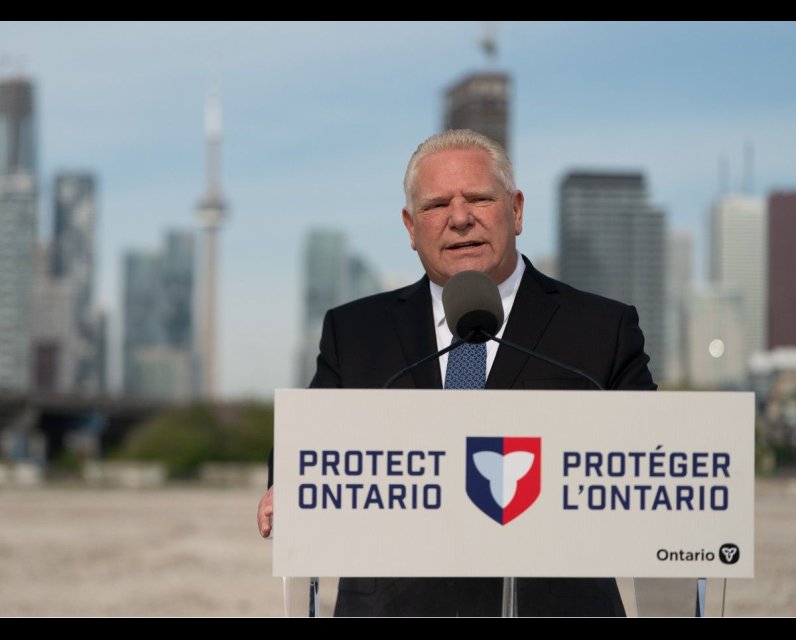
WASHINGTON, D.C. — Doug Ford is not known for playing nice with Donald Trump. The Ontario premier has repeatedly condemned the president’s 51st state rhetoric and boldly removed American booze exports from their biggest market: Ontario’s shelves.
It was also notably Ford’s Ronald Reagan ad that reportedly led to the breakdown in U.S.-Canada trade talks last year.
So the fact that Ford visited Washington this week, engaging lawmakers and business leaders and calling for getting the Canada-U.S.-Mexico Agreement (CUSMA) renewal done, may have seemed odd to many — and maybe downright risky.
But was it — or was it a sign that Canada has pivoted on its approach to Washington?
“You are looking at a change in tone from Ottawa,” said Graeme Thompson, senior analyst at Eurasia Group, who pointed to three relevant developments preceding Ford’s visit.
“There was Mr. Carney’s speech in New York, which was very conciliatory, and Dominic LeBlanc’s trip to Washington, where he met with Jamieson Greer and evidently presented at least constructive proposals and reported that the meeting went well.”
The third development was a statement from the Department of Canadian Heritage, indicating that the minister would instruct the regulator to revisit its decision on interpreting the Online Streaming Act to mean it would levy 15 per cent charges — as opposed to 5 per cent — on big tech companies’ streaming revenues in Canada to support Canadian industry.
That is “really important,” Thompson said, “because digital trade and digital taxes have emerged as a major bilateral trade irritant for the U.S., and that signals a softening of the Canadian position on that issue.”
Ian Keller, a professor at Carleton University’s Sprott School of Business, also sees a clear strategic shift toward a conciliatory tone with the U.S.
In New York, Mark Carney even leaned in on Trump’s MAGA messaging, saying “Canada Strong will help make America great again.”
Now, with Ford’s visit, that’s “the one-two punch,” said Keller.
“I think that this is one of those situations in which there’s a pretty good coordination between the government and between Ford,” said Christopher Sands, director of the Center for Canadian Studies at the Johns Hopkins School of Advanced International Studies in Washington.
Ford told reporters on Tuesday he spoke with LeBlanc before his trip to Washington and, while there, he met with Canada’s Ambassador Mark Wiseman — which suggests at least some coordination with Carney’s team.
“Towards late spring, there was a decision in Ottawa,” Sands said he believes, “that they were going to reboot, and if Carney needed to say nice things, he would say nice things.”
Sending Ford as a trade ambassador was risky, of course, but could he be Carney’s conservative foil?
“I think it’s possible,” said Sands, noting that the prime minister noticed how “Ford was a politician who had a populist ear, not unlike Trump, and whose message on Fox News or whatever outlet might cut through and convince some Americans that Canada’s not the enemy.”
Lawrence Herman, senior fellow at the C.D. Howe Institute who specializes in international trade and investment law, thinks Ford’s messaging has been good for Canada.
“It shows that Canada can speak with the same voice,” he said, noting that Ford is preferable to Alberta Premier Danielle Smith or Conservative MP Jamil Jivani “spreading the word about how Canada isn’t unified.”
Ford’s meetings, by all accounts, were positive, but his planned reception with Ross Perot Jr. at the U.S. Chamber of Commerce on Monday was cancelled — officially due to a scheduling conflict. The rumour, however, is that Trump’s team pressured the Chamber into cancelling what would have been a flashy moment for Ford with U.S. industry leaders.
Still, Ford had his meetings and TV interviews, sharing plugs for building a “Fortress North America,” a term used by both Ford and Carney in recent weeks.
Essentially, the fortress idea is a growth plan centred on the principle that “economic security is national security,” which aims to create more jobs, lower prices and strengthen continental security. To get there requires renewing CUSMA and eliminating the Section 232 tariffs on steel, aluminum and auto.
“There’s going to be more jobs, more opportunities for everyone,” Ford told reporters on Tuesday.
“We’re just sending a positive message. Let’s get this deal done.”
Keller said he believes the Fortress messaging is code for “no tariffs,” meaning that Canada may be willing to bend on its deal with China or on other issues so long as the sectoral tariffs disappear.
“I think that they’re throwing out trial balloons saying, ‘OK, if we go to Fortress North America, we’ll walk away from the Chinese, but then there’s got to be a lot in it for us.’”
But tariff elimination is unlikely, trade watchers say.
“I feel like tariffs are here to stay,” said Inu Manak, senior fellow for international trade at the Council on Foreign Relations, “and that it’s going to be challenging to have nothing on the books.”
“For consistency, USTR has to apply tariffs to Canada and Mexico, as a policy that tariffs apply to everyone.”
But how that’s implemented, Manak explained, is key.
The proposed remedy from USTR for Section 301 tariffs over forced labour issues, for example, offers the same exemptions as the IEEPA tariffs did for CUSMA-compliant goods, meaning that more than 80 per cent of trade would remain tariff-free.
The real question, Manak said, is “how do they structure some of the exemptions to the tariffs that are coming down the line to ensure that they do not impact Canada’s trade with the United States?”
Whatever happens with the tariffs, a CUSMA renewal may not be in the cards.
Neither Manak nor Eurasia Group’s Graeme Thompson believes a renewal is coming anytime soon.
Thompson pointed to the likely zombification of the trade agreement.
“It looks quite unlikely,” he said, “that there will be a trilateral agreement … where all three leaders sit down and sign a document that agrees to extend USMCA for the statutory 16 years.”
That would lead to a process of annual reviews.
“If you’re in a constant negotiation where there’s no real certainty that the terms you’ve signed up to are, in effect, permanent,” said Thompson, “then there’s not really a trade deal as such. It’s dead.”
“But at the same time, we expect, with the 85 or 90 per cent of Canadian exports to the U.S. that enter the U.S. tariff-free, that that will remain in place, and to that extent, the agreement lives.”
That, he said, would make it a “zombie agreement that’s neither fully dead nor alive.”
In that case, Ford’s U.S. booze ban would stick, as the premier said on Tuesday that he would not return the American products to Ontario’s shelves before a renewal is complete.
“Once that deal’s done,” he said, “I’m going to be … bringing all the booze back on shelves … and everyone’s going to be Kumbaya.”
Ford’s campaign continues over the next month with visits to South Carolina and Utah.
National Post
Our website is the place for the latest breaking news, exclusive scoops, longreads and provocative commentary. Please bookmark nationalpost.com and sign up for our newsletters here.

Unpublished Newswire



Comments
Be the first to comment