
Stay informed
Unpublished Opinions



Why Alberta Separatists Can’t Stop Talking about Immigration
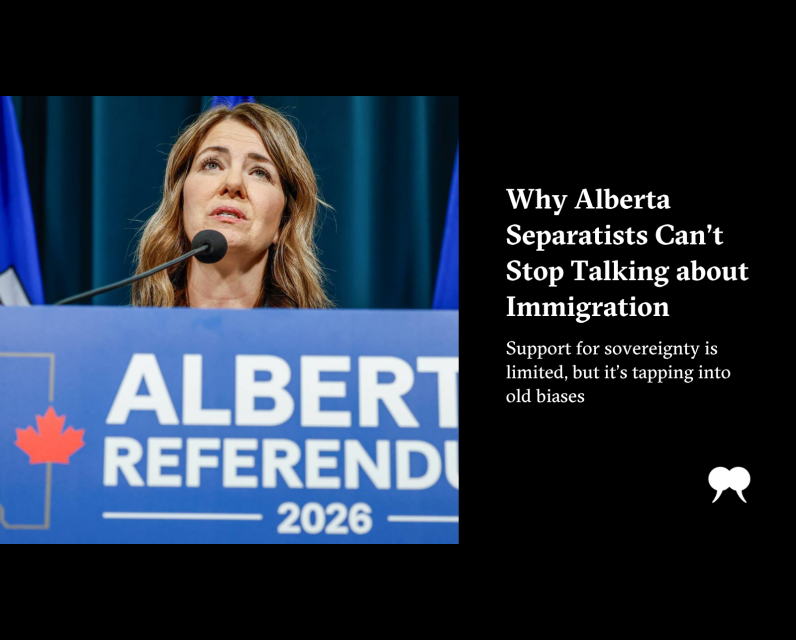
While much of the attention around Alberta premier Danielle Smith’s proposed October 19 referendum has been on the possibility of separation from Canada, parts of the referendum package focus directly on immigration and newcomer access to public services—issues that get to the heart of the debate.
According to the Government of Alberta’s referendum materials, the proposals include five questions aimed at expanding Alberta’s control over immigration, restricting access to some provincially funded services based on immigration status, and redefining eligibility for certain provincial benefits.
The debate comes amid rapid population growth in Alberta driven significantly by immigration and interprovincial migration. Statistics Canada’s Annual Demographics Estimates show Alberta recorded one of the fastest population growth rates in Canada in recent years. Provincial data in Alberta’s 2023/24 Annual Population Report also indicates that the province recorded the country’s largest net gain in interprovincial migration in 2023. According to the 2021 census, immigrants accounted for roughly 24 percent of Alberta’s population in 2021, up from about 17 percent in 2001.
Despite months of political tension and media attention, support for separation itself appears limited. New polling from the Angus Reid Institute suggests that a majority of Albertans do not support separation. The survey found that 61 percent of respondents would vote against beginning a process toward separation, while 67 percent said they would choose to remain in Canada when presented with a simpler “leave” or “stay” framing. The poll also found that 51 percent of Albertans considered the referendum questions confusing.
Political scientist Jared Wesley of the University of Alberta, whose research focuses on Alberta’s political culture and identity, argues that the significance of the referendum lies less in its immediate likelihood of separation than in how the debate is reshaping conversations around immigration, identity, and belonging.
According to Wesley, some sovereignty narratives reflect anxieties tied to globalization, economic insecurity, and rapid social change, with immigrants sometimes becoming symbolic targets within broader frustrations about affordability, public services, and cultural change. The tension may become increasingly pronounced as Alberta’s rapidly changing demographic reality collides with older narratives about identity, belonging, and provincial culture, said Wesley in an interview with New Canadian Media.
Wesley notes that many newcomers are not rejecting Alberta’s traditional identity and are instead embracing aspects of it—particularly the province’s long-standing emphasis on self-reliance, economic opportunity, and social mobility. In his view, Alberta’s frontier ethos continues to resonate with immigrants seeking stability and upward mobility.
But, Wesley argues, parts of the sovereignty debate continue to draw on older political narratives centred on grievance, cultural protection, and resistance to federal authority, even as Alberta itself becomes increasingly diverse economically and demographically.
Bukola Salami, a professor at the University of Calgary whose research focuses on migration, health, and racialized communities, also challenges political narratives portraying immigrants as a burden on public resources. She says immigrants continue to play a critical role in sustaining Alberta’s public services, particularly the health care system. “Immigrants contribute enormously to the health workforce,” Salami says, noting that many physicians and nurses working in Alberta are internationally trained and are especially vital in rural and underserved communities.
“The prevailing political rhetoric, however, tends to frame immigrants as a drain on public resources—a characterization that is not supported by evidence,” she adds.
Concerns about immigration’s impact on housing affordability, infrastructure, and public services have increasingly shaped political debates over rapid population growth. Critics of Alberta’s referendum argue that some of the rhetoric risks reinforcing perceptions that immigrants and temporary residents are contributing to those pressures.
Wesley warns that such political narratives can have broader social consequences by shaping perceptions of legitimacy and belonging, particularly for refugees, temporary residents, and racialized communities. In his assessment, some newcomers increasingly experience belonging as conditional—tied to whether they are viewed as economically useful, culturally compatible, or politically acceptable.
Salami says similar patterns emerged in her own research using Statistics Canada’s Canadian Health Measures Survey, which found that community belonging and income security are among the strongest determinants of mental health outcomes among immigrants. She adds that immigrant service providers across Canada have documented exclusionary practices that can undermine newcomers’ sense of belonging.
“As anti-immigrant rhetoric flourishes, it creates conditions in which racism and discrimination are more likely to flourish,” Salami says, warning that such dynamics can carry consequences for both mental health and civic participation among newcomers and racialized communities.
Not all observers view Alberta’s sovereignty debate as inherently anti-immigrant. Marco Navarro-Genie, president of the Haultain Research Institute, argues that much of the debate is being misunderstood outside Alberta. In his view, many Albertans are less concerned about immigration itself than with what they see as growing federal intrusion into provincial jurisdiction.
“What Central Canada presents as Alberta’s hostility to immigrants (but not in other provinces),” Navarro-Genie says, “is a demand that Ottawa restrain centralizing policies that harm provinces and disrespect constitutional jurisdictions.” He is of the view that many sovereignty supporters want Alberta to exercise greater control over policy areas already assigned to provinces under the Constitution, including aspects of immigration administration and settlement policy.
Alberta’s growing economic dependence on immigration, alongside increasingly polarized political debates over identity and provincial autonomy, may become one of the defining issues shaping the province’s future.
“Alberta is at a crossroads,” Wesley says, referring to what he sees as a widening gap between older political narratives and the province’s changing demographic reality.
For now, Alberta’s separatism may not be electorally dominant. But the rhetoric surrounding it is increasingly shaping conversations about immigration, identity, provincial autonomy, and belonging within Alberta.
Originally published as “As Alberta Flirts with Separation, Debates over Immigration Intensify” by New Canadian Media. Reprinted here with permission.
The post Why Alberta Separatists Can’t Stop Talking about Immigration first appeared on The Walrus.
Unpublished Newswire



Comments
Be the first to comment