
Stay informed



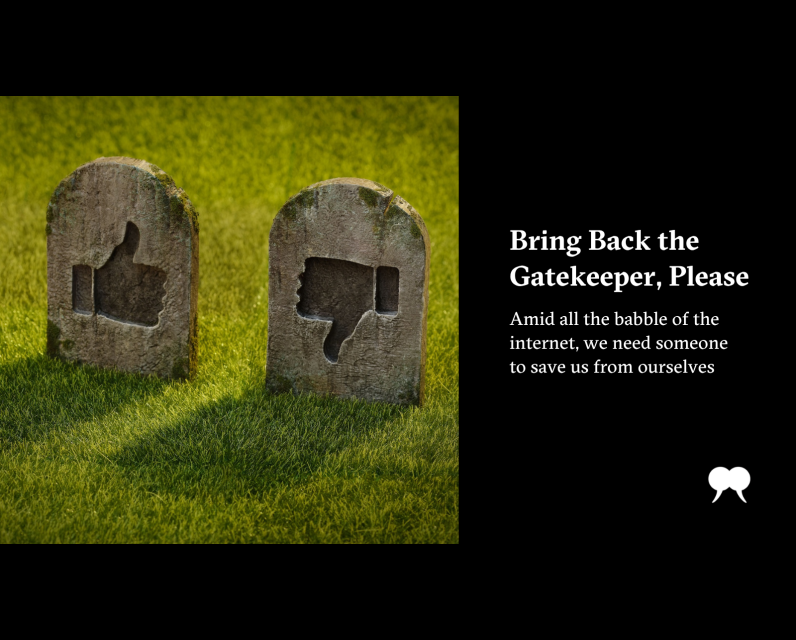
Bring Back the Gatekeeper, Please
WHEN WILLIAM GIBSON was starting out as a short story writer, he made a point of avoiding what he later called the “paper Internet”—the fanzine ecosystem where novices could place their work for free. As he explained in his 2012 book Distrust That Particular Flavor, Gibson felt he needed the go-ahead of a proper gatekeeper. “Either someone whose rent was paid by their job of selecting stories, someone for whom it actually mattered, could be induced by my words on a page to buy my story, or they couldn’t,” wrote Gibson, who sold his first piece to a magazine for $23 in 1976. “This seemed like magic to me, and still does.”
What an alien idea in 2026, worthy of science fiction: we should let someone else decide if our words are worth airing.
Today, the gatekeeper is a diminished figure. Certainly, in the literary microclimate, the species of editor Gibson once sought to impress (an actual humanoid, employed to source and print good writing) is endangered. Blame the non-paper internet; blame the blogosphere, Facebook, Tumblr, X, Instagram, TikTok, YouTube, podcasts, your smartphone’s camera—the list of immediately accessible bullhorns is endless.
Plus, the coveted spaces overseen by gatekeepers have dwindled as traditional media outlets have contracted. In the past year alone, the Washington Post track-changed away its books section as well as about 30 percent of its staff. The Associated Press dispensed with book reviews, and the Chicago Tribune its film critic.
The self-published post is out of the bottle and has been for decades. Many writers have now taken to Substack, a veldt of largely unedited voices it’s hard to be heard in. Everyone’s a critic (or conspiracy theorist) and the few who break through and attract paying subscribers are immediately at the mercy of those subscribers. (Without the cover of gatekeepers, writers are captive to readers.) Facts go unchecked, journalistic standards are chucked, and algorithmically incentivized brainrot (a pizzeria harbours pedophiles, Churchill was World War II’s true villain) is broadcast widely.
And yet many of us seem cool with the demise of gatekeepers. The word itself has long been an epithet. Gatekeepers, after all, stand in the way: of mastheads, schools, health care, the smoke-filled backroom, the boss’s inner sanctum, the politician’s ear. And anyway, when it comes to media and publishing, haven’t the gatekeepers traditionally been too powerful, too male, too monochromatic? (Short answer: sure.)
Still, I want to stand up for the idea of the gatekeeper (which includes the obviously brilliant editor who polished this piece and the stony sentries at The New Yorker who never answer my emails). Gatekeeper, here, doesn’t mean the patriarchal bogeyman of progressive fever dreams. It means the picky curator who maintains a necessary membrane between your half-formed, typo-addled thoughts and the wider world. It means the tastemaker who triages opinions and batters the better ones into readable form. It means the authority figure who sometimes says no—and saves us from ourselves.
“Nothing stinks like a pile of unpublished writing,” wrote Sylvia Plath. The gatekeeper, by giving their stamp of approval, dispels the stink.
Perhaps it’s foolish to mourn the loss of a slower, more hierarchical model of publishing, which isn’t coming back. Perhaps what I’m really mourning is the loss of humility, which isn’t a virtue that correlates with most bloggers, podcasters, pundits, influencers, webcam exhibitionists, self-taught historians, selfie-snappers, looks-maxxers, cat-picture-uploaders, definitely-informed-opinion-havers, and do-their-own-researchers.
“I liked the era where there was a bit of mystery about everyone’s stupidities,” said the journalist Michael Moynihan on a recent podcast.
Calling for people to reconsider posting their immediate thoughts about a drone strike or their 50,000-word fan-fiction masterpieces is like asking my kids to stop scratching mosquito bites. Nevertheless, we should resist the instant perches that Wi-Fi makes plentiful. Like young William Gibson (who coined the term “cyberspace” and predicted something like the internet), we should be wary of frictionless freedom. We used to put our writing, like bread dough, in drawers to properly age. As gatekeepers recede, writers—all of us, really—need to slow down and save that post in drafts.
The post Bring Back the Gatekeeper, Please first appeared on The Walrus.
Unpublished Newswire

Comments
Be the first to comment