
Stay informed
Unpublished Opinions


Your Smart Home Has Been Spying on You This Whole Time
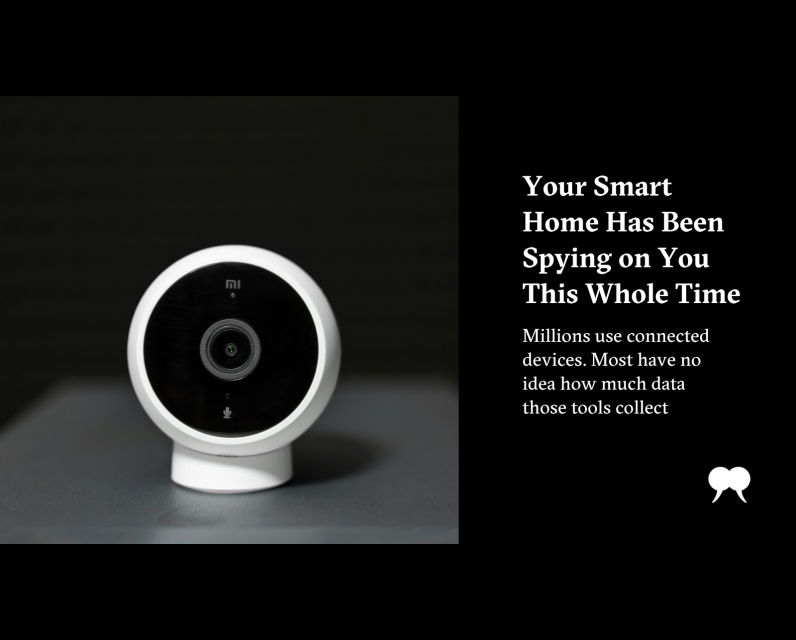
There was a time when the walls around you were mute, passive, indifferent to your presence. The door stayed closed unless you opened it, the lights remained off unless you flipped the switch, the air remained heavy unless you adjusted it yourself. The home was a shelter, a place where action was visible and cause was tangible, where comfort depended on conscious effort, and the environment responded only to direct, physical commands.
Then, almost without ceremony, the house began to wake up. It started with small conveniences: a thermostat you could adjust from your phone, a set of lights that obeyed a remote click instead of a wall-mounted switch, a speaker that responded to your voice with weather reports or trivia questions. These early steps felt like miracles of frictionless living, tiny victories over the minor annoyances of daily maintenance. What harm could there be in a house that helped you with reminders, adjusted to your preferences, tuned itself to your rhythms?
At first, the sensation was one of empowerment. Your home seemed to rise into consciousness, an extension of your intent, your desire, your immediate needs. It learned not just to obey, but to anticipate. But in surrendering these small frictions, you also surrendered something less visible: the finality of action, the privacy of space, the solitude of thought that once came naturally when the walls were deaf and the appliances were dumb.
The first time you asked a digital assistant to dim the lights, order paper towels, or play a favourite song, it felt indulgent, futuristic, almost magical. You spoke, and the world obeyed. Tasks that once required movement, planning, and minor effort now unfolded at the speed of voice. It was thrilling, in the way a magic trick is thrilling the first time it is revealed: astonishing not just because it happened but because it violated your expectations of what should be possible.
But convenience, once tasted, rarely remains a luxury. It becomes expectation, and soon, you no longer marvelled at the lights that dimmed on command. You grew impatient when they did not. You no longer admired the thermostat that adjusted itself as you arrived home; you became irritated when it failed to anticipate a change in the weather. Convenience, once a gift, hardened into entitlement.
The smart home shifted the baseline of comfort, not by dramatically transforming the nature of life but by eroding your tolerance for any friction at all. You learned, slowly and without intent to regard effort as failure, delay as inconvenience, manual action as an insult to your lifestyle.
And because these technologies were embedded invisibly into your daily rituals, you forgot how recent these expectations of technology were. You forgot that, not long ago, it was normal to return to a cold house, to fumble for a light switch in the dark, to make lists by hand and shop without digital assistants buffering your forgetfulness. You did not notice how quickly you adjusted to a home that served you, and how quickly you lost the resilience that came from serving yourself.
I tried to join the smart home movement early, perhaps too early. The moment the Nest thermostat was announced, I bought one. The promise of intelligent climate control was irresistible. But upon installation, I was promptly told that it wasn’t compatible with older buildings like my condo. It was like bringing home a futuristic appliance only to find that my walls spoke a different dialect. The disappointment was sharp—not because I couldn’t automate the temperature, but because I had imagined the start of a new relationship with my space.
Undeterred, I shifted course. Alexa came first, her voice filling the living room with playlists and the occasional weather report. Then came Google Home: two of them. One sits on my desk, the other lives in the kitchen. They’ve both become, in their own ways, collaborators.
My kitchen Google is now a trusted sous-chef, always ready with baking temperatures and last-minute recipe clarifications, to immediately answer me when I call out, “How many grams in a cup of flour?” My office Google, on the other hand, is my silent academic companion. I’ve asked it to define terms mid-presentation, not just for my clarity, but so clients can see that my knowledge is supported, triangulated, externalized. That I don’t pretend to know everything, but I do know how to ask.
Perhaps that’s the most subtle behavioural shift the smart home introduces: we’ve grown comfortable in dialog with our machines not simply as tools but as participants in our cognition.
One of the unspoken bargains of the smart home is that, in order to serve you, it must observe you. Every preference you voice, every command you utter, every routine you unconsciously enact becomes a data point, a pattern, a thread woven into a tapestry of prediction.
Your house knows when you wake. It knows how long you linger in the kitchen before heading to work. It knows when you prefer warmer temperatures and when you like the windows shut tight. It knows what music you ask for when you are alone and what you request when guests arrive. It learns your schedules, your moods, your habits, and your deviations from routine.
You forget, in the daily chorus of “Hey, Google” and “Alexa, play” that every command is a disclosure. You forget that the house does not forget. The intelligence embedded in your walls does not distinguish between your grandest ambitions and your most trivial whims; it records both with equal fidelity.
The walls are now attentive, and in their attentiveness, they accumulate knowledge not just about what you do but about who you are. That knowledge is not confined to the devices themselves but often siphoned off, uploaded, and aggregated into profiles you cannot see and systems you do not control. That knowledge travels far beyond the home, moving into networks of corporate memory whose interests are not always aligned with your privacy.
The home, once a refuge from the observing eyes of the world, becomes another opportunity for surveillance, a space where privacy thins not by force but by your own repeated acts of convenience. You trade secrets for simplicity and solitude for service. And you do it gladly, because the house that listens makes life so much smoother, so much softer, so much less burdened by the demands of memory and effort.
As the systems grew more complex, more predictive, more adaptive, a subtle inversion occurred. You stopped telling the house what you wanted and started accepting what it suggested. The lights dimmed automatically as evening fell, and you left them that way. The thermostat nudged itself a degree higher on a cold night, and you agreed without thinking. The shopping list filled itself with items you had ordered before, and you simply approved it with a tap.
Delegation replaced autonomy as you outsourced not just actions but decisions. You entrusted your preferences to a memory not your own, to a networked brain whose algorithms increasingly guessed better than you did. And with each act of delegation, you ceded a small measure of agency: a tiny surrender that felt rational, even wise, because why spend energy on decisions the system could make for you? But agency, like muscle, atrophies when unused, and the more things you allowed your environment to decide, the less accustomed you became to the friction, the ambiguity, the deliberation that decision making requires.
You risked becoming a passenger inside your own habits, a willing ghost drifting through a house that anticipated your movements so precisely you could almost forget that you once initiated them yourself.
The gentle pressure to accept rather than to choose was not malevolent; it was mechanical, built into the logic of optimization. More profoundly still, the smart home became a mirror, reflecting not only your stated preferences but your unconscious routines, your hidden desires, your inconsistencies and contradictions. The data it gathered did not simply serve you. It shaped you.
You noticed that the house played upbeat music when you returned late from work, and you began to associate exhaustion with cheerfulness, even when you felt neither. You noticed that the kitchen lights warmed in the morning and began to believe you were a morning person, even though you still felt the old resistance to rising. You noticed that groceries reordered themselves based on past purchases, and you stopped experimenting with new ingredients, narrowing your palate without intending to.
The house mirrored you back to yourself, not as you imagined yourself to be but as you behaved. And over time, that mirror became a template. You stopped asking if your routines were the ones you wanted and started accepting that they must be, because the house remembered them better than you did.
The smart home, in its silent attentiveness, redefined your identity not through explicit instruction but through the quiet layering of repeated behaviours, reflected, reinforced, and rendered invisible until they felt inevitable. Your home became not merely a tool for managing life but a narrative about who you are, a narrative you consented to not through affirmation but through repetition.
You no longer lived in a house; you lived in an archive of yourself that updated in real time, a living record of who you had been, woven so deeply into the environment that you might forget you ever chose otherwise. The walls became autobiographical, telling your story back to you without asking if you were still interested in hearing it.
Perhaps the deepest, least noticed change brought by the smart home is the erosion of solitude: the full privacy of mind, the unobserved shaping of thought, the sanctuary of a space that neither records nor responds.
When your home listens, when it responds, when it anticipates, it ceases to be merely a background to your life and becomes a participant: a witness and silent conversational partner, offering recommendations, responding to moods, recording habits. The walls listen with an attentiveness you barely notice until it is no longer avoidable.
In such an environment, true solitude, the kind that allows reflection to wander freely, unobserved, unprompted, is harder to achieve. You are never truly alone when every room is waiting to assist you, when every device hums invisibly in readiness, when every uttered word becomes part of a growing archive of preferences and tendencies. The space that once cradled your private becoming now gently shapes it. The absence of solitude does not feel like something taken away; it feels comfortable. But it carries a quiet cost.
You lose the moments when thought could meander without audience, when impulse could emerge without suggestion, when memory could surface without being tagged, indexed, or categorized. You lose the interiority that comes not from isolation but from the absence of responsive expectation. The smart home is attentive, but solitude requires indifference. In trading indifference for service, you surrendered more than inconvenience; you surrendered a kind of freedom that once grew silently within the old, oblivious walls.
In an attentive house, even your most fleeting moments, your sighs, your muttered frustrations, your spontaneous outbursts, are data.
And knowing that changes you, even if you do not notice it. Solitude shrinks, not out of neglect but because of hyper-attention.
A smart home promises comfort, efficiency, and anticipation. It gives you what you want before you know you want it and smooths the rough edges of living. But in doing so, it invites a question you may not have realized you were asking: What part of yourself is being shaped by a life lived inside spaces that never forget, that always listen, that gently nudge you toward the self you have been, rather than the self you are becoming? The smart home records. It predicts. It comforts. But it also tempts you to stop moving forward, to live inside a version of yourself stabilized by memory, rather than animated by choice. And the danger of living inside a memory is not that it is inaccurate. It is that it is incomplete.
Because you are not just the person who prefers the kitchen lights at 2,700 Kelvin. You are not just the shopper who buys quinoa and oat milk on Wednesdays. You are not just the resident of a schedule so well mapped that the thermostat knows when to warm the bedroom. You are also the person you have not yet chosen to be. A smart home remembers who you were, but only you can insist on becoming someone new.
Adapted from You Were Never Just Using It: How Technology Rewrote the Self One Click at a Time. Copyright © 2026, Alexander Manu. Reprinted by permission of Sutherland House Books.
The post Your Smart Home Has Been Spying on You This Whole Time first appeared on The Walrus.
Unpublished Newswire


Comments
Be the first to comment