
Stay informed



Carney’s Political Honeymoon May Be Over
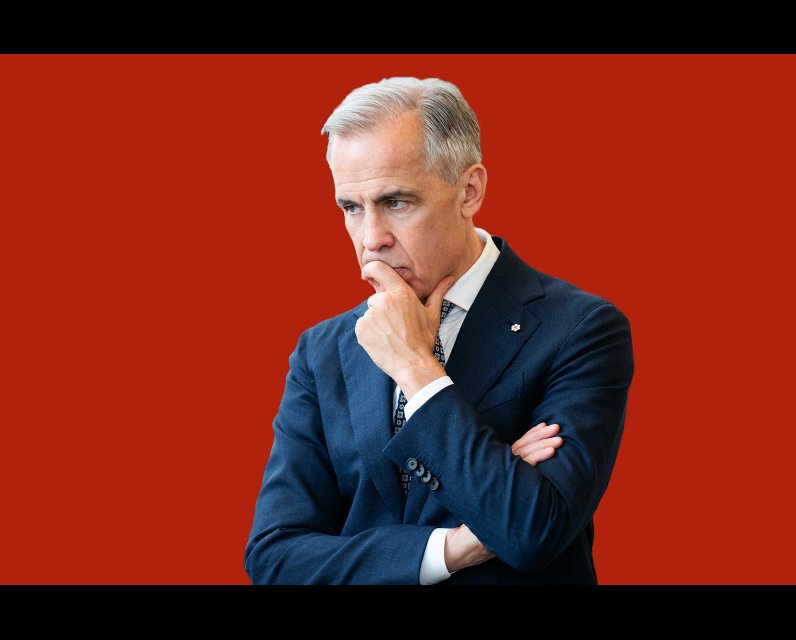
Nothing in politics is ever inevitable, but once a particular dynamic has solidified, it can be tempting to see it as permanent.
Such has been the case since Mark Carney’s election victory a little over a year ago, and in poll after poll, Liberal fortunes have only seemed to rise further: the Conservatives gradually losing ground and the New Democratic Party mostly treading water. In short order, both in the sense of public psychology and the Liberal Party’s seat count in Parliament, the Carney era has seemed to consolidate itself as the new norm.
On a personal level, Carney himself has often looked politically unassailable: the cool and collected new face of elite managerial competence in an uncertain time; popular and politically ambidextrous enough to attract floor crossers from the Conservatives and the NDP alike. This popularity has been compounded by generally high approval ratings for the government itself and—as you can read here in this recent analysis from David Coletto—by the sense among some 47 percent of Canadians that the country is headed in the right direction (that figure representing a ten-year high). At various points, the Liberal Party has even looked poised to leapfrog the Tories in Alberta.
For the first time since April 2025, however, we are beginning to see at least a nascent shifting of the political winds. There are signs of real movement when it comes to public opinion and, as Coletto further observes here, the prevailing mood of relative optimism is starting to subside.
Looking at recent polls from Liason, Nanos, and Abacus, we see some real variance. It’s not as if the Liberals have experienced some precipitous fall, but across all three surveys, there is a visible uptick for the NDP. When you add to this the decidedly non-negligible recent drops in both Carney and the government’s approval ratings, there is good reason to think something real is afoot.
With all this in mind, here are some broader observations about where things stand and where I think they might be going.
First, the Avi Lewis effect can’t be discounted. It’s important to remember that the single biggest factor in the NDP’s catastrophic 2025 election wipeout was the migration of a good chunk of its base to the Liberals. This matters for obvious reasons, but it’s also relevant because so much discourse since has concerned the bleed of blue collar NDP voters to the Conservatives. Though that’s undoubtedly a real phenomenon, I strongly believe its scale and significance have been greatly exaggerated.
As I wrote back in January:
[T]he decisive factor in the NDP’s collapse—evident in these seats and many others—was its considerable bleeding of support to the Liberals. To this point, data published by Ipsos Reid suggests that, while 5 percent of 2021 NDP voters switched to the Conservatives, nearly four times that number (19 percent) switched to the Liberals. Even in seats that swung to the former, this often had major implications.
In spring 2025, the Donald Trump phenomenon created a series of fairly unique conditions that allowed the Liberals to attract vast swathes of traditional NDP voters on a scale that’s never really been seen. And throughout much of the time since, the NDP—and its message—have been less visible to the Canadian public than usual. Notwithstanding the fine work of Don Davies and his caucus colleagues, it’s lacked a leader, lacked official party status, and has been mostly relegated to the margins of federal politics.
Since his victory at the NDP’s Winnipeg convention a few months ago, as I argued here, Avi Lewis has successfully brought the party renewed attention and, on a number of critical issues, reintroduced a vital social democratic critique into the national debate (notably, as you’ll see in this video, in the wake of the government’s spring economic update).
This matters on its own terms, but I’d wager it’s making an impact partly because the debate between the government and Conservative opposition has hitherto been so incredibly narrow. Which, incidentally, brings us to the next point.
The Conservatives are struggling because Carney has outflanked them on the right. And the NDP is gaining ground for the exact same reason.
Insofar as there are meaningful points of ideological distinction between government and opposition since April 2025, they’ve mostly been differences of degree rather than sharp breaks. For as long as anyone can remember, the Conservatives have been arguing for public spending cuts, the reduction of federal taxes, the removal of regulatory constraints in the oil and gas sector in particular, and the state-subsidized construction of new pipelines. They’ve also wanted more money spent on the military and have repeatedly insisted that the best means of addressing Canada’s ongoing crisis in the cost of living is, well, to cut public spending, reduce taxes, and remove regulations.
And you can see what the problem is, right? Because the preceding is basically a truncated description of the Carney program, which means, in turn, that opposition leader Pierre Poilievre and the Conservatives now spend much of their time fighting the government on its own chosen turf rather than articulating any kind of real alternative. In practice, this often means complaining when the Liberals do the very things Poilievre has said they should do, then insisting they aren’t doing them fast or competently enough.
It’s the political equivalent of ordering at a restaurant and demanding a refund because the food was terrible and the portion was too small. And, perhaps unsurprisingly, it does not seem to be working for the Tories. On the flip side, Carney’s rather sharp pivot to the right has created a clear opportunity for the NDP to pry back the voters it lost to the Liberals in 2025—an opportunity its new leadership already seems to be exploiting.
Carney’s victory in 2025 was achieved through the successful marriage of social democratic rhetoric and centrist civic nationalism. If he and the Liberals did not explicitly promise massive social investment, economic de-integration from the United States, and a return to activist government, they nonetheless gestured at all of them quite skillfully and reaped electoral dividends as a result.
I’m a broken record on this by now, but as I argued here, here, and elsewhere too, there has, in practice, been a vast divergence between the substance of the Carney agenda and the story the prime minister continues to tell about it. Carney’s agenda is, by any reasonable standard, a right-leaning program of deregulation, cuts, and public sector retrenchment. In effect, it reflects an approach to policymaking that sees the meeting of basic needs, like good wages and affordable housing, as secondary to—or, at any rate, downstream from—the well-being of large firms and institutional investors. In part for this very reason, it’s one fundamentally uninterested in disentangling from American capital or meaningfully challenging the Trump administration (here, in fact, the government seems to be moving in the opposite direction).
Even on the basis of the Carney agenda’s own rather narrow logic, it will fail. But, more importantly, the vast chasm separating it from the attractive-sounding story Carney has opted to employ as a sales pitch is only going to grow more apparent to voters over time. In the main, what originally made Carneyism politically attractive to the electorate was its implicit promise to navigate the choppy waters of the second Trump presidency in a spirit of publicly minded compassion with a view to making Canada more economically and geopolitically independent from the United States. At the level of public narrative, this promise lives on in the deceptive use of communitarian phrases like “sovereign wealth fund” and “industrial strategy.” But strip this branding away and what’s left simply isn’t the program millions of Canadians thought they were voting for.
That mostly hasn’t mattered because Carney has successfully projected a veneer of competence and offered people a sense of calm. Here, he’s been aided by a few things: among them, the personal unpopularity of Pierre Poilievre, the weakened position of the NDP to his left, and the continued onslaught of Trump-related news cycles. While the first of these might persist, the dynamics elsewhere appear to be changing in ways that will make Carney’s act increasingly difficult to maintain.
Indeed, as we have seen, things may in fact be shifting already.
Originally published as “Something’s got to give” by Luke Savage (Substack). Reprinted with permission of the author.
The post Carney’s Political Honeymoon May Be Over first appeared on The Walrus.
Unpublished Newswire


Comments
Be the first to comment