
Stay informed



Stop Panicking about CUSMA. Canada’s Trade Future Isn’t as Dire as It Looks
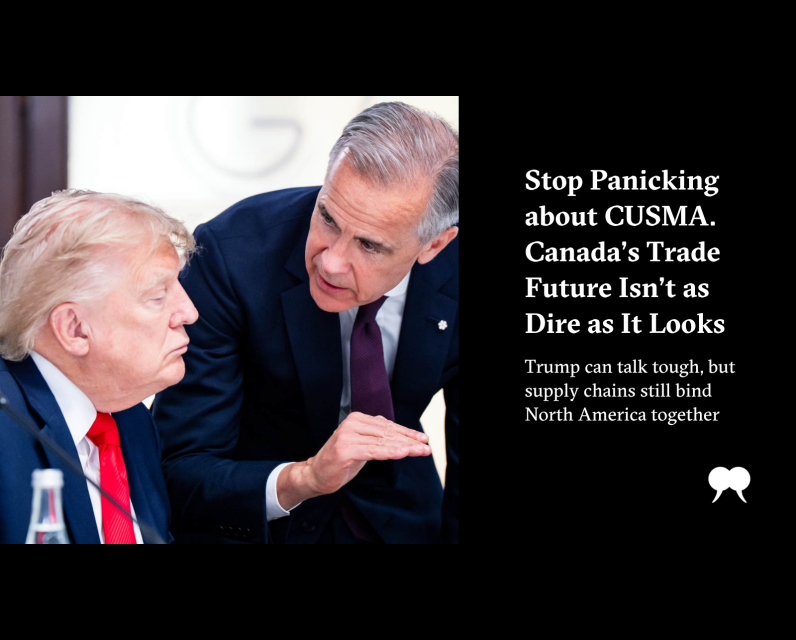
A disturbing effect of the Trump era is how the most routine bureaucratic exercises become freighted with existential panic. Case in point: the mandatory review of the Canada–United States–Mexico Agreement, set to begin in a few weeks. Signed in 2018 to replace the earlier North American Free Trade Agreement (NAFTA), CUSMA is the playbook that allows North America to function as a deeply integrated market rather than three separate ones. It establishes common rules for everything from auto manufacturing to agricultural exports.
Despite having negotiated it himself, Donald Trump has attacked the CUSMA deal relentlessly. He has slapped tariffs on Canadian steel and aluminum, openly mocked our sovereignty, and declared that Washington may no longer need the pact. The drumbeat of reporting over the coming sit-down with US officials might have you believing we are headed for gladiatorial combat, and not besuited teams working out the fine print of customs classifications and supply chain logistics.
In this world, Pascal Chan, who helps lead the Canadian Chamber of Commerce, has emerged as a kind of trade whisperer, translating the more complicated, anxiety-ridden debates about our economic relationship with the US.
With the CUSMA nerves running high, I called Chan over Zoom to ask how we should be thinking about what happens next. Our exchange has been edited for clarity.
What has surprised me is how hostile the US has been heading into this review. Their message is basically a middle finger. Maybe we can start with how you understand this moment. What, right now, is the state of play?
Around here we use the metaphor of shadowboxing. We’ve seen a number of threats from the US president over the course of the past year and a half. Some materialize. Some remain words on Truth Social. At different moments, the administration has fixated on electric vehicles, the use of the Gordie Howe International Bridge, fentanyl, border crossings, even the ad Ontario premier Doug Ford ran during the Super Bowl. A lot of these things are raised as irritants, then become conditions that supposedly need to be addressed before broader negotiations can proceed. But with the sudden shifts the negotiators have had to contend with, it’s difficult to know what’s real. From a shadowboxing perspective, you can stand in front of the mirror and work on doubling the jab straight right, left foot to the body. But if you don’t even know if you’re facing a righty or a lefty, it’s going to make it pretty tough to formulate a game plan, much less execute.
What is the game plan?
You build the team. We’ve got Mark Wiseman as Canada’s ambassador to the US, and we’ve got Janice Charette as the chief trade negotiator to the US, underlined by her experience as clerk of the Privy Council as well as secretary to the cabinet. That means she has a comprehensive understanding of how the various federal government departments fit into the puzzle, along with a pre-existing reporting relationship with so many of the heads of those departments. So the game pieces are all on the board. It’s a strong signal from the prime minister that this is going to be a whole-of-government effort.
You’re squaring off against an administration that believes that it doesn’t need anything from Canada. How do you negotiate? What incentives can you offer?
We’ve heard the White House say they don’t need Canada. Whether they genuinely believe that is another thing. US businesses, and an overwhelming number of economists, don’t share that view. Going back to threats around the opening of the Gordie Howe Bridge, as an example, there was an response from the governor of Michigan who said the bridge—which we paid for, by the way—was a “huge boon” to her state. Months ago, Detroit Regional Chamber of Commerce said, “Canada is more than a neighbour. It’s critical to our economic future.”
But Trump clearly doesn’t care what Michigan’s governor thinks. So how does that help you?
Because she represents cold, hard reality. The incentive for Washington to negotiate is the same it’s always been. Basically, you can’t take what will be a loss—no renewal—and declare it a win. I think even Trump knows that. There’s a reason these trade conversations have been ongoing despite all his bluster. Pretty much everyone agrees a deal is better than no deal.
Why is a deal better than no deal? Why not tell Trump, “No thanks,” accept the short-term pain, and build a more diversified economy over the long run? Why is a renewal so urgent?
You have to start with the extraordinary degree to which our economies have been integrated. Keeping an agreement in place is critical for the manufacturers, suppliers, and workers on both sides of the border that have built their businesses around the expectation of relatively frictionless trade. Look at the auto sector and the way parts will cross the border up to seven or eight times before they get to a completed product. Roughly 85 percent of goods still move freely under CUSMA, even with punishing tariffs on steel, aluminum, and softwood lumber. A renewed agreement remains the most beneficial, least disruptive path for everyone. We’re better off building together and creating jobs together.
What would a trade win look like? What’s the minimum that would bring enough benefit to make the deal worth it?
What’s in a deal are typically the things both parties agree on. Things we don’t have alignment on don’t end up in a deal. So a win is a deal that has more of the latter than the former. Ideally, it would look modernized and get us provisions around digital trade and artificial intelligence without tearing up what’s already working in the current agreement. I’m not about to get into the line-by-line details, but at a high level, it would be something both sides can legitimately feel good about, something with tangible policy progress that proves it’s more than smoke and mirrors.
We recently reported on the US hunting for alternative sources of potash they get from us. Does that worry your colleagues? Is there a sense that Washington increasingly sees Canada as a stopgap partner—useful for now, but ultimately looking to replace us wherever it can?
They can definitely try to find other sources for the things they import from us. But supply chains are stubbornly real things: they don’t exist because of American goodwill. They exist because they are what’s most affordable and efficient for everybody involved. We don’t have a trade deal with the US just because we’re neighbours. We have one because it makes economic sense.
Explain that a bit more.
Just look at some of the things we trade with them. Canada is the largest source of American energy imports, accounting for 60 percent of the crude oil, 85 percent of the electrical energy, and 100 percent of all natural gas. Switching that won’t be easy. In fact, it will be quite costly. You mention potash. Canada accounts for nearly 85 percent of potash imported into the US. You’ll probably recall that after Trump imposed a blanket 25 percent tariff, they lowered the tariff on fertilizer to 10 percent because there was such a negative reaction from Republican lawmakers in states where farming is economically critical. Could the US get potash instead from, say, Belarus? I guess. But it’s harder to justify when those sources are so far away, come with added shipping costs, and operate in less politically aligned jurisdictions. That’s what I mean when I say the most powerful factor in these negotiations will be the math.
So, you’re not worried?
There’s always the possibility the US will try to secure alternative sources for its needs, including near-shoring. Our business data lab has done myth-busting research on this question. Basically, the conclusion is always the same: reversals would be expensive and self-sabotaging. It would take a long time just to return to where the status quo is now.
You describe a situation where there are certain economic realities that even Trump can’t wish away. But he can still try. Which means there’s a non-negligible chance we don’t get a deal by the deadline—or, at least, not the deal Canada wants, on the timeline everyone is hoping for. What happens then? Does our economy just ground to a halt?
There’s concern that if we don’t get to a renewal right now, everything falls apart. That’s not the case. We just go then into an annual review cycle every year. Sure, if we can hit a renewal now, that’s great. It extends the duration of the agreement. But the practical effect of a failed renewal is more uncertainty, not instant collapse. Annual reviews give us repeated chances to extend the deal, but they also create a period of instability for businesses making long-term decisions.
That makes it sound like disaster is still far off, but I don’t think you would be good at your job if you weren’t planning for the worst-case scenario.
We have. The harsh truth is Canada has been complacent about expanding and diversifying trade because we were comfortable with our relationship with the US. The Chamber of Commerce has been warning about this for a long time. We’ve been talking about the need to invest in trade infrastructure, in export capacity, in our ability to move goods abroad more reliably, in major projects that can get resources to the markets that want them. We’re finally taking steps. I would say there’s been a renewed focus because of this turmoil with the US, and public opinion has moved with it. Bank of Canada governor Tiff Macklin said we should have been doing this fifteen years ago but that the next best time to do it is now. We’re finally here.
But none of that will be fixed before CUSMA has to be renewed.
You’re right. We’re not going to shift all of our trade to the port of Vancouver or the port of Montreal overnight and suddenly replace everything we do with the US. It’s going to take time. But there’s a lot we can do now. There was the team Canada trade mission to Mexico a few months ago, for which we organized a kind of a side mission. Despite the fact we’re part of a trilateral free trade agreement with them, they account for 3.6 percent of our total trade. I was shocked when I saw that. We already have great trade agreements with a lot of countries. The challenge now is building the capacity to actually trade with them at scale.
But that’s just one piece of the equation. The other is getting our own house in order. That means making progress on internal trade. We have to give credit where credit is due. In the past year, the federal government removed all remaining federal exceptions in the Canadian Free Trade Agreement. There was the mutual recognition agreement on the sale of goods, excluding food. And there was also further progress on trucking, labour, mobility, financial services, as well the issue everybody loves to talk about: direct-to-consumer alcohol sales.
So there are two tracks here: the outward-facing piece and the inward-facing piece. We need to improve our ability to trade with the rest of the world while making it easier to do business within Canada. Those pieces won’t eliminate our dependence on the US overnight. We can’t change geography. The US will always be a trading partner. But we can make sure it’s not our only option.
The post Stop Panicking about CUSMA. Canada’s Trade Future Isn’t as Dire as It Looks first appeared on The Walrus.
Unpublished Newswire


Comments
Be the first to comment