
Stay informed
Unpublished Opinions



How BlackBerry Staged a Comeback by Winning Over Car Companies
Dubbed “Crackberry” by ardent users—Webster’s New World College Dictionary proclaimed it the Word of the Year in 2006—the impact and influence of the BlackBerry device in the early 2000s could be found everywhere. It featured in pop song titles and explicit rap lyrics; Kim Kardashian was a loyal user; former United States president Barack Obama famously said he was “clinging” to his BlackBerry and that they would have to “pry it out of [his] hands” when he entered office.
Key points- After BlackBerry’s mobile business faltered, the company pivoted to cybersecurity and software
- QNX, an operating system acquired and owned by BlackBerry, now brings in half of the company’s total revenue
- QNX is a critical component used in cars, medicine, and nuclear power due to its ability to handle precision timing
The Blackberry was the signature product of Research In Motion, or RIM. Founded in 1984 by University of Waterloo engineering students Mike Lazaridis and Douglas Fregin, the company paved the way for future smartphones. At its peak in 2009, it commanded at least 43 percent of the US market and 20 percent of the international market. By 2011, 77 million annual subscribers couldn’t get enough of the seemingly indestructible devices and their tactile QWERTY keyboard buttons. But new smartphones, such as the iPhone and Android, kept eating into Blackberry’s market share. Fortunes dwindled quickly, and the company officially changed its name to BlackBerry in 2013 to signal both a fresh start and to maximize on the brand recognition. But within months, a “for sale” sign was up, though ultimately, there would be no deal.
By 2016, the company’s market share had nosedived to 0 percent, according to research firm Gartner. That same year, the company announced it would no longer manufacture its own devices and outsourced production to Chinese electronics company TCL. In January 2022, the company formally decommissioned the BlackBerry service, shutting down the software and infrastructure that underpinned its legacy mobile devices. You might still find BlackBerry-branded phones in the wild, running on Android, but as far as the public was concerned, BlackBerry seemed relegated to the history books.
Yet the groundwork for the company’s future was laid more than a decade earlier, when RIM bought QNX (pronounced “Q-nix”) for $200 million in April 2010. Founded in 1980 by another pair of University of Waterloo students, Gordon Bell and Dan Dodge, QNX was an operating system that would become part of RIM’s strategy to beef up future BlackBerry devices. As its core mobile business faltered, however, the company began pivoting to cybersecurity and software for Internet of Things (IoT) under the helm of then chief executive officer John Chen, who had been brought in to save a business that was “just days away from potential bankruptcy.”
Following a years-long restructuring effort that included selling 32,000 patents for up to $900 million in 2023, the smartphone pioneer that was once left for dead is showing signs of growth. As the Wall Street Journal recently described it, “the division that was once a rounding error is the reason that BlackBerry is suddenly making money again.” Thanks to QNX, which now brings in half of the company’s total revenue, BlackBerry managed to eek out five straight profitable quarters by mid-2026—a milestone not seen since the heyday of BlackBerry phones.
The company has also recovered something even rarer than profits: the ability to matter.
For years, BlackBerry has been quietly carving out a role as the go-to software technology for critical systems in cars, medicine, and even nuclear power plants because of QNX. If you drive, it probably had a hand in getting you from point A to point B. And if you’ve ever had an X-ray or CT scan, you can probably thank BlackBerry for that too. Like its once-ubiquitous phone, BlackBerry is still everywhere—we just don’t see it.
In medicine, QNX is used by 90 percent of medical device manufacturers in more than fifty different types of devices, including diagnostic imaging, therapeutics, and surgical robotics.
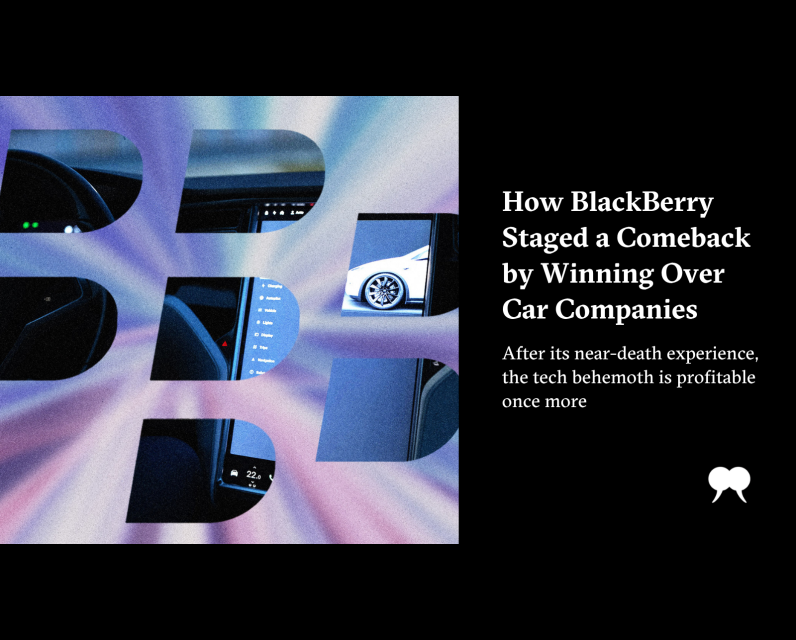
This invisible infrastructure has also become an automotive standard, serving as the brain for running your car, helping to power and manage everything from the dashboard to the cameras and safety sensors monitoring your surroundings to the music you listen to. Advanced Driver Assistance Systems (ADAS), technologies such as adjusting car speed to maintain a safe distance, monitoring blind spots, and automatic emergency braking, depend on QNX. According to company figures, QNX software is embedded into more than 275 million cars around the world as of May 2025. More than 270 makes and models use it, including those from the world’s top ten automakers, the top five Tier 1 suppliers, and twenty-four of the twenty-five top electric vehicle makers. Industry reports estimate nearly 40 percent of the market uses QNX.
QNX won over car companies for several reasons. The software is designed to handle jobs where precision timing—as little as microseconds—can be a matter of life and death. Whether it’s the deployment of airbags and car brakes or pacemakers and infusion pumps (devices that deliver controlled and specific amounts of fluid intravenously to a patient), the system always prioritizes critical tasks and completes them within a precise and predetermined deadline. In industry terms, they call this type of design a real-time operating system (RTOS).
The software’s architecture, known as a microkernel, is also designed to be as secure and fail-safe as possible. Most of us are more familiar with traditional “monolithic kernel” models like Microsoft Windows—whose design places all operating system functions in a single kernel, or core program. It has its advantages, but if something goes wrong, the entire system can crash, which is not what we want in our cars, medical devices, flight control systems, or nuclear power plants. With a microkernel, catastrophic system failures are minimized because it is more resilient and reliable. Each application or process is isolated from one another, so if one malfunctions or is attacked, only the affected component gets a reboot, while the rest of the system remains intact. This also makes it difficult to seize complete control of an entire system.
QNX also comes pre-certified for the highest level in automotive safety and security and pre-integrated with other systems, which helps carmakers save time and money.
While there is other similar software out there, global industry leaders seem to prefer QNX—at least for now.
While it has made significant inroads across a number of industries, including robotics companies, its positioning in the rapidly evolving automotive sector is attracting the greatest attention. As carmakers transition to “Software Defined Vehicles” (SDVs)—cars whose core functions are managed and updated through software instead of physical hardware—analysts and shareholders seem cautiously optimistic about BlackBerry’s future.
Globally, 28 percent of all cars sold in 2026 are projected to come from EV sales. So far this year, those sales are breaking records in more than two dozen countries, according to the International Energy Agency. China, the world’s biggest manufacturing hub for EVs, accounted for nearly 75 percent of EV production last year and continues to be a leader in EV innovation. A slew of partnerships with Chinese firms, including a deal with autonomous driving tech company WeRide, has only deepened QNX’s commanding market share in China and overall global footprint.
Meanwhile, notable partnerships with industry leaders like NVIDIA, the dominant global hardware and software supplier for artificial intelligence, data centres, and autonomous vehicles, are bolstering the company’s broader ambitions for QNX in the emerging field of physical AI, which allows autonomous machines like surgical robots to perform intricate tasks, such as threading a needle, and warehouse robots to avoid obstacles and human traffic.
BlackBerry’s turnaround proves that reinvention is possible. When Chen was brought in to resuscitate the company, he cautioned against complacency, noting that losing that sense of urgency can be “fatal.” Competing against tech giants meant focusing on one’s strengths, he said. For BlackBerry, that was security and privacy.
QNX hopes its innovative platform can capitalize on the accelerating growth in EVs and the AI explosion. But among the lessons AI has taught us is how quickly things can change and how easily fierce competition can potentially topple industry leaders. It’s a lesson BlackBerry learned nearly two decades ago and will likely remember going forward.
The post How BlackBerry Staged a Comeback by Winning Over Car Companies first appeared on The Walrus.
Unpublished Newswire


Comments
Be the first to comment