
Stay informed

Premiers need to give leeway for feds to negotiate hard with Trump, trade analysts say
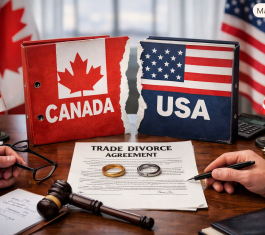
OTTAWA – With Canada set to intensify trade negotiations with the U.S. in the coming weeks, trade analysts say the premiers must give the federal government latitude to negotiate from a position of strength.
“The premiers are going to have to give the federal government the political licence and the social licence to make some of those difficult decisions when it comes down to negotiating,” said Matthew Holmes, executive vice-president & chief of public policy at the Canadian Chamber of Commerce.
The U.S. administration has announced its intention to impose a 50 per-cent tariff on range of Canadian goods last week, in response to what they view as unfair trade practices from Canada on dairy, U.S. alcohol moratoriums at the provincial level and auto tariff quotas. The tariffs would be imposed under Section 338 of the Tariff Act of 1930.
In response, Prime Minister Mark Carney said he and U.S. President Donald Trump have agreed to “intensify” negotiations in the coming weeks, ahead of the tariffs coming into effect on Aug. 19.
Canada-U.S. Trade Minister Dominic LeBlanc was in Washington this week, along with Chief Trade Negotiator Janice Charette, where they met with U.S. Trade Representative Jamieson Greer.
Greer said told U.S. senators last week, that he hopes to have potential “interim” agreements with Mexico and Canada separately, by the end of 2026. While broader issues like rules of origin related to the Canada-United-States-Mexico-Agreement (CUSMA) will be addressed in 2027, as it requires engagement with U.S. Congress.
Carney has said that Canada is looking for a comprehensive agreement around the Section 232 tariffs that currently apply to Canadian steel, aluminum and autos, and would not rule out retaliation, should the latest Section 338 tariffs go through.
The prime minister this week ruled out cutting oil exports to the U.S., arguing there are “other things” Canada has at its disposal.
Maryscott Greenwood, former U.S. diplomat and founder of Ottawa Street Strategy, said while Canada up until now has been proportional and reasonable, it is now time for Canada to use its leverage.
“It’s about leverage, and it’s about being willing to exercise leverage and making sure that Canadians, writ large, the business community, the public, regardless of where they’re from geographically or what sector they’re in, give the government the leeway it needs to be tough and to negotiate what’s in the best interest for Canada,” she said, adding that it’s easier said than done.
The premiers met in Charlottetown last week, with Trump’s latest tariff threat overshadowing the agenda. All the premiers had strong views on the best course of action in the face of the new tariff threat.
Quebec Premier Christine Fréchette called for provinces to have a seat at the negotiating table, while B.C. Premier David Eby and Ontario Premier Doug Ford offered ideas on possible retaliation, including leveraging potash, energy and critical mineral exports to the U.S. At the conclusion of the first minister’s meeting, premiers touted a united front, but Holmes is not convinced it will last if the trade war persists.
“The longer we go, the more daylight there is between all of the premiers, and there was a shockingly long honeymoon for Carney with the premiers, but they’re not going to stay on the same page,” said Holmes. “We’re a very decentralized country constitutionally.”
Mark Warner, trade lawyer at Maaw Law, said he is puzzled by the trade strategy Carney has demonstrated so far.
“I just wonder what Mark Carney’s agenda is,” said Warner. “It’s kind of like he doesn’t want to have an agreement, to me.”
Warner also isn’t convinced the Canadian government has been willing to risk anything to obtain a deal with the Americans.
“It doesn’t seem to me that what the government is doing is in any way conducive to having a real negotiation, and up until this point, it doesn’t strike me that Mr. Carney is inclined to use any political capital whatsoever,” he said.
“Somebody who’s that further ahead of his opposition in the polls, it seems odd that he wouldn’t want, wouldn’t be willing to risk some of that to try to get to an agreement,” he added.
A recent poll by the Angus Reid Institute said public confidence in Carney’s ability to secure a deal has dropped since the spring, falling from 53 per cent to 43 per cent who now believe Carney can deliver a good outcome.
Warner said he’s not convinced the Americans are willing to have a conversation about Section 232 tariffs, which could be the source of a stalemate between the two negotiating parties.
Holmes views the current state of negotiations like a game of chicken, which could prove dangerous with an economy that is bigger than Canada’s.
“There is a little bit of a game of chicken that starts to be played, and that’s dangerous because you know they’re driving… a much bigger truck,” he said.
National Post
Our website is the place for the latest breaking news, exclusive scoops, longreads and provocative commentary. Please bookmark nationalpost.com and sign up for our newsletters here.

Unpublished Newswire

Comments
Be the first to comment