
Stay informed
Unpublished Opinions

Carney's lead over Poilievre may be more about vibes than policies, new poll suggests
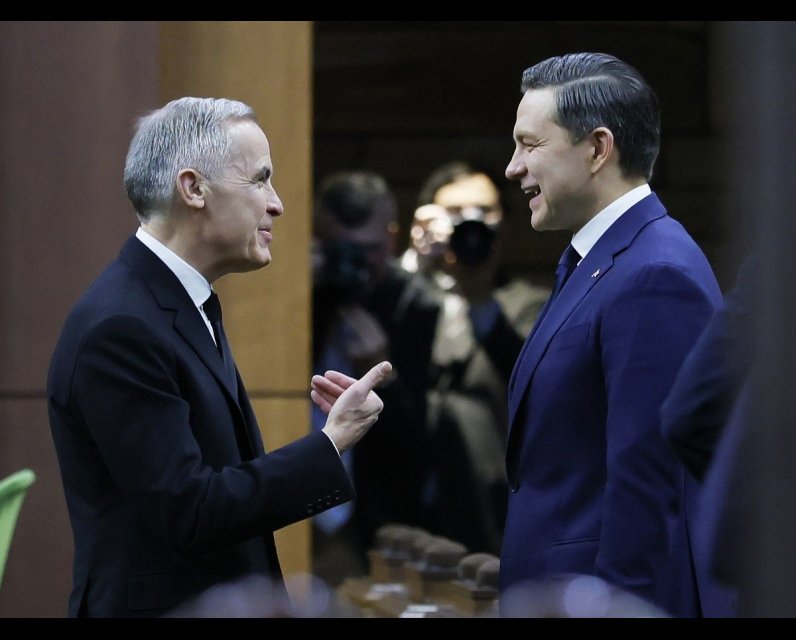
OTTAWA — Do Canadians currently prefer Prime Minister Mark Carney’s ideas over those of Conservative Leader Pierre Poilievre’s or do they simply trust Carney more than Poilievre? A new Leger poll suggests the difference between the two may largely be based on vibes.
To test the theory, the Postmedia-Leger poll chose six policy positions on which Mark Carney’s Liberals and Pierre Poilievre’s Conservatives broadly share similar objectives, even if their proposed approaches may somewhat differ.
The 1,514 online poll sample was then randomly split into two equal groups: 757 respondents were asked how much they trusted Carney on each policy when he said they were good for Canada, while 757 were asked the same questions about Poilievre. The policy positions were identical for both groups; only the leader referenced in the questions changed.
The results were unequivocal: no matter the policy, respondents trusted Carney more than Poilievre when either man said a policy would be good for Canada. The gap ranged from nine to 14 points.
That’s roughly the same lead the Liberals have held over the Conservatives in polling since Carney was elected prime minister last spring, Leger executive vice-president Andrew Enns noted in an interview. In this poll, despite a two point drop, the Liberals (46 per cent) still hold a 12 point lead over the Conservatives (34 per cent).
The poll suggests that while Carney’s reputation still affords him the benefit of the doubt from Canadians, Poilievre still has a tone and image problem to overcome if he wants to defeat the Liberals, Enns added.
The pollster noted that while Poilievre has years of political “reputational baggage,” Carney is still a relatively new politician with professional experience that clearly impresses many Canadians.
“You look at the two party leaders from a substance standpoint; they’re coming at things very similarly. (Carney’s) got probably more of a resume advantage… and probably has a style advantage. Or maybe Poilievre has the style disadvantage because… he generates a pretty negative reaction for a lot of people, just seeing the guy,” Enns said in an interview.
The policy positions put to respondents of the poll were that Canada needs to:
- dramatically speed up the construction of major infrastructure and energy projects;
- increase its energy production and build new pipelines;
- allow fewer numbers of immigrants into Canada;
- negotiate a trade deal with the United States even if some concessions need to be made by Canada;
- significantly increase spending on Canada’s military to meet NATO commitments and protect the Arctic;
- grow its energy sector and still make meaningful progress in meeting our global warming and climate change commitments.
The biggest trust gap (14 points) was on Canada’s need to significantly increase military spending. A clear majority (60 per cent) of respondents who were asked if they trusted Carney when he said that, whereas Poilievre only garnered the trust of 46 per cent of his respondents.
The lowest trust gap (nine points) was on trust in developing the energy sector while still making progress in climate change commitments. There, 56 per cent of Carney questionnaire respondents said they trusted the prime minister when he said it was good policy, whereas 47 per cent said the same of Poilievre.
And both leaders got their lowest trust scores when it came to the proposal that it’s important for Canada’s economic future to negotiate a trade deal with the United States even if some concessions need to be made by Canada. Half of those asked if they trusted Carney on that policy said yes, whereas 38 per cent said the same when it came from Poilievre’s mouth.
“I think that’s a sign of you know a significant number of Canadians don’t want to make any concession, and so that, by its nature, kind of lowered it on both,” Enns noted.
What also jumped out at Enns is how, for most of those now-popular policies, Poilievre was pushing his proposals well before the Liberals adopted them under Carney. The results suggest the Conservatives don’t need to make significant policy adjustments but need to focus on the leader’s image, demeanour and communication style, he said.
“For a lot of opposition leaders, you know, a lot of times they’re on the wrong side of too many policies, and that that needs to change. But in this case, I would say the Conservatives aren’t that far off the mark from a policy standpoint,” said Enns.
While voters were ready to “hold their nose” and vote for Poilievre at the end of Justin Trudeau’s time as Liberal leader, the same does not hold true any longer with Carney, he said.
“If I was a Conservative strategist, I think they they might have been more careful with their leader brand at that time,” he added. “I think they were they were building up some personal negatives around around the leader, and now I think those are those are kind of haunting them a bit.”
The Leger poll sampled 1,514 Canadians online between Aug. 1 and 3, 2026. For comparison purposes, a probability sample of this size yields a margin of error no greater than plus or minus 2.5 per cent (19 times out of 20) for the sample.
National Post
cnardi@postmedia.com
Our website is the place for the latest breaking news, exclusive scoops, longreads and provocative commentary. Please bookmark nationalpost.com and sign up for our politics newsletter, First Reading, here.

Unpublished Newswire

Comments
Be the first to comment