
Stay informed
Unpublished Opinions

How Canada's best-known 9/11 widow became a fierce advocate for terrorist victims
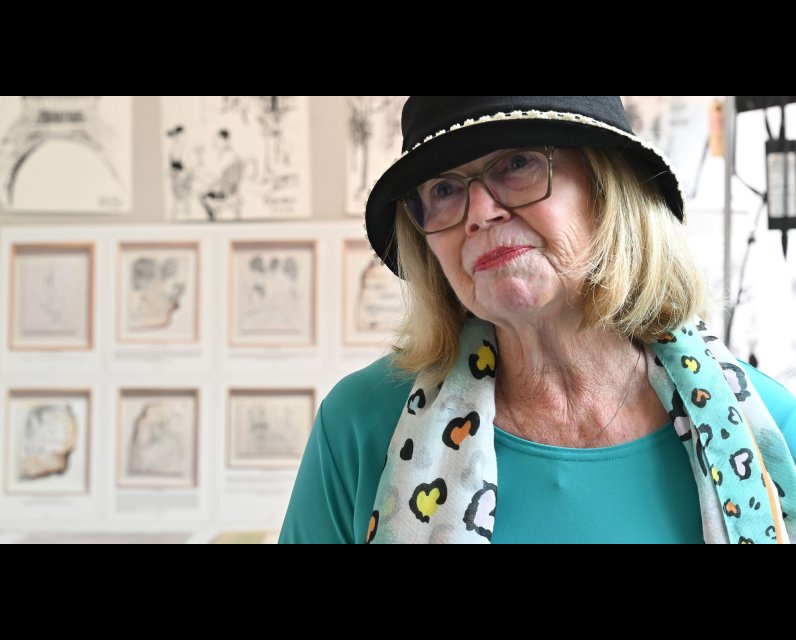
Maureen Basnicki, her car stuffed with frames swaddled in blankets and bubble wrap, finally found a good spot to park in midtown Toronto just as artist John Coburn emerged from his studio to help unload.
“This one is special,” she cautioned, touching the thickest frame. Inside the deep shadow box sat a U.S. flag folded into a tight triangle, its white stars on deep blue cloth identical to those seen in a thousand movie scenes of American military funerals.
Although the folded flag is a marker of death, neither of them seemed unsettled, perhaps because their whole enterprise that day was spawned by murder. Death and destruction were how they met and this recent reunion was to prepare for the 25th anniversary of 9/11, the deadliest terrorist attack in history.
Maureen Basnicki, 75, has the misfortune of being Canada’s best-known 9/11 widow after her husband, Ken Basnicki, was one of thousands killed in the attacks on Sept. 11, 2001. John Coburn, 69, became woven into the fabric of 9/11 through his extraordinary artistic venture among the rubble of Ground Zero in New York City.
Next week marks a grim anniversary, an observance of a milestone remembering one of the most cataclysmic and stressful days of modern history, when al-Qaida terrorists, a jihadist group, hijacked four U.S. passenger airliners and used them as deadly weapons. Two were crashed into skyscrapers in the heart of New York, one into the Pentagon, the headquarters for the U.S. military, and a fourth crashed in a field before reaching its target when passengers tried to take back control of the plane.
For the world, 9/11 changed global politics, security, travel, policing, privacy, social cohesion and much more, but for the families of the victims, it reshaped everything else.
Twenty-five years later, its impact is still felt. Twenty five years. The importance of this anniversary isn’t so much its milestone number, but the substantive passage of time it signals. It reminds Maureen an entire generation had not yet been born on 9/11; that generation Z has no personal memory of it, and she fears they won’t grasp its enormity.
Alongside dealing with her personal trauma, Maureen has been using those years to solve that conundrum, and trying to tilt the legacy of 9/11 from just the evil toward something good. In the process, she has become a prominent champion for victims, public safety and prevention of mass violence. She has forged new law, sparked awareness and even changed Canada’s calendar, but — always the advocate — she says more needs to be done.
If 25 years is long enough to forget, it is long enough to create change.
“It wasn’t just my life that changed,” she said, “it was all of us that changed.”
Horrors of Sept. 11, 2001Ken Basnicki was 48 and had never been to New York City.
He was the Canadian marketing and sales rep for a U.S. tech firm that specialized in financial transaction processing. Ken had recently been promoted and was invited to an international finance technology conference in New York on Sept. 11, 2001.
The conference was at an exciting venue, high up in one of the distinctive twin towers marking New York’s skyline. Once the world’s tallest, the skyscrapers were each 110 stories, with their iconic presence flowing from height rather than beauty.
“He didn’t want to go to New York. He was there to network, as they say in business, to introduce himself in his new capacity,” Maureen said. “He was going into management so that he could spend more time with his family, ironically.
“Ken reassured me, he said, ‘Maureen, this is going to give me more time with you.’” Ken left for New York on Sunday afternoon after he and Maureen planned a date night for when he returned.
Maureen was a flight attendant for Air Canada. The next day, Monday, she left Toronto as well, working a flight to Frankfurt, Germany.
Around 8:30 a.m., New York time, on Tuesday, Sept. 11, Ken joined about 80 other delegates at the conference on the 106th floor of the North Tower in the World Trade Center. Breakfast was being served.
At 8:46 a.m., American Airlines Flight 11, which had been hijacked by five terrorists shortly after takeoff, was flown into the northern face of the North Tower, crashing into floors 93 through 99 and destroying all downward exits for floors above.
At 9:03 a.m., United Airlines Flight 175, similarly commandeered by five terrorists, was flown into the South Tower.
It was almost 3 p.m. in Germany when the first plane crashed in New York.
Maureen, along with the rest of her flight crew, was staying at a hotel in Mainz on a layover, waiting to staff a return flight to Canada. The hotel by the Rhine River was popular with flight crews; employees from Air Canada, United and American airlines were all staying there.
Maureen was unaware of what was unfolding across the sea. In her hotel room, she tuned the TV to CNN, a travel habit to catch English-language news. She was jolted by scenes of an aviation disaster and as she watched, she felt her life begin to crumble.
“I watched with horror what was happening, knowing that Ken was in New York.” She needed to reach him and hear he was safe. Ken had a cellphone, uncommon at the time, but she did not.
“I ran down to the lobby and there was a buzz around the hotel. I gave the concierge woman the number of Ken’s cellphone and I said, ‘Call this number. My husband’s in the World Trade Center.’ I had such a look of horror on my face that nobody questioned me. She didn’t even hesitate. She called that number and I got his voice-mail message.”
Maureen then called her mother. “I said, ‘Mom, something horrible has happened.’ She didn’t even let me finish. She said, ‘Where are you, dear?’ And I said, ‘I’m in Germany, Mom.’ She said, ‘Can you come home?’ So, my heart sunk and I said, ‘Oh, Mom, have you heard from Ken?’ And she said, ‘Yes, we have, he called his mother.’
“So, then I had optimism again. And I said, ‘What did he say?’ And she told me honestly, that he said, ‘Mom, something horrible has happened. I’m on the 106th floor of the World Trade Center. The room is full of smoke and I don’t know how I’m going to get out.’
“So, you can only imagine,” Maureen said, her voice trailing as emotion — even with edges sanded by 25 years — caught her.
At 9:37 a.m., the hijacked American Airlines Flight 77 hit the Pentagon.
At 9:59 a.m., the South Tower of the World Trade Center collapsed. At 10:03 a.m., United Airlines Flight 93 crashed into a field in Shanksville, Pa., as its passengers mounted a fight against their hijackers.
At 10:28 a.m., the North Tower of the World Trade Center also collapsed.
Trapped overseasMaureen went searching for her Air Canada flight director.
“I grabbed him by his collar and I said, ‘I want to go home. I’m booking off.’ That was a term we used for unable to work. And I said, ‘I need to go home. Ken is in the World Trade Center.’ And he sat me down gently and he said, ‘Maureen, you can’t go home right now. The skies are closed.’”
Shortly after the third airliner hit the Pentagon, U.S. airspace was completely shut down for the first time in history.
Arriving aircraft were ordered to turn around and land wherever they could. Canadian airspace was shut soon after, except for landing diverted U.S.-bound planes; 239 flights that had passed the halfway point were rerouted to 17 airports in Canada, requiring towns and cities to absorb 33,000 stranded passengers in what was called Operation Yellow Ribbon.
While those diverted passengers, mostly Americans, were buoyed by safe refuge and a heartwarming Canadian welcome, Maureen was stuck in Germany and falling apart.
“I was trapped overseas. Without sounding dramatic, you know, the crew had to keep me from swimming across the ocean. I felt like Dorothy in The Wizard of Oz. All I wanted to do was get home and be with my children.”
Ken and Maureen were living in Toronto’s west end in 2001, and they rarely travelled at the same time so that one of them was home for their two children. This time, however, with their son Brennan having turned 16 and their daughter Erica 21, they made their travel plans. Brennan was waiting for his dad to return so he could get his driver’s licence. Erica was starting her second year of university in Toronto studying journalism.
With all flights cancelled, however, all Maureen could do was talk to her distraught children on the phone over four painful days.
“We each played a sort of game in our phone calls, saying if anybody could get out from the 106th floor, if anybody could escape, it would be Ken. He was a physically fit guy, and that number of stairs wouldn’t have been something he couldn’t handle.
“I pretended to my kids to have hope that he would be one of the survivors … I still wanted to believe in my mind that he had escaped, but I knew in my heart that my husband was dead.”
Despite medication, she could barely sleep.
“I was wide awake with the television on. I kept watching TV because I wanted to see him in the crowd of survivors. Looking back, maybe that wasn’t a good thing because it’s not something that I can erase from my mind.
“I’m being graphic here, but the 106th floor was referred to as the jumper floor, it’s where people chose to jump from the (burning) tower. And the fact that he was on the jumper floor is also not something that I can erase from my mind, although I do everything possible not to dwell on it.”
By the time Maureen was back in Canada, the global importance and overwhelming interest in 9/11 meant the Basnicki family’s grief was never particularly private. It took a toll and much adjustment.
For Maureen, her time as a flight attendant was over.
“It wasn’t a fear of flying,” she said. “I loved my job as a flight attendant. It was the trauma that prevented me from going back to work.” A therapist she was sent to by the airline’s insurance company told her to return to work six weeks after 9/11, Maureen said.
“When she suggested that going back to work was like getting back up on a horse, that it would be good for me to get back in an airplane, I looked at her and I said: ‘An airplane was used as a weapon to murder my husband.’”
The aftermath of 9/11Looming alongside grief was the reality of finances. Without either of the couple’s income and facing a growing list of costs from his death, she felt she was drowning all over again.
“It was very expensive being a victim of terrorism,” she said.
In the United States, families of the victims have access to a wide range of support and assistance. The 9/11 Victim Compensation Fund, which was reopened in 2011, is still settling claims for U.S. families and first responders with more than US$18 billion already spent.
The quirk of geography put the Basnicki family in a tough spot. As Canadians living in Canada, they were not eligible for most of the U.S. funding. Most of the other Canadians killed in the attacks lived in the United States.
She flew to New York and was handed Ken’s plastic AT&T calling card, which was used in those days to reduce the cost of long-distance phone calls. “The card was burnt on the edges but, sure enough, you can read Ken’s name, Ken Basnicki. And it’s comforting. Those kinds of things are comforting,” she said.
“What is even more shocking is that eventually, I believe it was around a year later, I got my first shipment of body parts. Suddenly body parts were found and it made his death certificate invalid. Who has ever heard of an invalid death certificate? And so, I had to reapply for another death certificate because it was now inaccurate.”
Nor was there the machinery of sympathy and care in Canada that erupted in the United States to help survivors and victims.
Some months after the attacks, Maureen was notified by a courier company that a registered envelope was waiting for her. She drove out alone to pick it up and opened it at the counter.
“It was Ken’s death certificate, and it said, cause of death homicide, no body found. I had no warning, no support with me. I was so shocked that they had to call me a taxi to take me home and I had to come back to get my car the next day.”
On another day, she answered a phone call from a New York City police official who told her they had found something in the wreckage that had belonged to Ken. She was asked if she would come and retrieve it.
As recovery efforts continued through the massive rubble at Ground Zero, where the towers tumbled, she would be notified four times over several years that DNA testing had identified more of Ken’s remains. They revealed the devastation of the attack.
“They could fit in a cigar tube,” she said.
“I had to go through a funeral parlour both in the U.S. and Canada — at each end — and I had to pay for both and pay for each shipment.”
Every discovery brought fresh pain and new expenses. Ken’s gravesite near Collingwood, where the family had moved, was dug up each time for a small addition beneath Ken’s tombstone, comprised of two dark granite pillars mimicking the shape of the twin towers. Maureen said she plans on joining him there someday.
Eventually, she called the New York medical examiner’s office and asked that no more remains be sent. Subsequent discoveries were instead sent, along with others, to an underground repository at the 9/11 Memorial and Museum in New York.
2,977 people killed, including 24 CanadiansThere were 2,977 people killed in the terror attacks on 9/11, including 24 Canadians and a few others with close ties to Canada. Most of the dead — 2,753 of them — died at the World Trade Center, including those who had been in the towers and those in the planes. Ken is one of 1,654 victims who officials have positively identified remains for — the latest identification was announced just last week.
After some victim compensation money arrived from the U.S. about three years after the attacks, Maureen heard from Ottawa. It was not an offer to help her; it sought to tax her.
“I had to fight the federal government. They wanted to tax the fund money. They wanted to treat it like winning a lottery.” Even then, she said, while U.S. lawyers were clamouring to help U.S.-based victims for free, in Canada, Maureen said her legal fees on both sides of the border were about $180,000.
Maureen found her tasks as a victim in Canada onerous and confusing and her support and assistance scant.
She realized that remembering 9/11, talking about Ken’s murder, meeting with other victims, and doing interviews was her safety net rather than an anchor. She had found new purpose.
“I remember all these things being thrown at me, and I remember thinking, there’s no way anyone should be put through what my family and I were. And I’ve got to do my best to make changes for future victims of terrorism or anybody (who) suddenly finds themself traumatized in mass murder. In my mind, it was going to happen again, and I didn’t ever want to be saying, ‘I told you so’ and have us not prepared.
“I’m the kind of woman who goes to a movie and wants a happy ending,” she said. “But there’s no happy ending to 9/11. There’s no finality. There’s no closure, for me, at least, not yet. It’s a constant daily battle for me, really. But I wake up with a purpose, and that purpose is for all of us to never forget.
“But how can we get people to remember it?” she said.
“I wanted an appropriate way in Canada, because certainly the memorial down in New York is terrific. It’s powerful and I can go there. But in Canada, I never wanted it to be treated like just an American event with an American solution. It was a global event.”
Sept. 11 proved the world could change in a day. She wondered what good could happen in a day if people just made the effort. She took inspiration from the Canadian response on 9/11 after the attacks.
“It occurred to me that people don’t want to embrace hate and horror. People don’t want to celebrate wars they haven’t won or anniversaries that are hard. We haven’t won the war against terror, but that day didn’t just take the life of my husband, it was an attack on our values.
“And I decided to concentrate on our values and the outpouring of kindness and humanity that ensued from the general public. It was just amazing. And I wanted to dwell on the goodness of mankind.
“Which would you rather go to, a funeral or a celebration of life?”
She started advocating for Sept. 11 to be a day of gratitude and service, a day for helping others and thanking those who serve — not just their country, but their own communities.
In 2011, the Canadian government formally recognized Sept. 11 as the annual National Day of Service. In Ontario, it was made the annual Provincial Day of Service in 2022.
“Service Day is just celebrating Canadians coming together and helping each other, regardless of who you are and regardless of what happened. It’s a Canadian value that we cherish. I want these values celebrated,” she said.
As Maureen recounted her story inside John Coburn’s Toronto studio, the artist sat mesmerized, his hand sometimes covering his mouth in horror even though he has heard it before. Every time, something new stands out, he said.
Maureen and John share a mission.
An artist at Ground ZeroNew York had long been John’s muse. Over many years, the Canadian artist prowled the city drawing its hotels, parks, neighbourhoods and people in his loose, stylish sketches that capture an essence in a few strokes of ink. Two years before 9/11, John sketched the towering skyline of the twin towers.
When the attacks brought those towers down, he felt compelled to return. Beside a Ground Zero barricade, he watched five construction workers coming out a door and he slipped in behind them before the door shut, he said.
“I walked five blocks (through) empty canyons and complete silence and found myself at the north end of Ground Zero and it was unlike anything I had visually ever looked at,” he said. He started sketching as if on autopilot. “I was in there for half an hour drawing and a police officer saw me and he said, ‘I don’t know what you’re doing here, but you’ve got to leave,’” John said.
“And out of my knapsack, I pulled a photocopy of my 1998 sketch of the towers and showed him and I said, ‘I don’t know why, but this is a journey I needed to do.’ And he looked at it and he could barely speak and said, ‘You do what you need to do,’ and walked away. So that started the journey.”
Over three weeks he sketched where the towers had stood, and then the churches and firehalls and surrounding buildings, capturing the places and faces of those who came to help and to grieve. He sketched first responders, construction workers, clergy, and families of victims. He documented the wreckage and resilience.
One spot John sketched at was St. Paul’s Chapel, a historic church across the street from the towers. The church was built in 1766 but somehow was spared when the towers fell, and it became a place of refuge and rest for recovery workers and volunteers. A chaplain there looked at John’s drawings and suggested they could carry a message of healing.
John published 37 of his sketches in a private book that was given to the families of the victims, called Healing Hearts. He met Maureen when he was trying to arrange the book on the first anniversary. It was an idea she supported.
A few years afterward, John’s studio was gutted by fire overnight. One of the few things Toronto firefighters salvaged from the wreckage was a leather portfolio containing his original 9/11 sketches. They were partially burned, some badly, but their core remained. Seeing them now, each neatly framed but scorched or burnt, if you didn’t know John’s story you might think it was an artistic flourish to echo the destruction in Lower Manhattan.
John’s artwork, like Maureen’s story, has gained its own momentum.
He donated 27 of the scorched drawings to the permanent collection of the 9/11 Museum in New York City on the 15th anniversary.
Ten of his drawings were recently flown to Toronto from the museum by the U.S. Consulate. Bolstered by additional works from private collections, they form a 9/11 exhibit running until Sept. 12 at the 918 Bathurst Centre in Toronto. As his art was being prepared for shipping from the museum, he was invited to New York to film a news documentary about it.
It was artwork and related items that Maureen was delivering to John’s studio for his show and for a National Service Day dinner she was hosting, that sparked their recent reunion.
Twenty-five years after 9/11Since the 9/11 attacks, Maureen’s advocacy has taken her places she could not have imagined. In 2002, she and her children visited the Vatican and met with Pope John Paul II. In 2013, she travelled to the U.S. Naval Base at Guantanamo Bay to watch military court proceedings against accused 9/11 planner Khalid Shaikh Mohammed and four others. The trial is still not resolved and will continue June 8, 2028.
She co-founded the Canadian Coalition Against Terror, an advocacy group to combat terrorism and support victims of terrorism. An eight-year campaign led to the Justice for Victims of Terrorism Act, a law allowing victims to sue attackers and supporting foreign states for financial compensation in Canada’s courts. The coalition has since rebranded as Secure Canada and expanded its mandate to include a wide range of public safety concerns.
“Let’s just say I’m giving it my all this year for the 25th,” she said, and added that it will be nice if someday she can feel her work is done. “After the 25-year mark, I’m really hoping that Canadians will refresh their memory, and younger Canadians will understand the role that Canada played and continue to understand that our world changed on 9/11.”
There is, however, an inescapable feeling about remembering 9/11 this year. This milestone happening now makes it more conflicted. Harsh rhetoric between Washington and Ottawa has been anything but friendly, with U.S. President Donald Trump belittling and insulting Canada, issuing punishing tariffs and threats, and the Canadian response of “elbows up” leave the warmth of the long-lauded relationship tattered.
Maureen knows it. John knows it.
Both feel the shift. For many Canadians, polling suggests, seeing the Stars and Stripes, like those on the folded flag presented to Maureen by the City of New York while Ground Zero still smouldered, doesn’t evoke the same sentiment it did. Feeling warm about America isn’t as easy now.
“I feel the difference for sure,” Maureen said.
“The politics of the day is dividing us, and it saddens me greatly. But I’m trying not to be political. And really, it was a terrorist attack. The terrorists didn’t respect borders; they didn’t know what religion you were or what your citizenship was. And I think we should reflect and hopefully come together to remember the friendship and the co-operation that we had then.”
Remembering Sept. 11, she said, can remind the United States how good a friend Canada has been, and how good it was to have friends when you’re hit and hurting.
“Not only do I want to remind Americans what we did post-9/11, but I want to remind Canadians what happened that day.”
She hopes this anniversary does both.
• Email: ahumphreys@postmedia.com | X: AD_Humphreys
Main image: Maureen Basnicki — who lost her husband, Ken, in the World Trade Center terror attack — in Toronto artist John Coburn’s studio on Aug. 16, 2026. Photo by Jon Blacker/Postmedia News

Unpublished Newswire

Comments
Be the first to comment