
Stay informed


Trump’s Greenland threats will only make Canada’s sovereignty claims in the Arctic more vulnerable, defence analysts say
OTTAWA — U.S. President Donald Trump’s threats to occupy Greenland will only make Canada’s sovereignty claims in the Arctic more vulnerable, defence analysts says.
Former chief of the defence staff retired Gen. Tom Lawson said the U.S. setting a precedent of taking Greenland for strategic hemispheric purposes should put the Canadian government on high alert.
“In fact, I think it would be fair to say that Denmark’s claim to sovereignty over Greenland is far stronger than Canada’s claim to sovereignty up to the North Pole for the entire archipelago,” said Lawson, who currently serves as chair of the Conference of Defence Associations Institute.
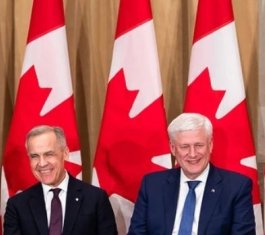
During a bilateral meeting with Prime Minister of Denmark Mette Frederiksen last week in Paris, Prime Minister Mark Carney said the future of Greenland will be determined “solely” by the people of Denmark and Greenland. Foreign Affairs Minister Anita Anand will also visit Nuuk, Greenland, in the coming weeks for the opening of Canada’s consulate in the region.
Lawson said recent investments by Carney’s government to bolster a military presence in the North, is an acknowledgement that Canadian sovereignty in the Arctic is under threat.
In addition to the increasing defence spending to five per cent of GDP by 2035, the federal government has recently announced $1 billion in funding over four years to improve civilian and military transportation infrastructure in the Arctic, a partnership with Australia to develop Arctic Over-the-Horizon Radar, and has made an initial investment to develop next-gen military satellite communications for Arctic operations.
Lawson said while these efforts are admirable, it may not be enough.
“Whether it’s enough to offset American desire to own territory in the north?” said Lawson. “I don’t know.”
Greenland, an autonomous territory which belongs to the Kingdom of Denmark, a member of the North Atlantic Treaty Organization (NATO), is an island of strategic importance in the Atlantic Ocean.
Trump has stepped up his threats to occupy the island in recent weeks, noting that if the U.S. doesn’t take Greenland, Russia and China will.
“One way or another, we will have Greenland,” he told reporters on Sunday.
Amid rising tensions, the Danish and Greenlandic foreign ministers will meet U.S. Vice President JD Vance and U.S. Secretary of State Marco Rubio on Wednesday.
“If they were to acquire Greenland, it would be the first step in eventually acquiring control over all of northern North America,” said Whitney Lackenbauer, research chair of the study of the Canadian North at Trent University.
This is not the first time Trump has expressed the desire for the U.S. to own Greenland. In 2019, Trump publicly confirmed his administration’s interest to buy the island, likening it to a real estate deal.
Now Trump is using the rationale of U.S. security interests in the Western Hemisphere, what is now being dubbed the “Donroe Doctrine” a re-imagining of the Monroe Doctrine that dates back to the 19th century under former U.S. President James Monroe, which aimed to stop European Nations from intervening in newly independent states in the hemisphere.
“It’s such a bizarre distortion of the Monroe Doctrine, which was about not allowing non- North American powers to assert and control North America,” said Lackenbauer.
Frederiksen has vehemently opposed any encroachment by the U.S. over its sovereignty in Greenland.
The U.S. has a longstanding relationship in place with the Kingdom of Denmark and Greenland that goes back to 1951, which gives the U.S. an established military presence in the region.
Lackenbauer does not buy the rationale that Trump is threatening to occupy Greenland based solely for security purposes.
“It’s telling that the Trump White House has not come back with any specific asks,” he said. “And that, to me, points to the fact that this is smoke and mirrors and this is about America wanting to grow.”
Robert Huebert, director of the centre for military, security and strategic studies at the University of Calgary, said there are a few possibilities of how the U.S. could assert itself in the North.
“The first part that we’ve always been concerned with is that the Americans would say we’re not pulling our weight, and they would go to systems that don’t need Canadian territory,” he said. “In other words, cut us out, so that NORAD either becomes hollow or doesn’t even become functioning.”
The second possibility is that the U.S. establishes over-the-horizon radar stations in the high Arctic Archipelago.
Recent events like the removal of Venezuelan President Nicolás Maduro from power and Trump’s threats against Colombia and Cuba demonstrate a more aggressive shift in U.S. foreign policy to protect its hemispheric interests.
“I think the EU and Canada, all of us are tiptoeing around Trump because we know he is very volatile,” said Andrea Charron, director of the Centre for Defence and Security Studies at the University of Manitoba.
“We are all economically very dependent on the U.S. and militarily dependent on the U.S.”
Charron said a potential rupture in NATO and Trump’s “Donroe Doctrine” runs the risk of creating “strong men” spheres of influence across the world.
“This then gives the nod to Russia to continue to control its sphere of influence and perhaps continue to try and annex Ukraine,” she said. “And China is going to take this as a licence to be able to dominate its area of the world.”
Ultimately, this raises the risk of potential global conflict.
“We’ve seen in history when you have this multi-polarity and these multiple spheres of influence, there’s the greatest likelihood of conflict because of this increased great power competition,” said Charron.
“And then accidents and incidents are more likely to be interpreted as nefarious, and everybody comes out swinging.”
National Post
Our website is the place for the latest breaking news, exclusive scoops, longreads and provocative commentary. Please bookmark nationalpost.com and sign up for our newsletters here.

Unpublished Newswire

Comments
Be the first to comment