For decades, we treated the universe like a giant stage where particles act out their lives. What if the stage itself isn't empty? What if the "void" of space is a structured, rotating medium that is constantly twisting & turning? We have been looking at the pieces of the puzzle, but ignoring the board they sit on. Has it been hiding in plain sight?
My idea on Helix Fields suggests that everything we see, from the smallest atom to the largest galaxy, is actually a "corkscrew" in the fabric of reality. In standard physics, we think of particles like tiny billiard balls.
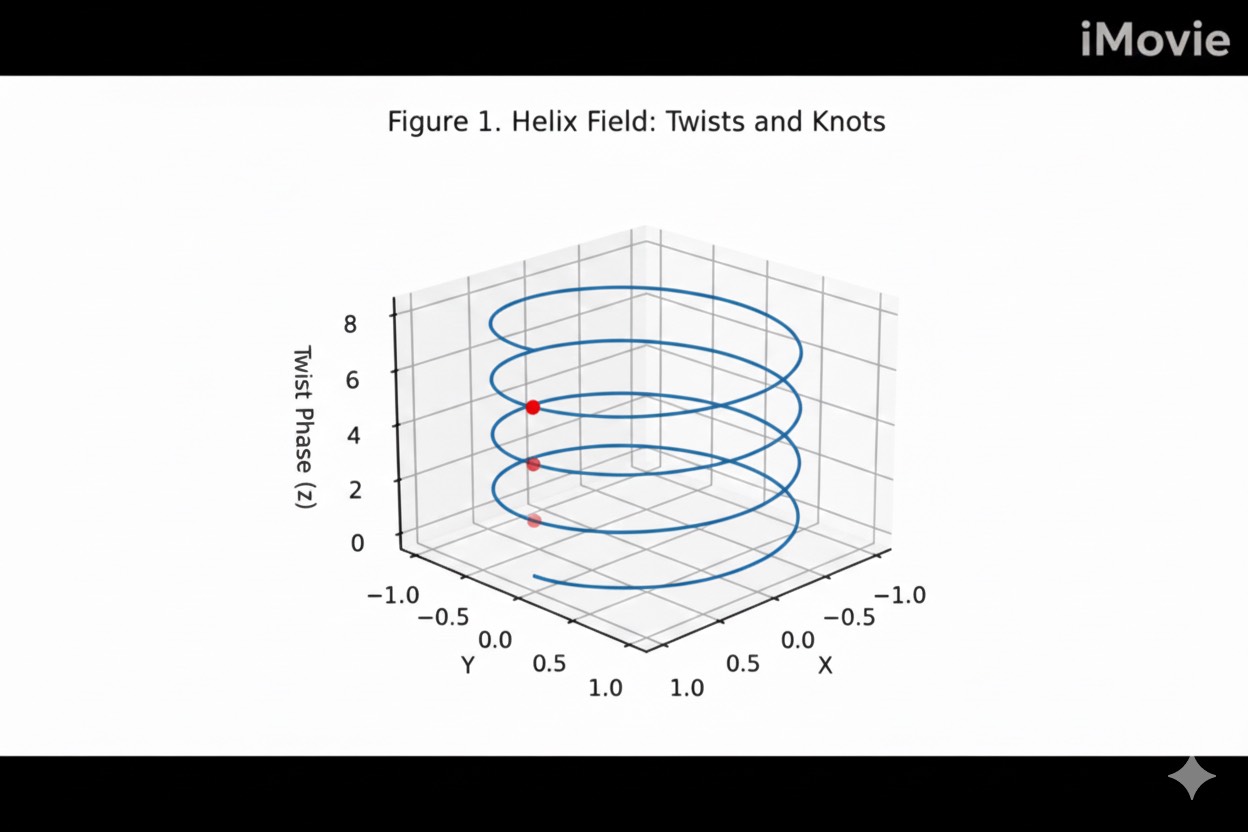
In Helix Field Theory, we rethink them as solitons - essentially stable, high-energy "whirlpools" or "corkscrews" made of space itself. Imagine a ribbon. If you pull it straight, it’s flat and simple. But if you twist it, you create a spiral. That twist is what we call Torsion.
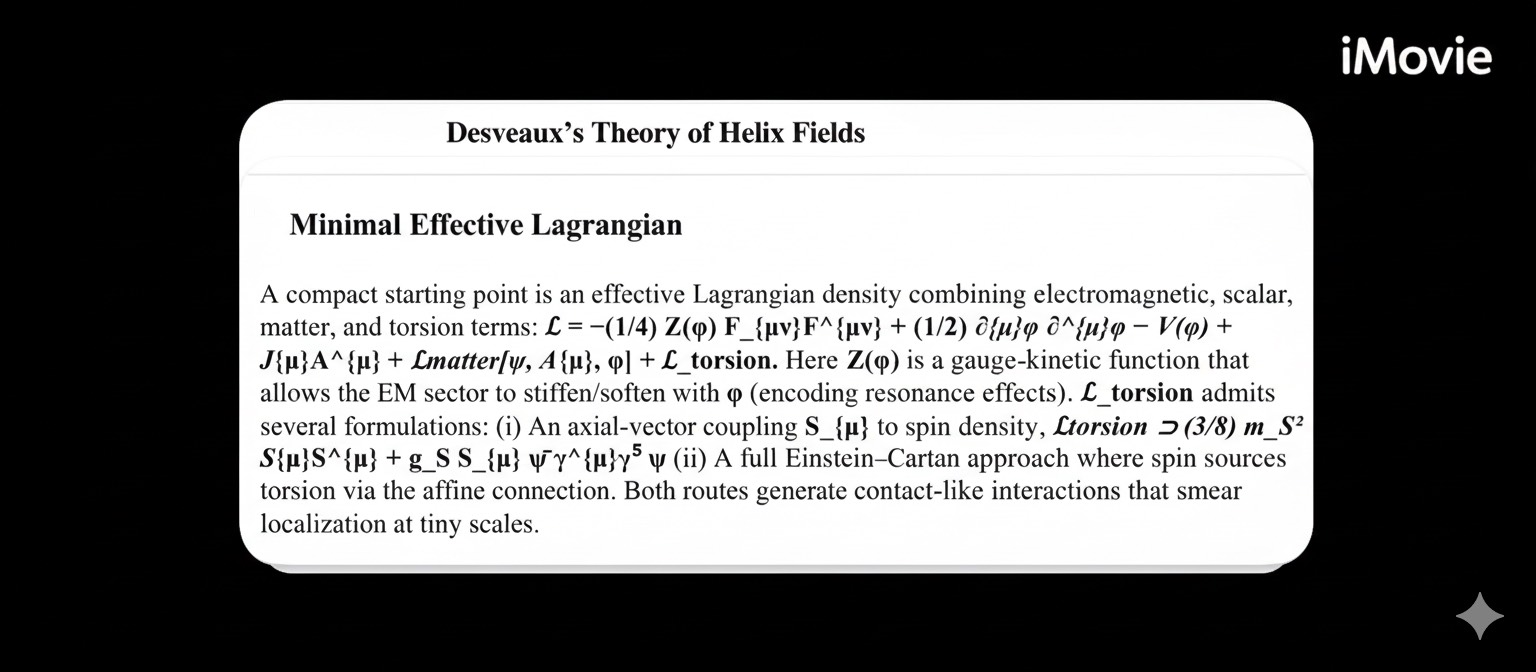
My theory says that what we perceive as "matter" is simply a place where the vacuum of space is rotating so tightly that it creates a "density core." To explain how this all works, we use a mathematical roadmap called a Lagrangian. Think of it as a master recipe or cookbook for the universe. It combines four key ingredients:
1. Electricity and Magnetism: How light and energy move.
2. Scalar Fields: The underlying "pressure" of the vacuum in space itself
3. Matter: The physical "stuff" we can touch.
4. Torsion: The "twist" or rotational force of space.
By looking at the universe through this "helix" lens, we can solve two of the biggest headaches in modern science:
The Hubble Tension - Astronomers are currently arguing over how fast the universe is expanding because different measurements give different answers. My theory suggests this "tension" exists because we haven't accounted for the universal rotation and torsion affecting our measurements.
The Dark Sector - We know there is "Dark Matter" and "Dark Energy" out there, but we can't find it. Helix Field Theory suggests these aren't invisible particles, but rather geometric artifacts - ripples and shadows created by the rotating vacuum itself. We are moving away from a universe of "things" and toward a universe of geometry and motion.
If the vacuum of space is a structured, rotating medium, then we aren't just living in the universe - we are part of its physical rotation. The "Quantum Substratum" isn't just a theory; it’s a new way to understand the very "twist" of existence.
- Protons: tiny rotating black hole-like cores anchoring the scalar field
- Neutrons: stabilisers that prevent proton cores from decaying
- Quarks & Gluons: the deepest torsion knots; the strong force is intrinsic torsion
- Electrons: corkscrew-shaped solitons producing microscopic magnetic vortices
- Neutrinos: ultra-light messenger waves traveling along the field’s “communication lines.”
- Photons: instruction ripples traveling at light speed
- Dark Photons: the “torsion messengers” of the Helix Field. They carry the twist, regulate the twist, and stabilize the twisting motion
- W and Z bosons: on/off switches and stabilising nodes in the neutrino network
- Higgs field: the local density of the scalar field, giving solitons their effective mass
- Dark energy: the gentle outward push caused by the field’s overall rotation
- Entropy: friction in that rotation, giving time its arrow
- Cosmic Microwave Background: the universal “sustain pedal” like on a guitar or piano, keeping the field’s vibrations in phase. In this vision, dark matter isn’t missing matter - it’s the gravitational echo of the scalar field itself.
Exploring antiparticles further: they may regulate the flow of time itself. In a rotational and torsional universe, time is a neutral observer: the past and future are fixed, but the present - our free will - is the point where choices echo into fate. Time is the “God” of the universe: ever-present, ever-aware, never interfering - just watching, as we decide which thread to follow.
A Brief Note on Scientific Context
1. Einstein–Cartan Theory (1928–1930) Einstein, working with mathematician Élie Cartan, developed a more complete version of gravity - one in which space-time can twist, not merely curve. This twist is called torsion, and it arises from the intrinsic spin of particles.
2. Gödel metric (1949) Dr. Kurt Gödel’s Rotating Universe - yes, the same Gödel famous for his incompleteness theorems - discovered a solution to Einstein’s equations in which the entire universe rotates. In such a cosmos, galaxies favour one direction of spin, and time can even form loops. Einstein admitted Gödel’s solution was mathematically flawless, yet he dismissed the idea that our universe actually rotates. New hints suggest that dismissal may have been premature.
3A - The New 2025 Observations: A new cosmological model shows the universe may rotate once every 500 billion years, and this tiny spin appears to resolve the long-standing “Hubble tension.”
3B - The James Webb Space Telescope, analyzing 263 early galaxies, found that roughly two-thirds spin clockwise from Earth’s perspective - exactly matching the kind of cosmic handedness Gödel predicted and the patterns Einstein–Cartan torsion would produce.
3C - Researchers Prof. Gao Zhifu from the Xinjiang Astronomical Observatory of the Chinese Academy of Sciences unveiled axion-torsion coupling via dark photons




Comments
Be the first to comment