
Stay informed
Unpublished Opinions



Yes, You Can Be Fired While on Maternity Leave
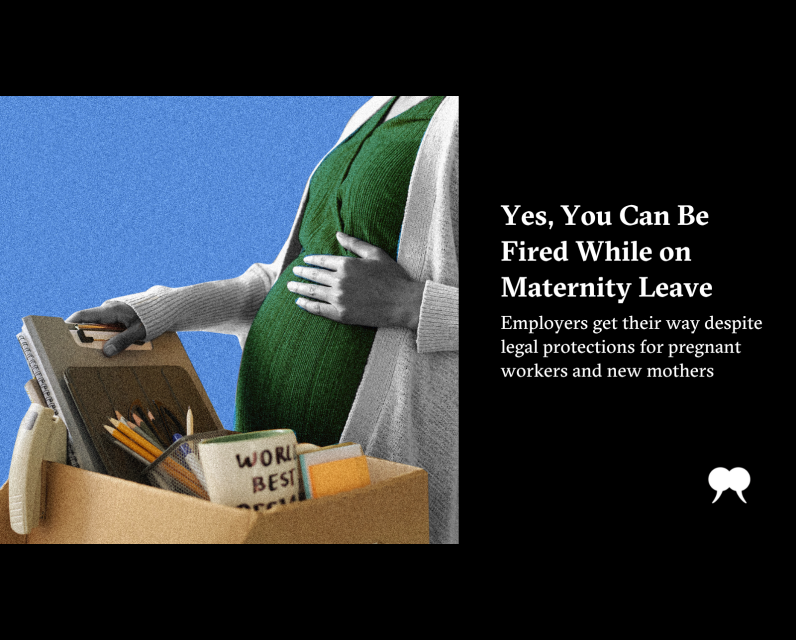
In the summer of 2024, a former employee of Google Canada sued the tech company for wrongful dismissal and a breach of the Ontario Human Rights Code. Sarah Lilleyman, then thirty-nine and who worked for Google Canada for around two and a half years, claimed that she had been terminated because she was pregnant; she had been fired just days after telling her bosses she was expecting.
Lilleyman was reportedly told by Google Canada that her firing was due to “restructuring” and “workforce reduction” and “changing business needs.”
In its statement of defence, as reported by the National Post, Google Canada stated that the company “denies it discriminated against Lilleyman in her employment or on termination on the basis of sex, gender, or any other protected ground under the Ontario Human Rights Code.” Furthermore, the company claimed, “Lilleyman’s allegations, even if true (which are expressly denied), do not amount to a violation of the Code . . . First, ‘pregnancy’ is not a protected ground under the Code.”
In fact, pregnancy is protected under the province’s human rights legislation: it is illegal to refuse to hire, to fire, to demote, or to lay off (even with notice) a person because they are or may become pregnant. But is Google’s claim, while untrue in a legal context, completely off the mark?
“It is a scary thing to put yourself out there to take on this gigantic company that does have so much power,” Lilleyman’s lawyer Kathryn Marshall told the National Post. “But she knows that there’s so many other women who are experiencing pregnancy discrimination at work who don’t have the ability to put themselves out there; either they don’t have the support, or they don’t have the resources. And she knows that she’s not only helping herself, but she’s helping so many other women.”
This past June, as Lilleyman’s suit moved through the courts, an organization called Moms at Work published survey data that canvassed 1,300 Canadian women working full time who had taken maternity leave from their workplace. Participants were recruited by connecting with women’s organizations and through online outreach, and data analysis was overseen by Rachel Margolis, a sociologist and demographer from Western University in London, Ontario.
The most headline-grabbing statistic? The data indicated that 15 percent of Canadian mothers were dismissed, laid off, or had contracts not renewed during their pregnancy, while they were on maternity leave, or shortly upon return to work after their leave. That percentage is three times the rate of workplace dismissal among the general population in a given year. On top of that, more than 27 percent of respondents in the survey were denied flexible arrangements post-leave, 16 percent were denied flexible work during pregnancy, 11 percent were discouraged from attending prenatal appointments, and 7 percent were denied sick leave after returning.
“I just got sick of people telling me that it wasn’t a problem,” says Allison Venditti, chief executive officer and founder of Moms at Work, on why she pursued the survey. Before Moms at Work, Venditti worked for years in disability management. At thirty-three, she suffered a traumatic brain injury, was off work for three years, lost the ability to read, developed a seizure disorder, and the left side of her body didn’t—still doesn’t—function well. She decided to go back to old clients and pitch herself as a consultant since her expertise in disability management meant she knew all the legislation (employment standards, health and safety, disability rights, parental leave) in Canada, the United States, and Europe. A mother herself, her clients ended up being mostly women and moms.
It wasn’t long before she realized that the women she was coaching needed her less than they needed a community of other women going through similar challenges. She started a Facebook group in 2018, and the first iteration of Moms at Work was born; once the pandemic hit, the community quickly jumped to 15,000 people. Today, it’s more than 21,000.
Venditti became increasingly interested in the issue of maternity leave firings during the pandemic. She noticed a sharp uptick in maternity leave dismissal and layoff stories in the Moms at Work community and began asking around—Statistics Canada, the Canadian Human Rights Commission—to see if anyone had data to support what she was seeing anecdotally. Nobody did. So, she decided to conduct the research herself.
“I saw it because I was in it,” Venditti says. “But no one had the numbers. How else was I going to get people to believe me?”
In 2024, the Vanier Institute published a report that provided a statistical portrait of families in Canada over the last thirty years. The increase in mothers’ labour force participation during that time is representative of a remarkable shift from the traditional model of family life dominant in Canada around the time of the Second World War.
More women are supporting half the family income, the majority of the family income, and becoming sole breadwinners of the household. Between 2000 and 2022, the proportion of different-gender couples in which women were sole breadwinners (i.e., receiving 100 percent of the household income) increased from 7.8 percent to 10.7 percent. But even though the percentage of women who are the primary breadwinners in the home has increased on the whole, women in couples without children are twice as likely to be breadwinners than in couples with children.
Put in plainer language: if you have kids, your chances of becoming a sole breadwinner are cut in half. “The motherhood penalty is real,” Venditti says. “People have very strong opinions about what women should be doing with their time—and that is taking care of babies. People come to us and say, ‘I got laid off today, and my boss told me that it would be great because I could spend time with my baby.’”
This is what sociologists Michelle J. Budig and Paula England coined, in 2001, as the “motherhood penalty”—referring to the economic disadvantages women often face in the workplace after becoming mothers or due to the assumption they will become mothers. The biggest one is that wages and employment for women drop after they have children—more so than they do for men. This disparity can start as soon as a woman returns from maternity leave and can persist throughout her career, and studies have consistently shown that mothers earn less than women without children. By contrast, many new fathers actually experience a bump in earnings.
Some other disadvantages for mothers include inadequate maternity leave support, poor flexible work arrangements and limited child care options. Mothers often face slower career progression and are less likely to be promoted compared to their colleagues. Perception can be just as damning: many employers view mothers as less competent or committed to their jobs, which can influence whether they get hired, if they get promoted, and performance evaluation.
In truth, it wasn’t hard to find sources for this article, but it was hard to find people to speak on the record. Most of these women spoke to me under the condition of anonymity, out of fear of facing repercussions.
There was the woman who was told she no longer had a job to return to halfway through her maternity leave. When she got the news about her job, she was in the thick of new parenthood: breastfeeding around the clock and generally consumed by all her new responsibilities. The idea of eventually returning to work, regaining some autonomy, and returning to a purpose outside of the beautiful, little baby she was taking care of had kept her going. Then she was told that wasn’t going to happen.
“I think any new parent, but maybe moms especially, lose themselves a little in parenthood,” she reflects. “Our bodies change, our priorities change, we lose sleep, we lose sanity. Of course, we gain a lot, too, but it is certainly a period of adjustment.” Sometimes the injustice is more subtle: one woman was promised a more senior position upon her return from leave, with a direct report to help free up her time to focus on larger projects. “This is music to my ears,” she remembers thinking.
Instead, her boss got in touch a few months after she had her baby to suggest she apply for a different management position, under the condition that she end her leave early. When she said she wasn’t prepared to do this, her boss shared that she could no longer guarantee the senior role she had been promised or even a role in the same department.
There was the woman who got laid off when her baby was ten months old, just as she was getting ready to go back to work. She loved her job and her colleagues and was completely devastated by the news. “Why did I get laid off? There were so many questions that didn’t get answered that rattled around in my head all night as I got up to feed my baby and cry. It’s literally the worst time to apply for a new job [or to take legal action]. People don’t realize the wide ranging and negative impact it has on women and their families when this happens.”
As the Moms at Work survey found, examples like these are shockingly common. And the most frequently repeated reaction upon hearing these stories is: Isn’t this illegal?
This is a typical path for an employee who becomes pregnant: sometime in the second trimester, once out of the uncertainty of the first, the employee will let their boss know that they are pregnant; a leave will be discussed and dates decided upon for when that leave will begin and when the employee will return to work.
Upon having the baby, the mother will apply for maternity benefits funded by the federal government. The program, which launched at a reduced rate in the early 1970s and became recognizable as the program we have today by the 1990s, offers 55 percent of one’s salary for twelve months (up to a maximum of $729 per week), or 33 percent of one’s salary for eighteen months (up to a maximum $437 per week). Some employers offer “top up”—money paid to employees to supplement what is provided by the government.
Discrimination related to pregnancy is prohibited under the Canadian Human Rights Act and under all provincial human rights legislation. Here, “pregnancy” also includes pregnancy-related conditions and circumstances, including post-pregnancy maternity leave. From the Canadian Human Rights Commission: “Pregnancy-related discrimination is a form of sex discrimination, because only women can become pregnant. Discriminatory practices related to pregnancy, such as negative treatment, refusal to hire or promote, termination of employment, or harassment, are against the law under the Act.” So, according to the laws of our country, women on leave should be protected.
Often, however, this is not what happens.
An employee can be terminated on a without-cause basis under both common law and the statutes. There are two human rights statutes that can apply: the Canadian Human Rights Act and the specific provincial human rights legislation, which, in Ontario, is the Ontario Human Rights Code. In employment, which one applies depends on whether the employee is federally or provincially regulated. This is broken down by industry, but only about 6 percent of employees in Canada are federally regulated (for example, those in telecommunications, transport, or banking), and the rest are provincially regulated.
“When it comes to employees on maternity leave, there is a misconception that an employee who is on a protected leave cannot be terminated and that’s not, strictly speaking, true,” says Aaron Zaltzman, associate lawyer at Whitten & Lublin, a Canadian employment law firm based in Toronto. In Canada, Zaltzman explains, it is not inherently illegal to terminate an employee who is pregnant or on parental or maternity leave, so long as that termination is unrelated to the pregnancy or to the leave itself. “You can already see where the law is falling short,” Zaltzman says. “Because no employer in their right mind is going to come out and admit a connection between an employee’s leave and their termination.”
Proving that discrimination has happened is difficult—but thankfully that’s not the threshold in Canada for evidence. Courts are aware of the fact that an employer is not going to admit to discrimination and so consider a three-step process for determining whether discrimination has occurred: First, is the person under protected grounds? (A person who is pregnant or was recently pregnant is.) Second, has there been an adverse event? (A termination of employment counts as one.) Third, and most importantly, is there a nexus between these two things? To find a nexus, courts undergo a second process with two steps. The first is they have a low evidentiary threshold for inferring that some discrimination has taken place. That threshold can be as straightforward as demonstrating that this person was terminated while they were on a parental leave, shortly after they returned from a parental leave, or shortly after they said they wanted to take a parental leave.
“It can be as simple as that,” says Zaltzman. “Once that court finds what’s called the prima facie case for discrimination, the second part of the process is that the burden of proof then shifts to the employer—and the employer has to satisfy the court that there’s actually an innocent explanation for the termination.”
“Some employers are simply poorly advised,” explains Deborah Hudson, managing partner at Hudson Sinclair LLP, a GTA-based law firm specializing in labour and employment law that partnered with Moms at Work for its survey. “They may not fully understand their legal obligations around parental leave or return-to-work rights, especially if they lack in-house HR or legal expertise.”
Hudson says that often employers are prioritizing short-term operational needs or perceived efficiencies over long-term equity and legal compliance. They might want to retain a high-performing maternity leave replacement and avoid the “disruption” of reintegrating the original employee, or they make quick restructuring decisions without fully considering the legal and human impact. “Other employers are willfully negligent,” Hudson says. “They’re aware of the risks but assume that most employees won’t pursue legal action due to the time, cost, or complexity involved.”
But employers and their HR departments have also gotten wiser, so employment law firms are seeing more efforts to paper over and present maternity leave layoffs as innocent business decisions. Employers often claim these firings are down to “restructuring” a company or organization, but upon closer scrutiny, it may become clear that the restructure disproportionately affects employees on leave. Even when a restructure is legitimate, the employer must still show that the decision was not influenced in any way by the employee’s leave. (“Why were they reevaluating the needs of the business such that they were able to determine they don’t need that person’s job anymore?” Zaltzman says. “It’s only because the person was on leave.”)
Employers also often claim (in cases when an employee is on parental leave) that the employee’s position no longer exists. It’s a tactic used as justification for a firing, but under employment standards legislation, if a comparable position exists, the employer is obligated to offer it to the returning employee. In other cases, upon returning to work after a parental leave, employers fail to properly reintegrate the employee or give preference to the replacement, which leads to indirect discrimination. Or employers may technically return the employee to their “old” job but, in practice, assign lesser duties, exclude them from meaningful projects, or keep the temporary replacement in the more substantial role.
Each of these tactics, if challenged, would require legal analysis to assess whether the employer’s decision was genuinely unrelated to the employee’s leave and whether the employer met their obligations under employment and human rights laws.
Relevant case law is evolving—terminating someone on parental leave without recourse is becoming a lot harder to get away with, and women on leave who find themselves in these difficult circumstances are often advised to consider this when deciding if it’s worth the cost to fight back. “Courts are not perfect,” Zaltzman says, “but they’re not that naïve.”
What Google Canada is trying to do with its statement of defence, by claiming pregnancy isn’t protected grounds, highlights why it’s crucial for women to understand their rights—the chances they will be infringed upon remain high. As the case moves through the courts, the landscape of protections for new and expectant mothers will undoubtedly shift.
Venditti hopes the publication of the Moms at Work survey results will help her with the next phase of her advocacy: changing how employment insurance (EI) works in Canada. Currently, EI and parental leave benefits come from the same pool—so if you lose your job near the end of your parental leave, there is a high probability that there will be no money left for you to draw on.
“Let’s stop trying to jerry rig EI to work for families, and instead of tying it to work, let’s tie it to the child,” says Venditti. “Tie the money to the child like the Canadian Childcare Benefit, and have it be a standalone benefit. Then it doesn’t matter if you have a full-time job or how many hours you work or if you’re a stay-at-home parent.” Basically, she’s suggesting that we decouple the funding that we give people who have lost their jobs from the funding we give new parents.
As far as the law, Zaltzman and Hudson have slightly differing perspectives on future reform.
Zaltzman thinks that two things can evolve in the jurisprudence: one is acknowledging that a parental leave is, and should be, a significant factor in someone’s common law notice entitlements. The second is decreasing the evidentiary burden on the employee and increasing the scrutiny and evidentiary burden on the employer. He also suggests making the minimum entitlements (in Ontario, for example, people can receive up to eight weeks of termination pay and up to twenty-six weeks of severance pay if they are terminated without cause) higher for anyone who is terminated within a certain time period before, during, or after protected leave.
Hudson believes what truly drives change is a combination of education and financial consequences. “Larger legal damages and stronger enforcement create real incentives for employers to alter their behaviour,” she says. “When discrimination becomes costly, employers are more motivated to make meaningful changes.” She thinks that when employers face significant financial risk—not just reputational harm—they are more likely to invest in effective preventative measures, such as better training, stronger policies, and fairer workplace practices. “This combination of financial impact and accountability would create a more meaningful incentive for employers to proactively reduce discrimination, ultimately cutting the number of cases significantly,” Hudson says.
Ultimately, Zaltzman and Hudson agree on the bigger picture. Since most of these cases don’t and won’t go to trial, a high priority of lawyers is to make sure people get compensated—and quickly. “At the end of the day we don’t have the ability to get your job back,” Zaltzman says. “And to be honest you may not want that, right? Who wants the remedy that they get to go work for an employer who just fired them in a discriminatory manner?”
For Venditti, the wider system is deeply flawed. “EI was designed at a time when everybody worked full time, and one person stayed home. And that is no longer the reality we live in,” she says. “If we’re saying we value families and maternal mental health and children, then the way to make all those things better is to get people money.”
After Moms at Work published its survey to their website and shared some of its findings on social media, the response was overwhelming. “Hi! It’s me! I’m one of them!” “Thank you for this. I’ve recently become part of the 15 percent. I was the primary breadwinner and am now scrambling for work while being the primary caregiver to an infant.” “Happened to me!” “I can attest to this!” Each one was part of that 15 percent of Canadian mothers who had been fired shortly before, during, or immediately after taking parental leave. The numbers don’t lie. Can the same be said about employers?
The post Yes, You Can Be Fired While on Maternity Leave first appeared on The Walrus.
Unpublished Newswire


Comments
Be the first to comment