
Stay informed



Pierre Poilievre Asks Albertans Not to Give Up on Canada
I’ve seen some online snark about Pierre Poilievre skipping the installation of Governor General Louise Arbour. I’m for not worrying about it. I do think the Conservative leader has made a conspicuous point of not endorsing Arbour’s rise to the viceroyalty. He maintained radio silence when Prime Minister Mark Carney announced her nomination a month ago, for instance. But that silence makes Poilievre measurably less critical of Arbour’s rise than this columnist and this one and this one.
Meanwhile, the king had no objection, and apparently, that’s what settles it, so Arbour gets the job. I think she’ll be a fine governor general, but then again, I liked the astronaut at first. What I don’t need is for anyone to be shamed into joining some enforced chorus of praise.
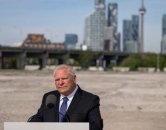
While Arbour was settling into her new role on June 8, Poilievre was speaking up for a united Canada in Calgary, as he had promised to do. Again, this is better than speaking up against a united Canada. Ezra Levant, with whom Poilievre has had many adventures over the years, is campaigning for independence. I’m not aware that the two have spent much time on opposite sides of any question. This can’t be easy for them. I prefer Poilievre’s stance to Levant’s.
On the matter of timing, Poilievre even argued that he’s way ahead of Mark Carney. “When is Prime Minister Mark Carney going to make his speech to Albertans? When will the jet-setting prime minister touch down here and make his pitch to Albertans?” Wait—I’m not actually quoting Poilievre here, or not yet. I’m quoting Rick Bell, a Calgary Sun columnist who is even better than I am at serving up beautiful lobs to whoever he happens to be interviewing.
And Poilievre knocked this one out of the park! “He should have been here a long time ago to denounce his own personal policies the Trudeau government implemented on his advice,” the Conservative leader told Bell. “Mark Carney founded a banking alliance to defund oil and gas. He said we should keep half our oil and gas in the ground. He advised Justin Trudeau against approving the pipeline to the Pacific.”
I think it’s reasonable to predict that if Albertans vote in October against a referendum on secession, as seems likely, Poilievre will say it’s because he was out there fighting for Canada while Carney was in Ottawa attending fancy ceremonies. And who would I be to argue otherwise?
What kind of argument did Poilievre make? Here’s a transcript, here’s a video. The speech can be divided into three parts that make two arguments, verse-chorus-verse: Canada is great, Liberals are terrible, Canada is great.
This wasn’t the speech I’d have given, but then, nobody asked me. Was it a useful contribution from Poilievre? Absolutely.
Poilievre began by noting the significance of his superbly chosen venue, Royal Canadian Legion Branch 1. “The ghosts of Canadian heroes walk these halls,” he said. “Among them, young men who left rural Alberta to fight for Canada in faraway lands.”
Many never returned, he said. As for those who did . . .
Those that did return from battlefield to farm field would then survive the Dust Bowl, see their children fight another world war, pay off the country’s entire war debt, and hand to the next generation the richest and freest nation on earth. Century Farm Plaques at the end of rural Alberta laneways still stand as monuments to the legacies they left their great-great-grandchildren, who still plow the same soil. Those farms and this country are here today because, no matter the hardship, they never gave up on Canada and neither should we. They fought for Canada, and now we must fight for Canada.
I think that’s quite good. It’s a valid question how heartily anyone should tug at the audience’s heartstrings when they’re four months away from a referendum on whether to have a referendum, but arguably, if you’re going to bat, you should take a swing. Carney has been mining Canadian history in his own speeches (“We mapped the continent before the Americans had even left St. Louis. We built a transcontinental railway in five years”), and it’s not clear to me he’s done a conspicuously better job of it.
Poilievre went on to catalogue many of the things that anyone who loves Alberta will love—’88 Olympics, Brian Orser, big sky, unpretentious—before pondering the British North America Act of 1867, which “crystallized” the “win-win of Confederation.” It tells provinces and the federal government what to do.
You can probably predict what came next. “The problem lately has been that the federal government has been terrible at the things that are its job, whilst sticking its nose in things that are not its job.”
This, again, has earned Poilievre some criticism since Monday, but he was ready for that. “Those who caused the problems in Canada today will tell you to pretend those problems don’t exist, and they will denounce as unpatriotic anyone who speaks honestly about them,” he said.
“Doing that in this referendum would only drive people further away. If you want frustrated Albertans to vote for Canada, the absolute worst thing we can do is to dismiss their legitimate grievances and thus signal there is no hope of fixing them at all.”
Hmm. Sure? To some extent? Poilievre opened this section of his speech by announcing the necessity for “honest conversations over these next several months.” Surely, part of honesty includes a level of frankness about which grievances are legitimate and which are on shaky ground. Poilievre’s former colleagues Jason Kenney and Ken Boessenkool are on the list of those who are spending a lot of time drawing these distinctions these days.
This was also the part of the speech where the opposition leader’s penchant for self-congratulation reached a peak. “Just as I speak to Bloc Québécois MPs every day on Parliament Hill, I will be speaking to Albertans on both sides of this referendum to hear their thoughts and to make the respectful case for Canada,” he said. Boy, it’s just not a working day here on Parliament Hill if Poilievre isn’t sitting around the potbellied stove, chewing the fat with a couple of Bloc Québécois members of Parliament.
Poilievre has stayed slimmer over the years than I have, yet I keep marvelling at his difficulties with portion control. He rarely settles for making a claim when he could make a claim and a half.
“Here are the undeniable facts,” he said. “Ten years ago, under the leadership of a great Albertan, Stephen Harper, there was no separatist movement in Alberta. When Mr. Harper left office, the Parti Québécois had been defeated, and the Bloc Québécois had been reduced to four seats—it didn’t even have party status. We thought that referendums on separation were a thing of the past.”
Now, I’ve actually got more patience for the notion that former prime minister Harper was good for national unity than a lot of my colleagues. I’ve argued on Radio-Canada’s Le Téléjournal, to the amazement of my fellow pundits, that Harper shut down the Canadian Unity Council with no discernible harm to Canadian unity and that, throughout an entire leaders’ debate in the 2008 Quebec election, none of the leaders mentioned Harper’s name once, which is so unheard of I wrote about it at the time.
But the claim here isn’t that a Conservative prime minister—indeed, the only one, ahem, the modern Conservative Party has ever had—was agile at handling the national unity file. The strong inference of Poilievre’s remarks is that Harper wiped two separatist movements off the map, until Liberal oafs brought it back. Meh. Here’s Leger’s polling on Quebec sovereignty since 2011 (Harper was prime minister until late 2015).
The numbers jump around, but there’s no stark change from 2011–2015 (Harper) to 2015–2024 (Trudeau). And as Leger implies, if the separatists are having a rough time of it since then, that’s probably more because of United States president Donald Trump than Mark Carney.
On Alberta, here’s Environics, which inconveniently didn’t ask the question while Harper was prime minister (Ah-ha!) but which sees little movement on separation between 2005 and 2026.
This great country has always had more than one pollster, though. In July 2008, two and a half years into the Harper nirvana, the Edmonton Journal reported that an Ipsos Reid survey “found that 35 percent of Quebecers would still like to see sovereignty become a reality, while one in five Albertans (18 percent) would like to declare independence.” That 18 percent matches what Ipsos found last week.
In August 2014, the Calgary Herald reported on an Insights West poll. “Asked if Alberta would be better off as its own country, 70 percent disagreed with separation, while just 23 percent agreed.”
But then, after engaging in a little light revisionism (“We need a Project Hope, not a Project Fear,” said the leader, who finished his last campaign warning about a “very dangerous future if the Liberals get their fourth term”), Poilievre returned to some genuinely affecting language about what Canada has to offer.
“Let me speak directly with you,” he said. “In the midst of our legitimate complaints, let us not forget what we have here and what we have built together. Sometimes in life, we forget what we have; we sometimes take for granted the things that have always been around. But look around the world: Where else would you really rather live?” There is “a reason that millions of people from all around the world leave behind their ancestral homes, families, jobs, and countries to flock here,” he said. “There is a reason why millions more would if they could.”
There are also reasons why the flocking is currently at near-historic lows, but that’s a discussion for another day.
I’m ambivalent about some of this, but after long experience in Quebec, I have a basic red-line test, which I developed during the terrible decade that followed the collapse of something called the Meech Lake Accord before you were born.
Here’s the test: putative federalists aren’t helping if they say the survival of the country should depend on the adoption of their preferred change. To me, Poilievre steered well clear of that line. Sure, he thinks it would be a better country if governments adopted Conservative policy. But he explicitly rejected making Conservative policy the test of Canada’s worth. “Sure, we can and should complain about our government. But Canada is more than a government.” I don’t know about you, but that’s all I need.
Binary referendum choices often induce infighting within the rival camps, as erstwhile rivals bring old habits to new fights or succumb to the temptation to impose purity tests on one another. So far, we haven’t seen much of that in the long run-up to an October confrontation that still seems artificially constructed and contrived. We don’t need more infighting. If this is how Pierre Poilievre campaigns for Canada, I’ll take it—all of it—and say thanks and ask for more.
Originally published as “How to save a country, approximately” by Paul Wells (Substack). Reprinted with permission of the author.
The post Pierre Poilievre Asks Albertans Not to Give Up on Canada first appeared on The Walrus.
Unpublished Newswire
Comments
Be the first to comment