

Unpublished Opinions
Clinton is an accredited writer for numerous publications in Canada and a panelist for talk radio across Canada and the United States
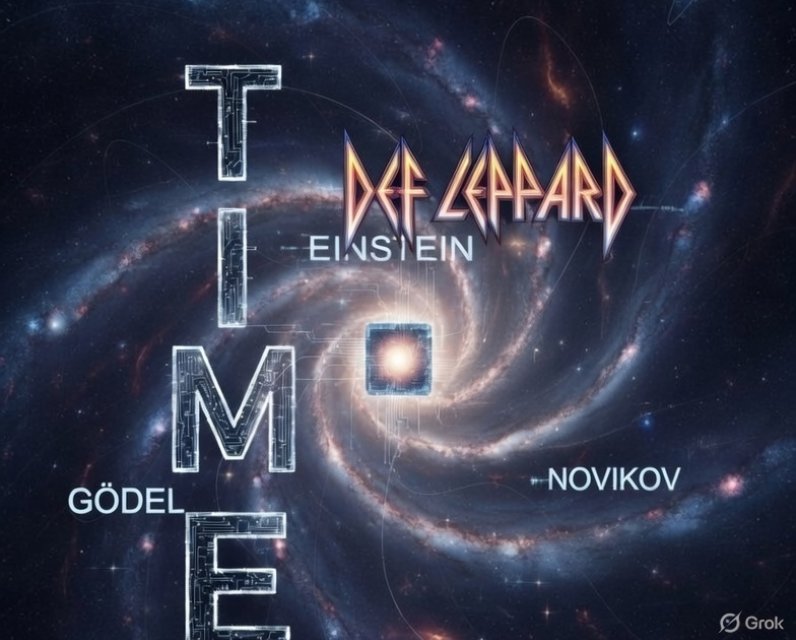
Cosmic Clockwork: How Dr. Kurt Gödel’s Rotating & Torsional Universe Wrote Two Def Leppard Destinies
Part 1 – Vivian Campbell
In a universe that spins like a cosmic helix, driven by the twisting dance of its tiniest particles, a single moment can reshape history. This is the story of two such moments.
Vivian Campbell was born on August 25, 1962, in Lisburn, County Antrim, Northern Ireland - a suburb of Belfast. He became a guitar junkie at a young age, a boy in constant search of permanent bandmates and bigger sounds. He was hooked on the vibrations and note patterns a guitar could generate. It was the science of sound.
Years later, Campbell would reflect on the mysterious workings of the universe - on serendipity, timing, and the strange way music and destiny can intersect.
Then came the moment that fixed everything in place.
Fast forward exactly 20 years to the day of his birth. At 2 a.m. Greenwich Mean Time, on August 25, 1982, rain fell in Belfast as the temperature hovered around 10°C (50°F). The shrill ring of a black rotary dial phone from the kitchen cut through the early morning.
Campbell was living with his parents. Ronnie James Dio was assembling a new band, and his bandmates were searching for a guitar player named Vivian Campbell - a young musician they’d heard was the standout talent in Northern Ireland. Vinny Appice, Dio’s drummer, suggested to Jimmy Bain that Viv could be the guy, so Jimmy made the initial contact.
The problem was that the Dio guys did not have a phone number or address for Vivian Campbell. There was only one Vivian Campbell listed in the entire Northern Ireland phone book - his father, who shared his name.
The phone clicked, and Jimmy Bain spoke. “Is this Vivian, the guitar player?”
“One moment,” said Vivian Campbell Senior, "Viv, it's 2 AM, and there's a Scot on the phone."
“Hello?” said Viv.
“Can you fly to London to try out for Ronnie James Dio?” Bain asked.
“Yeah, sure. When?”
“Tomorrow.”
At age 20, that became the moment when destinies aligned. It transformed his life, carrying him from the bleak Belfast of the early 1980s to a career performing in sold-out stadiums around the world, as if guided by the subtle twists of a torsion-driven, rotational universe.
Had Vivian not shared his father’s first name, he never would have received that 2 a.m. call. Sometimes, when luck and opportunity intersect, one must be ready to make a quick decision. That split-second choice rewrote Vivian’s timeline and altered the course of his fixed-point future.
That same summer, Def Leppard was in the studio recording their internationally iconic album Pyromania. Ten years later, in 1992, Vivian Campbell would join Def Leppard, stepping into that chapter of rock history.
Thirty-three years later, Vivian Campbell is still with Def Leppard, a testament to the enduring impact of that 2 a.m. phone call, seemingly orchestrated by the universe.
Part 2 – Joe Elliott
In a universe that spins and coils like a cosmic helix, a single change can redirect a lifetime. For Joe Elliott, that change came one ordinary Monday in Sheffield.
In Sheffield’s industrial heart, 18-year-old Joe Elliott lived amid the clang of steelworks and the shadows of smoke-stained chimneys. He worked at Osborn-Mushet Tools factory. Life moved to the rhythm of labour, school, apprenticeship, and the long path to the tool factory, making industrial bits. Joe felt it all closing in like a cage.
But inside him stirred a different rhythm: lyrics scribbled in a battered notebook, riffs strummed on a guitar. Music pulsed as quiet rebellion.
Each day, he caught the 5:02 p.m. bus home from the factory. The bus was always punctual, always predictable. Joe timed his days to its arrival, syncing with the pulse of the city.
But on Monday, August 15, 1977, something shifted.
Joe reached the bus stop on time - as he always did - but the bus had already gone. Early. Unexplainably early.
“The bus was early,” Joe later recalled. “I wasn’t late.”
Perhaps the air felt charged, thick, wrong. What if this wasn’t just bad luck, but a torsion spike - a ripple of cosmic spin where timelines brushed and reality briefly trembled?
He stood at a crossroads: wait another hour, or take a narrow side street and walk three miles uphill to his home. Something nudged him. Maybe the universe whispered, Move.
He walked.
Halfway along the unfamiliar route, he nearly collided with Pete Willis, a schoolmate and a guitarist who wanted to start a band. They walked together. They talked. They clicked. That spark, lit by a missed bus, led Joe to eventually form a band with Pete and Rick Savage a few nights later in Joe's house - the band that would become Def Leppard. That strange glitch in time - an ordinary afternoon bent by cosmic mechanics - redirected Joe from a life of tools & steel into a world defined by the vibrations of music.
Events like déjà vu and serendipity might just be two timelines brushing against each other in our torsional and rotational universe. It’s like when the individual strands in a rope momentarily touch each other under the torsion of twisting.
Just as chance moments shaped the destinies of these musicians, the universe itself may be orchestrated by twists and rotations beyond our perception.
Part 3 – The Rotating Universe
LIGO (Laser Interferometer Gravitational-Wave Observatory) has just completed its fourth major observing run on November 18th. This enormous experiment listens for ripples in space-time created when black holes or neutron stars collide.
It works by firing ultra-precise lasers down a pair of four-kilometre vacuum tunnels arranged in a perfect L-shape. There are two of these detectors in the United States: one in the desert near Hanford, Washington, and one in the quiet forests of Louisiana.
They operate alongside two other locations: Virgo, near Pisa in Italy, and KAGRA, deep underground in Japan. Together, all four detectors can pinpoint where in the sky a gravitational wave originated - effectively acting as a cosmic triangulation network.
Right now, scientists are analysing the newest batch of data. The raw recordings and the official event catalogue will be released to the public over the next six months. So far, every gravitational wave detected behaves exactly as Einstein’s general relativity predicted back in 1915.
But here’s the thrilling possibility: - Waves arriving from directions that should be impossible? - An extra “twist” or torsion in the signal? - A built-in left- or right-handed spin preference?
Even a single detection like that could change physics forever.
A Brief Note of Scientific Context
1. Einstein–Cartan Theory (1928–1930) Einstein, working with mathematician Élie Cartan, developed a more complete version of gravity — one in which space-time can twist, not merely curve. This twist is called torsion, and it arises from the intrinsic spin of particles.
2. Dr. Kurt Gödel’s Rotating Universe (1949) Gödel — yes, the same Gödel famous for his incompleteness theorems — discovered a solution to Einstein’s equations in which the entire universe rotates. In such a cosmos, galaxies favour one direction of spin, and time can even form loops. Einstein admitted Gödel’s solution was mathematically flawless, yet he dismissed the idea that our universe actually rotates. New hints suggest that dismissal may have been premature.
3. The New 2025 Observations A new cosmological model shows the universe may rotate once every 500 billion years, and this tiny spin appears to resolve the long-standing “Hubble tension.” The James Webb Space Telescope, analyzing 263 early galaxies, found that roughly two-thirds spin clockwise from Earth’s perspective — exactly matching the kind of cosmic handedness Gödel predicted and the patterns Einstein–Cartan torsion would produce.
A Unified Vision - what follows is a conceptual roadmap, not a settled model
Consider the universe as a single twisting and rotational scalar field:
- Protons: tiny rotating black hole-like cores anchoring the scalar field
- Neutrons: stabilisers that prevent proton cores from decaying
- Quarks & Gluons: the deepest torsion knots; the strong force is intrinsic torsion
- Electrons: corkscrew-shaped solitons producing microscopic magnetic vortices
- Neutrinos: ultra-light messenger waves traveling along the field’s “communication lines.”
- Photons: instruction ripples traveling at light speed
- W and Z bosons: on/off switches and stabilising nodes in the neutrino network
- Higgs field: the local density of the scalar field, giving solitons their effective mass
- Dark energy: the gentle outward push caused by the field’s overall rotation
- Entropy: friction in that rotation, giving time its arrow
- Cosmic Microwave Background: the universal “sustain pedal” like on a guitar or piano, keeping the field’s vibrations in phase
In this vision, dark matter isn’t missing matter - it’s the gravitational echo of the scalar field itself.
If LIGO’s newest data shows even the faintest sign of:
- an extra polarization
- a twist - a universal spin preference
- or a correlation with galaxy rotation directions
…then every piece of this cosmic puzzle I have put together snaps into place.
Exploring antiparticles further: they may regulate the flow of time itself. In a rotational and torsional universe, altering antiparticle dynamics could, in theory, allow backward time travel. Turning a neutrino into negative mass through controlled oscillation could even allow faster-than-light travel.
In this framework, Time is a neutral observer: the past and future are fixed, but the present - our free will - is the point where choices echo into fate. Time is, in this sense, the “God” of the universe: ever-present, ever-aware, but never interfering - just watching, as we decide which thread to follow.
The universe may not simply be expanding into the void. It may be turning - and twisting - at every scale of reality, taking us with it. From a phone call that should never have come, to a bus that should never have left, to a universe that should never have turned - torsion writes every story.
The data is being analyzed right now!
References

Comments
Be the first to comment