
Stay informed


Doug Ford Is Furious about the EV Deal Carney Made with China
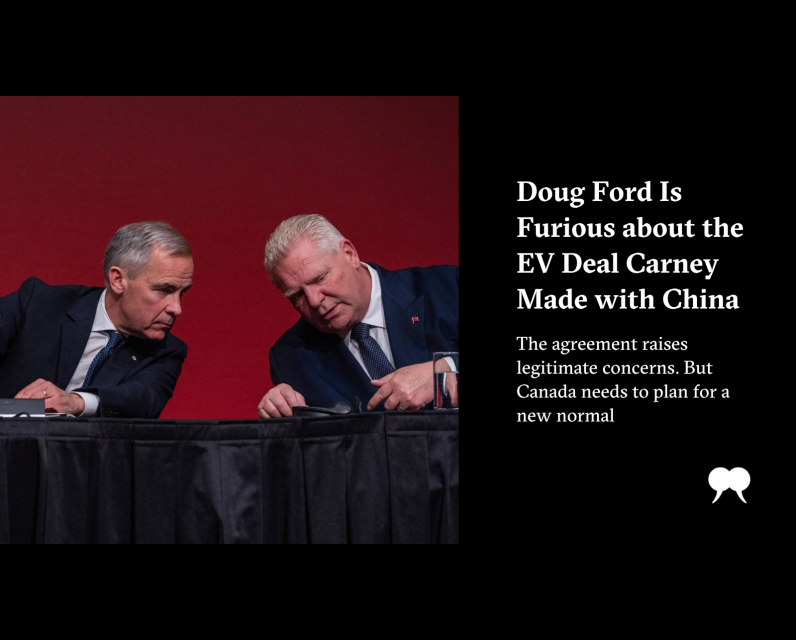
On Monday, Ontario premier Doug Ford doubled down on his condemnation of the federal government’s deal with China. Announced on Friday, the agreement will allow up to 49,000 electric vehicles into the Canadian market at a reduced tariff rate. In exchange, China will decrease its levies on canola and other Canadian products.
Ford argued that the deal would not only hurt the country’s auto industry, but also threaten Canadian security. “Once the camel gets his head in the tent, his whole body is in the tent,” he contended, later adding: “I’m not too sure if President [Donald] Trump wants Chinese spy vehicles coming across the border.”
Charlotte Yates, president and founding director of the Automotive Policy Research Centre—a non-profit research centre focused on the Canadian automotive industry—says she wasn’t surprised that Prime Minister Mark Carney’s trip to China resulted in a deal, but she was surprised by the content of the deal. “I think Carney had gone to China looking to make some trade-offs,” she says. “I didn’t know how much he would give up, but he needed to do something. I’m not sure that we had any other option.”
The Walrus spoke to Yates on what Carney’s so-called “landmark” deal with China means for Canada—specifically the Ontario auto sector—and whether or not the industry insider thinks that letting in more EVs is as problematic as Ford is making it out to be.
In 2025, the United States imposed a 25 percent levy on Canadian automobiles. Where did that leave the Canadian auto sector?
Canada exports the bulk of its vehicles to the US, but Trump has been very clear: he doesn’t think the US needs Canadian-made cars. He seems fine with Canadian automotive parts moving back and forth—but not Canadian cars. As long as that is his position, the Canadian auto industry is going to shrink.
Automakers can’t wait for four more years, or longer, for a change in the American government to advance a different policy. For Canada to remain competitive, or to even have an auto industry, there had to be some change in government policy which makes sure that companies that do business here are committed to Canada: Canadian jobs, Canadian industry.
How are Trump’s policies playing out on the ground, company by company?
We have already lost production and market share as a result. The decision by GM to close the Ingersoll, Ontario, plant temporarily (in fall 2025) shouldn’t have been surprising to anyone, even without the tariffs. The decision by GM to shift from producing a high-volume vehicle to producing an electric van that didn’t have a strong market put this plant in jeopardy. Tariffs were actually the last straw.
You also have automaker Ford shifting away from the production of EVs to vehicles destined for non-US markets. Then there was the decision by Stellantis to shift production from Windsor to the US. In short, the big three American automakers are expanding their footprint in the US as they shrink their footprints here. As the American producers reduce their production, Toyota and Honda become much more significant to the Canadian auto industry, as they produce the majority of vehicles made in Canada.
The second challenge here is tied to what is happening with EVs. The Canadian and provincial governments invested millions of dollars to support companies making the shift in production from internal combustion engines to EVs. Canada’s automotive strategy pre-Trump centred on building an automotive supply chain that stretched from the extraction and refinement of rare minerals needed for batteries to the production of EVs—thus guaranteeing Canada a place in the future of automobile production. This coincided with a move across the US and Europe toward EVs. GM, Stellantis, Ford, and Honda all seized on these government incentives to invest in massive transformations of their vehicle production.
The tariffs by the US, as well as shifts in the global market for EVs, have caused a real disruption to the market, and that doubled the pressures on the Canadian industry at a time when so much investment had been tied to making that EV transition.
Last week, Prime Minister Carney announced a deal with Beijing allowing nearly 50,000 Chinese-made EVs into Canada at a low tariff rate. Is this as big a deal as Premier Ford is saying? How does that change things for our sector?
In the short term, Premier Ford is right to be concerned, but we need to see what the details are of this trade deal. I also think that Ford is assuming that Trump will eventually come to his senses and realize that CUSMA is the way to go; that things will go back to normal.
Everything Trump has indicated demonstrates that he doesn’t care about CUSMA, and if, on the off chance he does care, he’s going to renegotiate it on terms that are probably not going to be good for us and not good for Mexico. So, our playbook has to be about how we can position ourselves in a new world. This fits with the prime minister’s speech this week at the Global Economic Forum.
To his credit, Premier Ford is expressing the concerns held by the automakers and autoworkers who are rightfully worried about the decision to let Chinese EVs into Canada. But let us be clear: the number of Chinese vehicles being allowed into Canada is a small part of Canada’s vehicle market—about 3 percent.
Many are worried about how Trump will react to this deal. Will he take further retaliatory action against our auto industry? I think there are ways in which the federal government can protect Canadian workers and encourage a restructuring of the industry—hopefully to create a sustainable Canadian auto industry that continues to produce great vehicles and good jobs.
The premier firmly criticized the deal, saying it could close the door on Canadian automakers exporting to the US—our largest export destination. Why would this be a concern?
Well, because the US is our largest market. Since the end of World War II, Canada’s dominant trading partner has been the US, and it’s taken us decades to build that relationship.
Then, suddenly, along comes Trump, who disrupts it with his tariffs and his comments about Canada becoming the fifty-first state. Premier Ford is right to say that, if for some reason, the US cuts us off from the market, it would be a devastating blow to the Canadian auto industry. So, if our market dries up, where do our cars go? We’re in a bit of a box right now.
What does the deal mean for jobs in the province?
Jobs have already been lost as a result of tariffs. We have seen plant closures and delayed retooling of plants, such as Stellantis in Brampton. But for the long term, it’s too early to tell. The federal government announced on Sunday that there’s more money coming for the auto industry. I have to assume that this is the first step in a more complete industrial policy that also supports joint ventures between existing producers in Canada and other international automotive companies but also shores up workers and, ultimately, the union until a reconfigured industry begins to emerge.
It’s imperative to remember the role that UNIFOR has played in building the industry. They have made sure that auto industry jobs are good jobs, have lobbied successfully for government investment in the industry, and have been part of creating our automotive workforce as one of the best in the world. Given that February is the timeline for the federal government’s new automotive policy, I think we’ve got to see what that means.
What does this mean for consumers looking to purchase an EV?
For consumers, the deal with China could mean access to cheaper electric vehicles. The low price is why there are lots of BYDs (Build Your Own Dream cars) in Mexico and why Chinese EVs have made such inroads into other markets: they’re cheaper. Remember, Tesla is produced in China. So, analysts do believe that one of the first cars to come into Canada in greater numbers, ironically, is Tesla.
But we also have to see how Canadian demand for EVs shapes up. Many Canadian consumers have been cautious about EVs, in part because we live in such a cold climate, and range issues are important in a vast country such as Canada.
But I suspect that with a cheaper electrical alternative, we’ll probably see a bit of an uptick in consumer demand.
There’s also been some criticism of Carney’s deal posing a security risk. Ford called the Chinese vehicles “subsidized spy cars.” Should we be concerned?
I think you have to be concerned with any trade with China on that front. Canada has been extremely vigilant over the past few years about the transfer of intellectual property to China because there’s lots of evidence to suggest that the Chinese have a high degree of surveillance over their own population but also of other populations around the world, including Canada. We know that. They have surveilled the Chinese community here.
The government will have to make sure that various standards for Chinese cars are met. I don’t know how they’ll do this, but they’ll want to make sure they pay attention to this issue because it would be a real concern if data from Canadian consumers was being fed back to China.
You worry about the dumping of cars on the international market by China. If Chinese automakers already have massive overcapacity—they’re producing more cars than there is market—does it raise further questions about their willingness to set up shop here?
How can you predict what the Chinese government will do? Auto may be a way for them to gain access—and keep access—to this Canadian market. The Chinese might be willing to invest in automotive production in order to be able to get access to various other things that they’re interested in buying—our raw materials, our oil and gas. Setting up shop here may be the price they pay for access. They are not private companies—they’re ultimately subsidized by the government of China.
A senior official told the Globe and Mail that Ottawa’s new auto policy—expected to be unveiled in February—will give foreign companies that make cars in Canada more favourable access to the Canadian market. Is Canada a big enough market to lure an auto assembly plant?
Canada used similar policy tools almost fifty years ago to secure investment from Japanese automakers Toyota and Honda. So, this is not a new playbook. This approach to securing investment and production is an alternative to tariffs. Secondly, we have a fairly large market—around 1.8 million sold to Canadian consumers. It’s more significant than we think. It would be difficult for Canada to produce a “Made in Canada” car at home, but with an investor from another automaker, it may be possible.
You say the government had to do something. As you mentioned, two Canadian auto plants are idled, and job losses continue throughout the auto parts supply chain.
We have to think about the future. To echo what Prime Minister Carney said at the Global Economic Forum, we are never going back to the world that we were in. CUSMA, our relations with large global powers, such as the United States and China and our trading partners, are all going to be permanently changed by what is going on today in the world. This is not a hiccup in the continued global expansion of capital and free markets.
Remember, this change is happening not only in Canada but in Europe, Africa, and around the globe. The question, therefore, becomes how do we sustain our own industries and how do we become a global player in our own right? Countries smaller than us have done it.
The post Doug Ford Is Furious about the EV Deal Carney Made with China first appeared on The Walrus.
Unpublished Newswire

Comments
Be the first to comment