
Stay informed


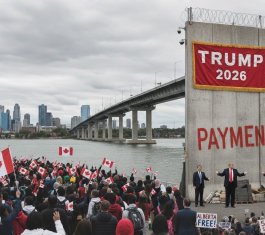
In His Rambling Davos Speech, Trump Calls Canada “Ungrateful”
It was President Donald Trump’s day at Davos yesterday. His speech was a long one. He looked tired. His flight had been delayed.
The early going was dedicated to a lengthy self-promotion of the United States’ Trumpian economy. Among the self-plaudits was a zinger about how, thanks to his “landslide” election victory and his energy policies, the US had avoided the “Green New Scam,” what he called “perhaps the greatest hoax in history.”
Mixed in with stuff about credit card debt and making the US the crypto capital of the world, there was a reminder about how the president had personally ridden to the rescue of the American economy, so that it now knows “virtually no inflation and extraordinarily high economic growth.” There was the usual tilting at whatever crossed his vision, including windmills, Joe Biden, Emmanuel Macron’s sunglasses (he has an eye infection), the tiresome Swiss (lady) president and her wheedling phone call, and the surprising intelligence of Somali criminals, despite their origins in an African non-state.
True to form, he veered into another disturbing diatribe about Greenland, the continuation of a spiel that began at the start of the new year. Trump apparently sees Greenland, an autonomous Arctic island territory of the Kingdom of Denmark, and shivers. It’s nothing but a massive ice sheet, apparently with no inhabitants, no desires, and no sovereignty. But it’s big—especially on Mercator maps, one of which hung as an AI-altered backdrop recently in the Oval Office, blazoned with an American flag pasted across its territory (Canada got the same treatment)—and it’s out there in the Arctic. It’s not terra incognita quite, but terra Americana. His prologue was that he wasn’t going to talk about Greenland but knew his audience would expect him to. Probably the truest thing he said.
His Greenland monologue required a rewriting of the history of World War II to include the preposterous idea that the US won the war all by itself. No “Grand Alliance,” no countries (such as the United Kingdom and Canada) who fought the Third Reich for two years before the US was forced into the war by Pearl Harbor at the end of 1941, no Soviet Union, no Eastern Front. In the Trump rewrite, the US (also single-handedly) defended the ice island from a German invasion and then magnanimously handed it back to Denmark.
How stupid—according to Trump—how ungrateful were the Danes! In fact, Greenland returned to Danish control after the defeat of the Third Reich, in 1945, and the release of Denmark from Nazi subjugation. The process had nothing to do with the US ceding control.
The only war fought over Greenland during World War II was a weather war, a side show to the Battle of the Atlantic. Germany managed to establish four small, manned weather monitoring stations on the east coast of Greenland. All were either abandoned under pressure or attacked and bombed. I don’t think we will see a repeat of the weather war in the twenty-first century. It’s all done from space.
Trump once again beat the drum about the US needing Greenland for strategic purposes. He has said various things about this strategic need in the past—that it had to do with the threat of Russian and Chinese ships “swarming about” (a Trumpian fantasy) or access to critical minerals (locked away under the ice, and none being mined at present).
This time around, the “need” was reduced to one thing: US plans for a futuristic and unrealizable dream of a Golden Dome missile system. For this, Greenland is somehow key. The Golden Dome is Trump’s drawing-board plan for a comprehensive missile shield based on innumerable interceptors in space. The “Star Wars” program reimagined, if your imagination is on drugs. Canada, Greenland’s Arctic cousin, got honourable mention as a place that the Golden Dome would protect (but not, of course, free of charge).
It is not enough for the US to be able to deploy whatever missile defence systems it thinks it needs on Greenland, available to it under the existing agreement with Denmark. The agreement dates back to 1951 and was extended in 2004. It basically provides for unlimited US military deployments on Greenland, subject only to consultation with the Greenland government and the Kingdom of Denmark. No constraints have ever been placed on the US military presence on the island for over seventy years. But not good enough, apparently, for the real estate guy. A “lease” of territory, Trump said, is not enough; ownership is the thing. Ownership of an island that is within the US’s western hemisphere, which the US national security strategy has emphatically stated must be dominated by the US.
As Trump claimed at Davos, Greenland is actually part of North America—“it’s our territory.” What’s worse, in Trump’s view, it has been left undefended. No sign of Denmark there, he said. You can’t see what you don’t want to see: Danish naval warships conduct regular patrols. There is a Danish Arctic warfare centre in the capital of Greenland at Nuuk. There is a specialized patrol, an elite Danish naval unit, that operates in the north and east of the country. Denmark has promised more aerial surveillance and more sensor systems. Other NATO countries are willing to add military capabilities.
But in Trump’s mind, only the US can protect Greenland. Not hapless Denmark, not NATO. NATO is also under Trump’s skin. There is a big Trump grievance, an itch that Trump loves to scratch. NATO, in his view, is all take, no give. It’s an old and persistent refrain from this president.
Trump rolled on. Where did it end? He said two things about Greenland’s future. One will bring relief; the other, trepidation. He said he didn’t want to use force, that he wouldn’t use force to take over Greenland. Maybe the president has come to his senses on that one, or someone has brought him to his senses. Remember this pledge against the use of military force from Trump, if honestly meant. It may mark a turning away from direct confrontation with Denmark, Greenland, and NATO.
But here’s the anxious piece that remains. Trump called for “immediate negotiations.” So have NATO countries that support Denmark and Greenland. Trump talked tough. He said that either NATO could agree with his demands, say yes, or it could say no. And if it said no, “we will remember.” That’s a veiled threat with all kinds of possible overtones—more tariffs, more economic coercion, rollback of US involvement in NATO, quitting the Ukraine peace talks. Trump doesn’t lack leverage or the willingness to swing a wrecking ball.
But in another crazy twist, as Trump departed Davos following a meeting with the NATO secretary general, Mark Rutte, he entertained (if that’s the word) a press scrum about a “framework” agreement having been reached over Greenland—or, note of caution, maybe reached. He called it a forever agreement, satisfying US needs, good for everybody. No details. No way of knowing, at this stage, what this is all about.
Maybe the Greenland takeover threat is about to vanish in a puff of smoke, the White House map pulled down and banished to a cupboard. Even if it does, Trump’s policy has done lasting damage to trust in the US as a responsible ally and global power. Even if Greenland ceases to be on the menu, the fear will persist that Canada is next.
Trump at Davos was a study in free association and belligerent non-restraint. He can’t resist throwing a punch. One was aimed at Prime Minister Mark Carney’s chin, thrust out in a memorable speech at Davos the previous day. Carney never once mentioned Trump or the US directly in his speech. He didn’t need to. Carney’s song, not quite dirge, was a tale of the fracturing of the old order, the rise of great powers wreaking havoc on global rules, institutions and principles, the use of economic coercion by the strong against the weak. He reminded his listeners of the Melian dialogue from Thucydides’s History of the Peloponnesian War, that “the strong do what they can, and the weak suffer what they must.” It was a classy speech, and it drew a rare standing ovation.
To avoid the fate of a middle power finding itself on the menu, Carney proposed economic strength at home and new trading and security coalitions abroad. He called it a diplomacy of “variable geometry.” He warned against the creation of fortresses, warned against nostalgia for the old order, warned against a weary temptation to go along with it all (repurposing a Stephen Harper phrase), argued for realism—quoting Václav Havel—and ended with a vision of Canada as a country that has what the world needs. He also suggested that Canada could be a model for what the world wants to be, its better angel.
Sounds like a challenge to Trump.
Trump couldn’t resist a counter-jab. He rolled out his usual story of grievance. Canada gets a lot of “freebies,” he said. It should be “grateful.” Canada needs to remember that it “lives because of us.” He urged “Mark” to remember that when he makes his next speech. Trump probably meant it all in Truth Social caps: “BE MORE GRATEFUL.” Where have we heard this before? We were being Zelenskyyed.
What was Trump’s departing line to the Davos crowd, who shamelessly stampeded in to see him, pushing hapless Swiss catering staff aside?
“I’ll see you around.”
Alas, too true.
Adapted from “Trump goes on and on” by Wesley Wark (Substack). Reprinted with permission of the author.
The post In His Rambling Davos Speech, Trump Calls Canada “Ungrateful” first appeared on The Walrus.
Unpublished Newswire



Comments
Be the first to comment