
Stay informed



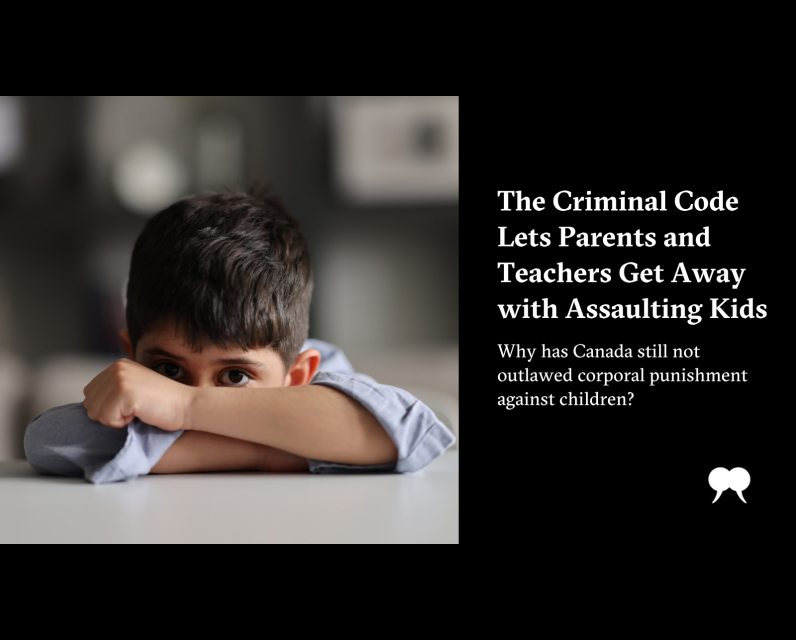
The Criminal Code Lets Parents and Teachers Get Away with Assaulting Kids
This story contains details about violence against children that some readers may find disturbing.
During the summer of 1994, the American Peterson family were holidaying in Canada. The parents, David and Paula, along with their children, Rachel (five years old) and William (almost two), were celebrating Paula’s birthday at an Ontario restaurant. At some point, David and the children left the restaurant to collect a gift for Paula that was in the car. The children were in the back seat and, as noted by the Ontario provincial court judge hearing the case, “almost immediately, young Rachel started to misbehave. She started fighting with her brother” and pushed him out of the open car door. When William attempted to climb back in, Rachel slammed the door of the car on her brother’s fingers. He screamed. David pulled Rachel out of the car, placed her across the trunk, and administered a “bare bottom spanking.” The event was witnessed by a number of people, one of whom called the police, and David was charged with assaulting Rachel. The story hit newspapers across the country.
I read the news reports at the time and knew that the chances of David Peterson being convicted of assault were slim to none. The reason being that parents, teachers, and others acting in the place of parents are provided with a defence within the Criminal Code of Canada. Section 43 is one of several defences within the Criminal Code that permits the use of force in specific incidences. Section 43 excuses those who use physical force on children for the purpose of correction, making children the only group of people specifically mentioned in the Criminal Code upon whom corporal punishment can be used. It states:
Every school teacher, parent or person standing in the place of the parent is justified in using force by way of correction toward the pupil or child, as the case may be, who is under his care, if the force does not exceed what is reasonable under the circumstances.David was successful in using section 43 as his defence. The Ontario court ruled that the physical punishment he meted out upon his five-year-old daughter was “reasonable under the circumstances,” and thus the assault charge against him was dismissed.
Childhood, according to seventeenth-century French cleric Pierre de Bérulle, “is the most vile and abject state of human nature, after that of death.” American law professor Susan Bitensky describes childhood as moving “in dark shadows that loom large with fear and pain.” I argue that these shadows are cast by adults with the backing of legal authority and power to use corporal punishment on young children, all in the name of discipline.
Children, like adults, value their personal safety. As adults, we object to and are insulted by slaps and blows to the body. Yet, even though our sense of outrage and shock over intrusions into our personal security is, at times, visceral, we do not as easily acknowledge the same reaction in children. Such an inability to empathize with children is a curious fact, particularly since we all were children once. Why is it, then, that corporal punishment is still permitted and, in fact, is a legal entitlement in many jurisdictions, including Canada?
Corporal or physical punishment is defined by the United Nations Committee on the Rights of the Child as any punishment in which physical force is used and intended to cause some degree of pain or discomfort, however light. Most involves hitting (“smacking,” “slapping,” “spanking”) children with the hand or with an implement—whip, stick, belt, shoe, wooden spoon, etc. But it can also involve kicking, shaking, or throwing children, scratching, pinching, burning, scalding, or forced ingestion (for example, washing children’s mouths out with soap or forcing them to swallow hot spices).
At the same time, it is considered a violation of the Criminal Code to apply force upon another without their consent—such force is considered an assault. Section 265 of the Criminal Code states that a person commits an assault when they apply force to another without their consent, threaten to apply force to another, or impede a person while carrying a weapon. However, there are times and circumstances in which using force on another person is justified, and the Criminal Code provides defences that can be applied to justify their actions. For example, section 37 allows the use of force to defend oneself and others under one’s protection as long as the force used is no more than is necessary; section 38 provides a defence for those who use force to protect their property as long as no bodily harm is caused to the trespasser; and section 45 protects those who perform skilled and careful surgical operations for the benefit of a patient.
Section 43 is another defence, one available to parents, teachers, and others standing in their place who use force to correct a child’s behaviour. The section provides protection to only one professional group: teachers. Others who work with children—such as daycare workers, social workers, coaches, camp counsellors, religious leaders, and nurses—are not included.
If needed, there are other defences that these professionals can use to protect themselves from charges of assault when the force they use on children is for their care and protection. Courts have recognized the duty of care parents and teachers have to children and students. This includes providing nurturing care that may involve restraint, such as putting a child in a car seat or preventing them from running onto the street. These are considered acts of care and protection of the child, and as such, parents who engage in them can be protected from possible criminal repercussions.
Section 43 has been part of the Criminal Code since 1892. The only change made to the original has been the elimination of other identified groups upon who corporal punishment could, at one time, be administered. Those originally included were sailors, apprentices, and prisoners. In 2001, section 446 of the Criminal Code was amended to provide stiffer penalties to those who “wilfully cause pain to an animal.”
The only group left vulnerable to physical punishment is one of the most vulnerable groups among us: children.
But if there is no defence for owners of animals who wilfully cause pain, suffering, or injury—and there should not be—why provide a legal defence for those who cause pain, suffering, or injury to children? Today, the defence available to those who were entitled to use physical punishment on sailors, apprentices, prisoners, wives, or animals is gone. The only remaining group left vulnerable to physical punishment is one of the most vulnerable groups among us: children.
To this day, in Canada, parents, teachers, and others who act in the place of parents can physically assault children. Despite the promise of and expansion of children’s rights within the Canadian Charter of Rights and Freedoms, the United Nations Convention on the Right of the Child, and numerous attempts to repeal section 43, nothing of any significance has changed. As of 2025, sixty-seven countries worldwide have done away with their equivalent of section 43—but not Canada.
I had written previously about child physical punishment, calling for an end to its use as a form of discipline and seeking the repeal of section 43. The Peterson case spurred me on to apply the law—the Canadian Charter of Rights and Freedoms—in my challenge of section 43. The Charter challenge argued that section 43 of the Criminal Code violated the equality rights of children under the Charter (section 15), as well as their right to “security of the person” (section 7), and that corporal punishment is a form of “cruel and unusual treatment” (section 12). The case, carried forward by the Canadian Foundation for Children, Youth and the Law (CFCYL), was eventually heard by the Supreme Court.
On January 30, 2004, the Supreme Court issued its ruling in the case of the Canadian Foundation for Children, Youth and the Law v. Canada (referred to as Foundation). In a 6–3 split decision, the Supreme Court ruled that section 43 of the Criminal Code does not violate the constitutional rights of children as enshrined in the Canadian Charter of Rights and Freedoms. It was an extremely disappointing ruling for those advocating for children’s rights—and a decision that has been roundly denounced.
The outcome in this significant Charter challenge was derailed by the court’s focus on parental rights.
The Supreme Court, in upholding the constitutionality of section 43, ruled that the purpose of section 43 was to “carve out a sphere within which children’s parents and teachers may use minor corrective force in some circumstances without facing criminal sanction” and that “this section provides a workable, constitutional standard that protects both children and parents.” Mark Carter, a legal scholar, observes that “no other criminal law provisions compares to section 43’s sanctioning of the use of violence by private individuals against innocent and uniquely vulnerable third parties—children—based upon the unfortunate accident of the children’s relationships to their attackers.”
The decision of the court’s majority considered, first and foremost, the rights of parents and adults. It missed the rights of children. The outcome in this significant Charter challenge was derailed by the court’s focus on parental rights. The court did this while rejecting any consideration of scientific evidence regarding the harm of child physical punishment, Canada’s obligations under the Convention on the Rights of the Child, subsequent international directives, and possible alternatives to child physical punishment. The decision fit squarely within the traditional conservative model associated with the notion that children are the property of their parents.
The Supreme Court limited the defence of “reasonable” force by setting what is referred to as the “zone of risk,” outlining the circumstances under which a person using physical punishment on a child could not use section 43 as a defence. A person steps outside the section 43 defence when he or she is not the child’s parents, when the child is younger than two or older than twelve, when the child is not capable of learning from the correction, when the force used exceeds what is considered trifling and transitory, when an object is used, when the force is not for corrective purposes but rather is the result of anger, and when the punishment is degrading, inhuman, and harmful.
Regrettably, the outcome of the Supreme Court’s majority decision left in its wake utter confusion. The case of R. v. A. (M.) provides a compelling case study of the confusion and arbitrariness which abounds in adjudicating child physical punishment within the current context of section 43.
The father, referred to as A. M., of a six-year-old girl, A. A., was acquitted of three charges of assault on his daughter because the judge was not satisfied “beyond a reasonable doubt” that the incidents either occurred or that they exceeded what was considered “reasonable.” The father was charged with three counts of assault. The first being the alleged spanking, the second resulting from allegedly knocking his daughter off the bed, and the third charge referred to the father shaking his fist at his daughter.
The parents were separated, and A. A. had been staying with her father for the weekend when the incident happened. The mother of the child called police after noticing bruises on A. A.’s buttocks that she said looked like handprints. According to the decision, the daughter was in bed and started screaming, waking her younger brother. The father told her to stop or he would spank her. She continued screaming, and he spanked her. She also fell to the floor while the father was removing her urine-soaked pajama bottoms.
The child said her father spanked her ten times. She was cross-examined and, again, said he spanked her ten times. During re-examination, she said he spanked her two times. The father said he spanked her two or three times. Later, during cross-examination, he said he slapped her once. A forensic pathologist provided expert evidence. He had examined the pictures of A. A.’s bruised bottom and said the bruises were typical of those made by a strike of an adult hand. He said, “We characterize this as forceful spanking, these types of injuries.”
However, the judge in this case, after making reference to the Foundation case, described the boundaries set by the Supreme Court in the case as including “the fact that the force applied to the child must have been intended to be for educative or corrective purposes, relating to restraining, controlling, or expressing disapproval of the actual behaviour of a child capable of benefiting from the correction.” The judge stated that the section 43 defence is available to the father only if he “subjectively believed” that he was using reasonable force, and the force was “objectively” reasonable under the circumstances.
Even though the judge found that the father “spanked her hard enough” and “with sufficient force to leave . . . bruises . . . that took one to two weeks to go away, he was not convinced it exceeded what is deemed “trifling or transitory.” He reviewed several cases presented to him by the father’s counsel to determine the limits of “trifling or transitory.” He accepted as a legitimate guideline a 2001 decision in which the parent of a child had used a belt to administer “a spanking of two or three blows, one of which left a bruise in the shape of the belt buckle.” The judge quoted from the 2001 decision which said, “When appropriate deference is shown to the parent’s value system and to their decision that they see the transgression as serious, the infliction of some pain and a bruise that is merely transient or trifling in nature . . . cannot . . . constitute unreasonable force,” and since the “spanking” was considered “transient or trifling,” it was not unreasonable force.
Other cases taken into consideration by the judge in determining what was considered “transitory and trifling” included striking an eleven-year-old on the face hard enough to leave finger marks and another case of spanking a child “hard enough to produce two small bruises and hand marks which lasted for at least several hours.” All of the cases referred to by the judge, in order to determine what is considered “transitory or trifling,” were heard prior to the 2004 Foundation case.
The judge quoted the Supreme Court, saying that “the gravity of the precipitating event is not relevant,” yet when the mother was being cross-examined, she “conceded . . . that A. A. is a handful at times and does not always do what she was told to do.” This comment from the mother, which one might interpret as evidence of the child’s behaviour leading to the “precipitating event,” was considered by the judge.
As we know, all persons charged with a criminal offence are innocent until proven guilty—that is, when they are determined guilty “beyond a reasonable doubt.” This is the standard of proof in a criminal case. Thus, every case of child physical punishment must meet this standard. Clearly, this is worrisome for several reasons, as evidenced in this case of A. A. One wonders what chance any child has if they carry the burden of proof, have been a “handful at times,” and suffer the bruises.
A significant step in ensuring that children are no longer subject to physical punishment is to get rid of the defence in the Criminal Code that exempts parents and others from charges of assault when they use force on children. This requires the federal government to repeal section 43 of the Criminal Code. Attempts at repealing section 43 have spanned decades and involved at least nineteen Private Members Bills (PMBs) and numerous legislative reports. More recently, the Truth and Reconciliation Commission’s (TRC) Report documented the history and impact of residential schools on the lives of Indigenous and Metis children and called on the government to repeal section 43. The report contained ninety-four Calls to Action designed to address the intergenerational impact of residential school on Indigenous people and to address systemic racism.
Call to Action 6 focused on the issue of child physical punishment, which was a traumatic part of residential schooling. The TRC detailed the physical abuse meted out on Indigenous students in order “to ‘civilize’ and Christianize” them. The TRC said it “believes that corporal punishment is a relic of a discredited past and has no place in Canadian schools or homes.”
When Justin Trudeau won the federal election in 2015, he promised to enact all ninety-four Calls to Action. In 2015, the Liberals had a majority government; this was reduced to a minority government in the following election. However, between 2022 and 2024, the federal Liberals were supported by the New Democratic Party, which might have allowed them to repeal section 43, but they did not do so.
As long as section 43 exists within the Criminal Code, children will be burdened with proving the assault took place.
Two PMBs were then introduced in Parliament within a few weeks of each other. The first was tabled in the House of Commons, on May 19, 2022, by member of Parliament Peter Julian (Bill C-273), and the second was tabled in the Senate by Senator Stan Kutcher, on June 16, 2022. Both bills sought full repeal of section 43, but in January 2025, Trudeau resigned as prime minister and prorogued Parliament. Once Parliament is prorogued, all bills that were in progress are wiped off the parliamentary agenda. If a new bill is introduced, the whole process has to start over.
As long as section 43 exists within the Criminal Code, children and their advocates will be burdened with proving the assault took place “beyond a reasonable doubt.” This is a momentous wall to climb when relying on the evidence of children who find themselves buttressed up against the social normalcy of child physical punishment.
The criminal law system was not made with children in mind. To leave things as they are is unconscionable. Children are being harmed, and Canada is disregarding its international obligations to protect children from all forms of physical violence and ignoring the overwhelming evidence that documents the harms associated with child physical punishment.
Adapted and excerpted, with permission, from Spare the Child: Ending Childhood Corporal Punishment by Ailsa M. Watkinson, published by the University of Regina Press, 2026. All rights reserved.
The post The Criminal Code Lets Parents and Teachers Get Away with Assaulting Kids first appeared on The Walrus.
Comments
Be the first to comment