
Stay informed



How a US Invasion of Canada Would Really Unfold—And How We Fight Back
What to make of a United States which threatens the sovereign territory of an allied democracy? Which invades another country to snatch its head of state and then makes the rest of the regime “an offer it can’t refuse” with respect to its oil resources? Where the head of the central bank is subjected to a sham criminal investigation for refusing to let the head of state interfere where the law forbids it? Or in which gangs of masked government thugs roam the streets, picking up anyone they wish and consigning them, with seemingly no due process, to a semi-legal hell on earth—and even shooting citizens who get in their way with seeming impunity?
It is almost beyond comprehension, as is the fact that much of the American political and judicial system has simply stood back and let this happen. This is, after all, a system founded on separate but equal branches of government whose primary function is to check one another and prevent the rise of the kind of despotic monarch Americans rejected when they handed in their British citizenship.
The situation prompts one to think the unthinkable. We now live in a time where, even if something remains highly unlikely, it is no longer impossible.
And so, as President Donald Trump continues his semi-invasion/proxy takeover of Venezuela and keeps threats to Greenland simmering, my thoughts turn to an unsettling question. What would we do if our restive neighbour to the south decided to test, once again, Thomas Jefferson’s maxim, propounded in 1812, that taking Canada is “a mere matter of marching”? How would we actually defend ourselves?
The analysis would depend on the related questions of why the Americans would go about invading us and how they would do it. On the question of why, Trump’s mercurial personality makes it difficult to base an answer on presumption of rationality. If Canada’s relations with him deteriorate to the point that he is seriously thinking of military action, that point will probably come after an acrimonious exchange over something like his desire to own our resources and/or control our Arctic—in both cases, for reasons of “national security.”
Presumably, we will have rejected a set of egregious demands, and he will turn to unsubtle military threats (likely framed as “everything is on the table”) to soften us up. In this telling, Trump’s actions are best seen as an example of hard-nosed bargaining. But deeper psychological imperatives cannot be dismissed, including a desire to be viewed by history as the man who more than doubled the size of the US and accomplished its “manifest destiny.”
This is a goal American leaders have pursued since before the Revolutionary War. In 1774, even before declaring independence, the First Continental Congress approved an open letter to the residents of what would become Canada, urging them to join—or face the consequences: “A moment’s reflection should convince you which will be most for your interest and happiness, to have all the rest of North-America your unalterable friends, or your inveterate enemies.” In 1775, the fledgling American forces attempted an invasion of Canada but were repelled. They would try again in 1812.
On the question of how the Americans might invade Canada, it is obvious that, if they decided to pull the full “shock and awe” special, we would be up the proverbial creek. But it seems unlikely they would do this. Our cities and infrastructure are valuable and would have to be expensively rebuilt after the conquest. Why bomb them? Moreover, if the purported political cover story for the attack is that, by making us Americans, Trump is merely doing that which we Canadians have always secretly longed for, hammering us seems counterintuitive. It is tough to make the argument that we are on the cusp of becoming the “cherished fifty-first state” when the missiles fall. So, an all-out shit-kicking is probably not in store.
In terms of the diplomatic prelude to a takeover, Trump’s negotiating style does display some traits that are, at least, consistent. When he really wants something, and the other side has said it won’t budge, his first move is to punch them in the face, verbally at least, and then demand something preposterous. The bargaining starts from there, backed up by steadily graduated pressure in the form of ever more outlandish statements and threats designed to sap our will and cause us to voluntarily see the light.
Most of this, as Trump has promised, would be economic in nature, with a generous dose of disinformation, cyber, and other such “soft” attacks thrown in, all intended to disrupt our economy and national life and to get us to question the reality that is unfolding before us. Almost certainly, it would involve support for Alberta separatists to try to weaken Canada and create an argument that MAGA has supporters here. This has already begun with the recent comments of the US treasury secretary gently urging the process along.
But one can also imagine a bit of physical intimidation to help us get the point. This could take the form of raids across the border by the US military to destroy some things or capture a leader or two. But it could also come in the form of irregular forces coming to stir things up.
When Vladimir Putin first invaded Ukraine in 2014, regular Russian troops were preceded by what were known as the “little green men”; special forces in camouflage but without any official insignia so that Putin could deny involvement. But what these irregulars did do was cause enough trouble to allow Putin to say that he was moving regular troops in to “restore order” and protect the ethnic Russian population of the affected areas.
So, Canada might perhaps face—as it deals with a steadily worsening economic and public order crisis—pin-prick attacks designed to throw Canadians further off balance. These could be undertaken by regular US troops in mufti but also by that growing army of MAGA extremists who attacked Congress on January 6—and whom Trump pardoned to serve as his private army. Using them would give Trump plausible deniability, but the message would be clear: heavier consequences will follow if we don’t smarten up.
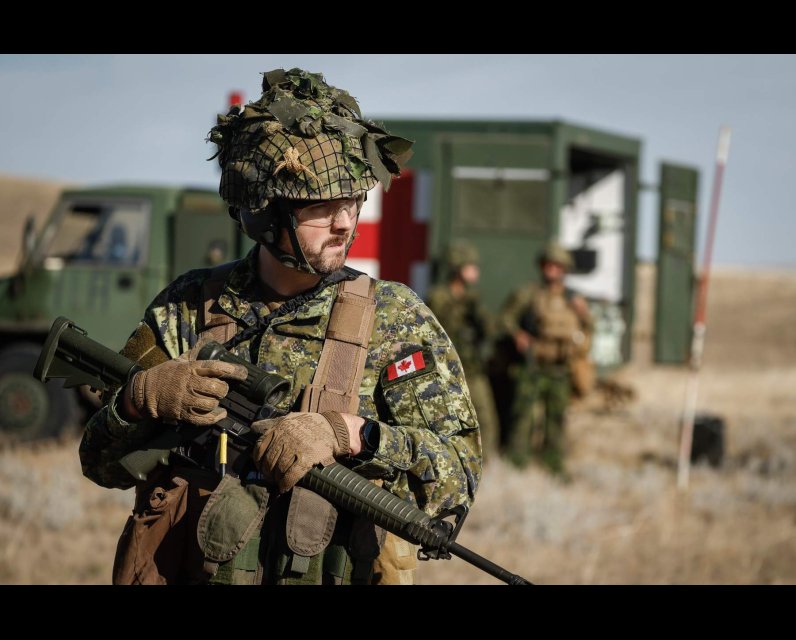
Much would depend on how Canada responds. Certainly, there is a need for our military and other security forces to be ready to forcefully engage, and not as a law enforcement operation but rather as a response to groups threatening our national survival. Trump will rely on our natural reluctance to do this for fear it would escalate the situation.
This is what happened in Ukraine in 2014. Ukrainians hesitated over confronting the little green men directly to avoid provoking Russia into doing even worse. But, of course, Putin fully intended to do worse all along; he was testing the waters to see how far he could go. So, it would be a mistake not to respond if Trump tried his own version of this tactic. This has to be met forcefully and quickly, or Trump will be able to sell the idea that Canadians aren’t really serious about defending their country.
The lesson of Ukraine is clear. Doing nothing in the hope Trump will be impressed by the restraint is a fool’s errand. All it will get us is further escalation. Some thought should be given as to where in Canada these pin-prick attacks may be likely and how we can best make the point that we are serious in meeting them.
A critical aspect of this skirmishing phase would be American public opinion. Polling consistently shows that Americans, of all political backgrounds, strongly oppose any takeover of Canada against the will of the Canadian people. Though quislings may be willing to argue that this is something Canadians secretly desire, we must show the American people the opposite. A clear lack of public support in the US could prevent Trump from moving much beyond this stage.
As an aside, gratuitous anti-American actions, like booing their national anthem at hockey games, may be satisfying and understandable under the circumstances, but we should give thought to whether it’s really such a good idea. Since the various branches of the actual US government are apparently incapable of containing Trump, the American public is probably going to be our greatest ally in terms of restraining him. We are certainly well within our rights to make it known we detest what Trump’s government is doing, but insulting Americans may not be so smart; we may need them.
Assuming we fail to get the message through, and if Trump believes he has the political backing to keep going, things could get warmer. Again, while an all-out war is doubtful, if it comes to a matter of Canadian military units having to fight their American counterparts in conventional battles, we won’t last long. Just one sharp attack could obliterate our limited military bases and infrastructure.
So, the objective becomes putting up a conventional fight, as long as we can make it clear we don’t accept any occupying forces, but then be ready to melt away for what will be a campaign to make the takeover as difficult as possible.
That task of making US occupation untenable can be quietly prepared in advance, and the Defence Department’s call for a reserve force of 100,000 and a supplementary reserve of 300,000 is interesting when seen in this light. Of course, these capabilities won’t be ready before Trump has left office, but some elements of a decentralized but still organized resistance could be prepared and dispersed across the country in a matter of a few months. This can include the military reserves we do have, retired military people, and groups like the Royal Canadian Mounted Police and other police forces who know the communities they reside in intimately. Weapons, explosives, IEDs, drones, and other supplies can be disbursed across the country and secured.
The Ukrainians have shown what can be done by determined resistance, making use of new technologies, such as drones. Since the Americans will likely try to silence the federal government in Ottawa as a first order of business, we must prepare for the elements of this resistance to operate largely independently across the country until central authority can be restored.
The key in all this will not be to defeat the Americans but to force them to make their occupation of Canada just that—an occupation. The lie that Canadians have accepted this invasion cannot be allowed to take hold; Americans, and the world, must see that Canadians do not accept this and are fighting back. The trick of finding pliable Canadians to govern on Trump’s behalf, as the Americans are trying to do in Venezuela, will be tried, but whoever they install in power must be resisted.
Thus, if we cannot defeat the Americans, we can make their grip on the country as costly as possible. We should also not be without an ability to send small units across the border to mount guerrilla-style attacks against critical American infrastructure. Their deepest hope will be that they can digest Canada without much resistance. Our strategy must therefore lie in making ourselves as “indigestible” as possible until the American public insists that this attempt to take over Canada be stopped. This will test Canadians, as casualties will go both ways. We must be prepared for that.
And, of course, while all of this is going on, the wider world will be going crazy. The Danish prime minister’s remark that an attack on Greenland would be the end of NATO could be multiplied dozens of times in the case of an actual American attack on Canada. An America which had gone so utterly rogue as to actually invade Canada would be something the international order could not live with. The global economy would be upended, for a start.
An American invasion of Canada would almost certainly trigger a severe economic crisis in the US. Even if other countries were unwilling or unable to intervene militarily, the global response would be punishing. Canada should therefore be quietly coordinating with international partners now to prepare a devastating economic counter-response to any such move. The experience of Greenland is instructive: when the European Union signalled that it was prepared to deploy the full range of its financial tools—the so-called trade “bazooka”—if Trump acted, that threat alone may have been enough to make him back off.
We should not, of course, overlook the possibility of a more limited US incursion into Canada. What if, following on from the line that it’s all about Arctic security, the Americans were to invade a part of our Arctic and declare it to, henceforth, be under the permanent “protection” of the US? They would presumably then go about the task of establishing a base there. This scenario would be difficult to respond to, though less personally dangerous for the majority of Canadians living in the southern part of the country. It would amount to their taking part of our country and then daring us to try to kick them out.
What would we do? How would we do it? At the very least, we need to think hard about capabilities we could bring to bear. Presumably, diplomacy aimed at the American public and international opinion would be a major part of the response, but military and economic options to make their stay on our territory much harder than they anticipate could also be looked at.
I don’t believe that any of this is necessarily likely. Several times, I have been shaking my head as I wrote this piece.
But the fact that we live in a world where we have to actually think about it, however fleetingly, shows us where we are today. Even if Trump won’t actually invade us, the challenge he has posed to our national survival is real. We have no choice but to regard the era of free trade and continental integration as over and to prepare for a future where our relations with the US, and the rest of the world, will be very different.
Complete separation from the US is not possible, and some level of co-operation in such areas as aerospace defence of the continent will go on, at least for a time. But we must diversify our economy and defence relations away from them to the maximum extent possible. That will not be easy, but what choice do we have?
The post How a US Invasion of Canada Would Really Unfold—And How We Fight Back first appeared on The Walrus.
Unpublished Newswire

Comments
Be the first to comment