
Stay informed



Poilievre Isn’t Pivoting. His Party Just Made That Very Clear
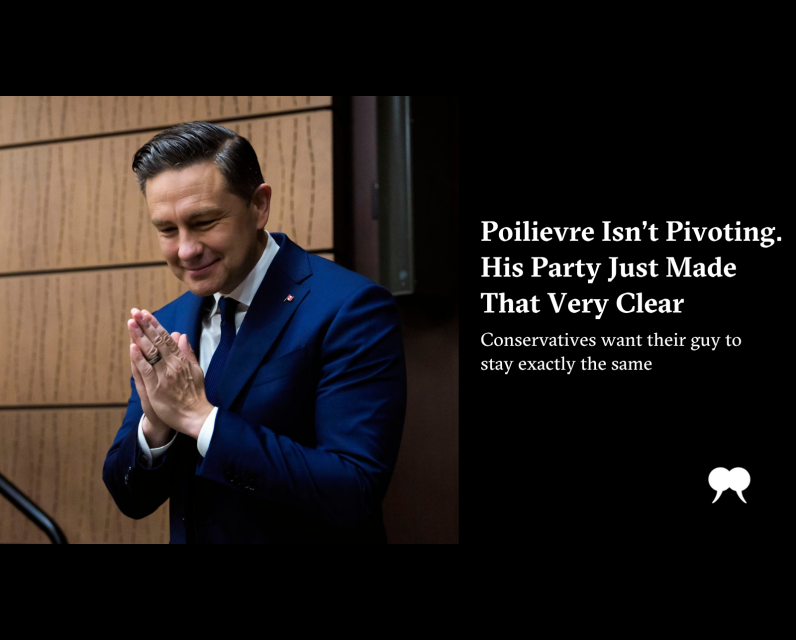
Conservative delegates’ resounding show of support for Pierre Poilievre’s leadership in Calgary is more interesting than a more tentative vote would have been. The way people talk about Poilievre in Ottawa and Toronto, including a lot of long-time Conservatives, suggests they think he’s trying to be like Prime Minister Mark Carney, and he’s bad at it. The weekend’s events in Calgary suggest Poilievre’s trying to be different from Carney, and that the party thinks he’s good at it.
No leader is safe forever. Three more floor-crossing members of Parliament or some unimaginable caucus revolt could yet bring Poilievre’s career crashing down. But don’t expect either. The party just had an effective, relatively painless chance to force Poilievre out—and rejected it resoundingly. The Conservative Party of Canada is now, in effect, all in on Pierre Poilievre.
Nor do I expect a big pivot in his style or issue set now that he’s past the review, and I don’t really understand claims that he’s already executing a pivot. See “trying to be different from Carney” above. Poilievre’s bet is that the Conservatives can hold more of their 2025 vote than the Liberals can hold of theirs. The Liberals’ share of the popular vote in 2025 increased by twice as much as in the Trudeaumania year of 1968. That’s a lot of new Liberal votes, many of them cast by people who don’t particularly think of themselves as Liberal voters. Poilievre will try to change their minds. But, mostly, he hopes Carney will change their minds—by disappointing them. That’s not guaranteed to happen, but neither is it foolish to hope it might.
Poilievre’s forty-nine-minute keynote speech—thanks to Global News for publishing a full transcript—mentioned “Carney” nine times, “Liberal” twenty-one, “God” four, “afford” ten, “tax” thirteen, “Donald Trump” not at all. It was mostly an economic speech, pitched street level instead of macro. Not a speech about the health of some atmospheric phenomenon called “the Canadian economy” but about the personal prospects of the people listening.
“Young people are wondering if they’ll ever have a job or a home,” he said. “Worried parents are sitting at kitchen tables with empty fridges and empty bank accounts, and seniors worry that their savings might not last as long as their days.”
It’s not that times are tough all over, he argued, but that rapidly growing Liberal governments have made times tough at home. “The cost of government is driving up the cost of living. Taxes and record money-printing deficits are inflating everything. It’s no coincidence, therefore, that as the Liberal government doubled the debt, housing costs and food bank lineups doubled at the very same time.”
This sort of talk is often called alarmist. Very well, says Poilievre in effect: the people who think it’s alarmist can vote Liberal, while the people who think it’s real vote Conservative. “These costs are so often unseen,” he said. “And even more often, so, too, are the people paying them. But my message to those people who have felt unseen for too long, who are carrying the country on their back and feel underappreciated and overworked: Conservatives see you, and Conservatives will fight for you.”
I was told, over the Christmas holidays, that Carney’s staff are quite concerned that this discourse hits them where they’re vulnerable and are preoccupied with finding ways to counter it. Well, they should be: the last time Liberals won a majority of seats in a Canadian Parliament, they had a leader who was talking about similar concerns. “How will we help our young people to get a good start in life and a good job?” Justin Trudeau said at the last Liberal convention before he won the 2015 election in a near-landslide. “How will we help Canadians who are strangled by their debt and who have no savings for retirement?”
It was concern over the Poilievre message—and the facts of life for Canadians—that put Carney in a grocery store last month and a GST break on Parliament’s agenda this month. It’ll take more than a shelf full of grapefruit to keep the polls on Carney’s side, and I’m sure he’s planning more, and the tension between the two leaders’ agendas is probably healthy. It reflects real disagreement among Canadians, and reflecting disagreements is one of the reasons we elect a whole Parliament full of MPs.
I think some of the most interesting work on Canada’s divided political culture has been done by David Coletto at Abacus Data. In an analysis of some large-sample surveys last week, Coletto wrote about differences in perception between people who already vote Conservative and those who don’t. He divided respondents into four groups: a “Conservative base,” 23 percent of the current electorate who only ever consider voting Conservative; a larger group of “Conservative voters,” 35 percent of respondents, that includes the base and anyone else who currently expects to vote Conservative; “Accessible Conservatives,” 14 percent who would consider voting Conservative but don’t currently plan to; and “everybody else,” Liberals, New Democratic Party, Bloc Québécois, non-voters, what have you, fully 65 percent of the electorate.
A Conservative probably can’t become prime minister without getting at least a little support from that “everybody else.” But Coletto found consistent differences on issues and attitudes between Conservative-friendly voters and that everybody else. So, 45 percent of Conservative base and voters want Poilievre to be more conservative; 50 percent of everybody else wants him to be less conservative. More than half of Conservative base and voters want him to be more confrontational; 81 percent of everybody else want him to be less confrontational. So, the stances and language that keep Poilievre from easily expanding his vote are the same stances and languages his supporters like. Bit of a Catch-22 there.
Poilievre clearly worked on his speech more than on most other speeches he’s ever given. Results were mixed. He smiled determinedly, even doggedly, all the way through, as if competing for a door prize. He referred offhandedly to Carney’s “strategic partnership with China for a ‘new world order,’” conflating two things Carney definitely said in ways that will resonate strongly with evangelical voters. He’s always calculating for maximum effect, and he has never been good at keeping that from being entirely obvious.
But if Canadians voted for the finest orators, Jean Chrétien would never have been prime minister. People vote from a rough sense of who hears their concerns and seems able to respond. Little else matters as much as that. Is it possible to imagine a future in which the cross-border fight against Trump feels futile, its champions spent? Sure, it is. If that future comes, Poilievre wants to be available. Not genius or villain, just . . . handy.
Originally published as “All smiles” by Paul Wells (Substack). Reprinted with permission of the author.
The post Poilievre Isn’t Pivoting. His Party Just Made That Very Clear first appeared on The Walrus.
Unpublished Newswire



Comments
Be the first to comment