
Stay informed



Quebec’s Olympic Hockey Heartbreak
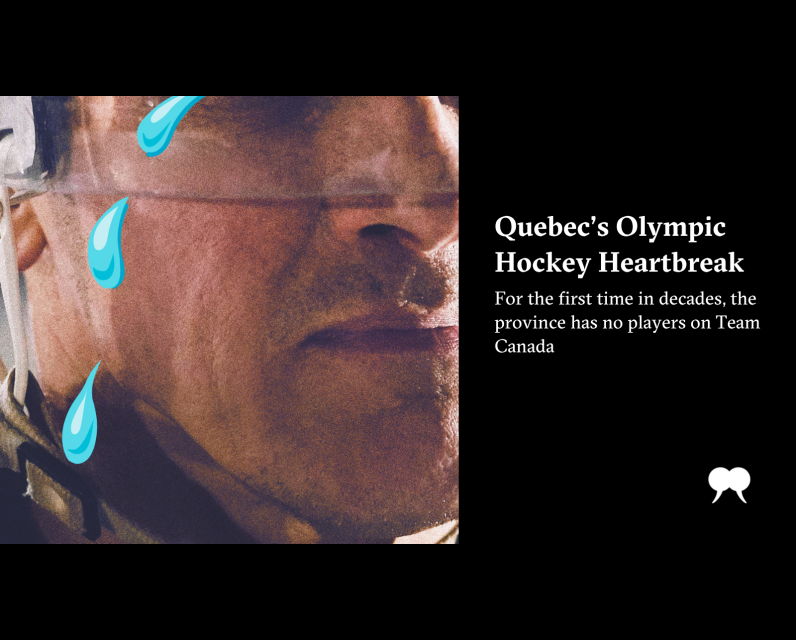
In a few days, when the Canadian men’s hockey Olympic team laces up their skates for their first game at the Milan–Cortina Games, there’ll be someone missing: Quebec players.
The province has traditionally supplied an average of four Quebec-born players per squad since the National Hockey League began allowing teams to send players to Olympic rosters. In 2010, at the Vancouver Olympics, when Canada won gold, all three goalies were Quebecers: Martin Brodeur, Marc-André Fleury, and Roberto Luongo.
In a historic first, since 1952, Canada’s twenty-five-man hockey delegation won’t have anyone from la belle province, where the game was born, where kids are raised to bask in the memory of Les Glorieux, and where the Montréal Canadiens’ legacy of twenty-four Stanley Cups (the most in the NHL) acts as a unifying force, transcending language and politics.
While the news reverberated across the country, in Quebec it was treated as a national tragedy, prompting hard questions about the province’s ability to produce elite talent. On social media, Montreal journalist Brendan Kelly called the Team Canada roster announcement an “indictment of Hockey Québec,” referring to the provincial body in charge of moulding future national players.
The author of Habs Nation: A People’s History of the Montreal Canadiens, which explores the deep relationship between Montreal’s legendary hockey team and Quebecers, Kelly says he understands why Quebecers are alarmed. “We live for hockey here,” he says. “It’s such an important part of our history, and it’s just fallen off the cliff. And successive Quebec governments have just sort of let it happen.”
The decline appears to have multiple causes. Hockey participation has fallen as soccer and basketball gain ground, while rising costs have made the sport inaccessible for many families. The shortage of outdoor refrigerated rinks means less ice time for development, and abuse and hazing scandals in the Quebec Maritimes Junior Hockey League—culminating in the resignation of its commissioner in 2023—have only further eroded the sport’s appeal.
But that still doesn’t explain why Quebec, which produced hockey legends like Patrick Roy, Claude Lemieux, and Vincent Damphousse, lags so badly and why other provinces are doing so much better. “People are turning away from hockey, it’s true,” Kelly says. “But it’s true everywhere.”
The data shows Ontario consistently acts as the leading producer of NHL players, typically outnumbering Quebec-born players by roughly three to one. Quebec, with over 9 million residents, is sending no one to Milan, while Nova Scotia, with just over 1 million, is sending Sidney Crosby, Nathan MacKinnon, and Brad Marchand.
In 2021, Quebec premier François Legault established a fifteen-member committee to find ways to relaunch hockey in the province, prompting sports journalist Pat Hickey to proclaim, “Quebec’s two most popular sports—hockey and nationalism—came together.”
The line between hockey and nationalism, however, has always been thin in Quebec. From the Maurice “Rocket” Richard riots of 1955—often cited as a spark of the Quiet Revolution—to a Montréal Canadiens franchise explicitly created to represent French Canadians, to the enduring legacies of Guy Lafleur and Jean Béliveau, hockey has long been bound up with Quebec’s sense of itself. Even the “Go, Habs, Go!” chant became a cultural flashpoint after Quebec’s language watchdog deemed it an anglicism and banned it from appearing on electric signs on Montreal buses (a decision quickly ridiculed and reversed).
Local politicians know the tradition well. Last year, Quebec’s minister of culture and communications, Mathieu Lacombe, tabled a bill to make hockey Quebec’s national sport. Starting this year, the first Saturday in February is designated “National Ice Hockey Day.”
As for the committee’s proposals, nothing really came of them. Suggestions to improve facilities and coaching all require more money, which is perhaps why the Coalition Avenir Québec government was content with the gesture of simply declaring hockey as the national sport.
And yet, despite present obstacles, Quebec’s bond with hockey remains profound, rooted in history. For generations of French Quebecers, hockey offered a platform for public accomplishment at a time when economic and political control rested largely with the English-speaking minority.
That history is why this moment hits a nerve. Sébastien Lemire, spokesperson for sports for the sovereigntist Bloc Québécois, said Quebec’s omission reflected “systematic discrimination against Quebecers” and sent a clear “message” to the province.
In an op-ed for La Presse, Simon-Pierre Thibeault, a master’s student in sociology, wrote that the absence of Quebec players “accentuates the marginalization of Quebec.” He later argued on a radio talk show that Canadian players cannot genuinely represent Quebecers because they lack the cultural references needed for Quebec fans to identify with them.
As compelling as these arguments by Quebec nationalists may be, hockey pundits agree the roster reflects reality. “For someone to say it’s some federal conspiracy,” says Kelly, “who didn’t they pick that they should have? There’s no one. The players simply aren’t there.”
The post Quebec’s Olympic Hockey Heartbreak first appeared on The Walrus.
Unpublished Newswire


Comments
Be the first to comment