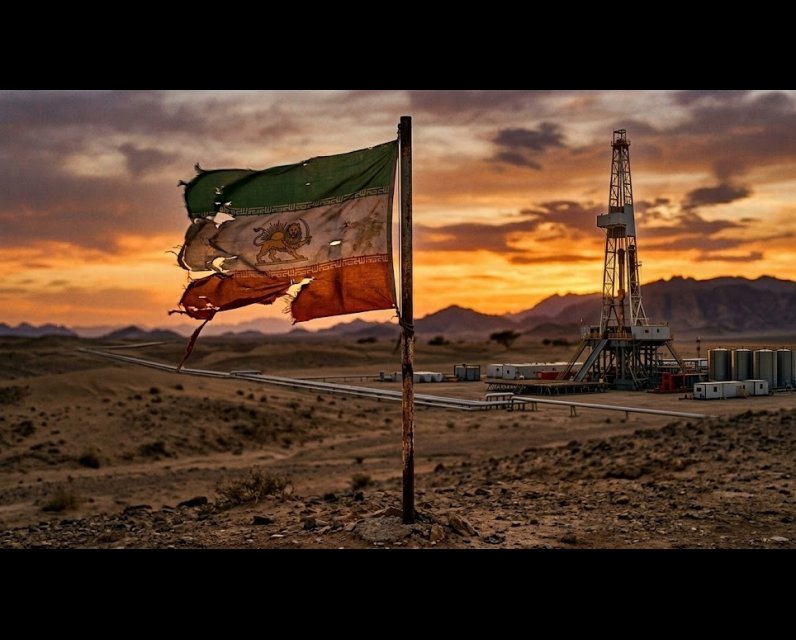
Seventy-three years ago, between August 15 and 19, 1953, the trajectory of the Middle East was rewritten by a shadow play. Iran’s democratically elected Prime Minister, Mohammad Mosaddegh, was toppled in a coup orchestrated by Western intelligence - an operation fueled not by a defense of liberty, but by an insatiable hunger for control over the nation’s massive oil reserves.
At the center of this storm was the Anglo-Iranian Oil Company (AIOC). To call it a business is an understatement; it was a "state within a state." Controlled by the British government (which held a 51% stake), the AIOC operated the Abadan Refinery - then the largest on Earth - and held a total monopoly through a 1933 concession that barred any other international firm from Iranian soil.
It is a stark historical irony: the United States’ vocal commitment to democracy and sovereignty often evaporates the moment a geopolitical map reveals a pipeline.
The fallout of that intervention did not stay buried in the 1950s. The 1953 coup didn't just install a puppet; it broke trust in democracy itself. People saw their vote meant nothing. By dismantling a secular democracy to protect British and American petroleum interests, the West inadvertently tilled the soil for the 1979 Revolution. When the Shah fled in the face of rage, the void didn't stay empty; it got filled by Khomeini and his clerics.
When you crush a moderate, democratically elected nationalist alternative, you leave a vacuum that only the most disciplined and fervent radicalism can fill.
But the justification for such interventions is rarely presented as a ledger of barrels of oil. Instead, the justification of war is rebranded as a culture war. The cold pursuit of Western commercial interests is wrapped in the noble cloth of "values," thereby disguising economic extraction as a religious or civilizational crusade.
We see this cycle repeating in the digital age. Today, the "shadow play" has moved from backroom deals to the digital front. Online Live Spaces and social media channels are increasingly occupied by intelligence assets and state-aligned actors, expertly steering the conversation. Their mission is simple: to convince the public that war is not just necessary, but a moral imperative.
Let's be honest and talk like adults for a change, Iran's oil map vs the ballot box means we are to blame...



Comments
Mohammed Mosaddegh was not a “democratically elected Prime Minister”. He was chosen by the Parliament of Iran, not by the people. Once in office as Prime Minister, he tried to fiddle with the voting requirements in order to give the parts of the country that supported him more representation in Parliament while reducing representation from non-supportive areas. Unsuccessful with his efforts to rig the elections in his favor in advance, he pulled no punches whatsoever when the counting of votes began. Knowing that his opponents had most of the support in rural areas, he arranged for votes to be counted quickly in the urban areas where he had support, then he cut off counting as soon as enough votes had been counted to elect the minimum number of MPs needed to reach quorum in Parliament. No further counting of votes was allowed, and the result was a Parliament made up of members drawn exclusively from the cities where he had strong support.
This is not what we call “democratically elected” here in Canada. Not today and not in 1952 or at any other time.
Mosaddegh nationalized the country’s oil industry and his cabinet included communists such as Hossein Fatemi. His key support in Parliament came from the Tudeh (Communist) Party . As a western ally, the CIA put a lot of resources into tracking individuals who attained cabinet level positions in western-aligned countries and who “played for the other team” so to speak. As was VERY common on BOTH sides during the cold war, the CIA did what the Soviet Union did in Hungary in 1956 and Czechoslovakia in 1968, only with a whole lot less bloodshed.
It is well known that the Soviet Union would meddle in the affairs of western nations by bribing members of Parliament to vote for “their” candidate for President. Salvador Allende was not elected president of Chile in a democratic vote as the fellow travelers in the west like to say. He was chosen by the Parliament of Chile. In Allende’s case, as we know now, he won the vote after officials of the Soviet Union paid bribes to a number of Members of Parliament. The example of Allende is enough to justify suspicion that the same thing happened with Mosadegh.
None of Hungary, Czechoslovakia or Chile have any oil reserves to speak of. Only Iran. These interventions during the cold war were without a doubt fueled by a defense of liberty in the case of western interventions and fueled by a desire to attack liberty in the case of the Soviet interventions.
Mosaddegh’s other key allied group in parliament was Ayatollah Abol-Ghasem Kashani (the Speaker of Parliament) and his group of Islamic scholars. The choice of Mossadegh and the government he led were neither democratic, nor secular.
There is no irony here. The US commitment is to democracy and sovereignty. They act when those principles are at stake. During the Cold War, those principles were most at stake when the Soviet Union started messing around in the internal affairs of western-aligned countries, notably when they started getting communist aligned individuals into key governmental positions and nationalizing key industries. That’s what drove the events of 1953 in Iran. Not some pipeline.