
Stay informed

The Yukon’s Most Important Piece of Infrastructure Is a Plastic Blue Jug
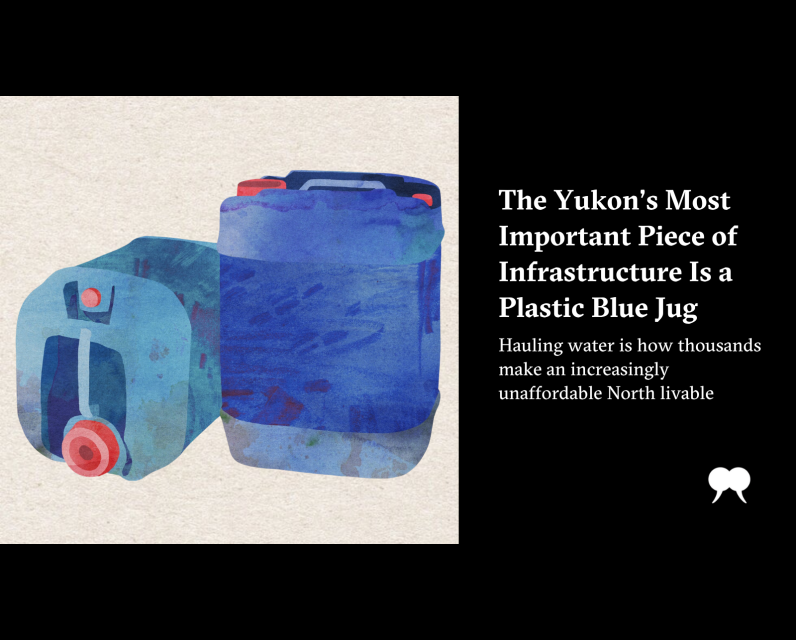
I open the faucet and water gushes out, frothing as it fills a bright blue twenty-litre plastic jug, its faded sticker declaring BUILT TOUGH. You’ve probably seen one in the outdoors aisle at Canadian Tire: a cubic jug with a red or white screw-top faucet and a built-in handle for convenience. Most Canadians would associate the blue jug with camping trips.
I’m lugging six twenty-litre blue jugs in the back of my truck to my permanent residence outside of Whitehorse, a dwelling without running water known as a “dry cabin.” These 120 litres will last myself and my partner—and our three dogs—just over a week. On average, individual Canadians use 223 litres of water a day. For us, it rounds down to just under nine.
Yukoners call us “blue juggers,” or that we’re “blue-jugging it”; the lifestyle is both a noun and a verb. We use an outhouse, even at minus forty, and shower opportunistically at my in-laws’, the cross-country ski club, or a corner gas station.
In the Yukon, a territory of 47,170 people, we belong to a fringe demographic for whom the blue jug isn’t recreational but an essential vessel. It’s difficult to say how many of us exist. Some dry cabins have formal rental agreements. Many, ourselves included, don’t count on paper but, instead, rely on handshake deals.
While modern life is built for convenience, and artificial intelligence works to erode away human labour, the blue jug stands in stark opposition. A tool of utilitarian labour, of measuring out a vital resource and valuing every last drop, the blue jug means something to Yukoners. It’s described with love and resentment, it shows up in art, it’s stitched onto wedding quilts.
I’ve learned to keep empty blue jugs in the back of my truck, always ready for the inevitable invitation to fill them. When friends invite us over for dinner, they offer a hot shower or a load of laundry. Several of them know the ritual well: they’ve lived the blue-jug rite of passage themselves before finding a way onto the grid. Sometimes I feel acutely self-aware, a forty-year-old woman filling blue jugs in a friend’s bathtub. But in the Yukon, there’s nothing strange or taboo about it. If anything, it’s a measure of intimacy, a yardstick for the depth of friendship.
The humble blue jug is quietly tied to the Yukon’s history of self-reliance and grit, of community, and trying to make a home in the so-called last frontier.
Long before the advent of the plastic blue jug, First Nations peoples procured water using vessels made from spruce and birch bark. Rivers were lifelines for fishing, hunting, and trading, including for the Kwanlin Dün, whose history in the Whitehorse area is older than 5,000 years. In Southern Tutchone, Kwanlin means “running water through canyon.”
After the construction of the Alaska Highway in 1943, the population in Whitehorse spiked through the ’50s and ’60s, prompting a housing crisis. While the federal government poured money into new housing subdivisions for army, air force, and government workers, communities of “squatters”—people occupying land without formal land tenure—sprung up along the riverbank and around town like mushrooms after a hard rain.
These communities, with names like Whiskey Flats and Sleepy Hollow, were made up of settler and First Nations peoples alike, functioning without running water or sewage systems. Despite social problems of overcrowding and poverty, residents remember a strong sense of community: neighbours looked out for one another. Government evictions started in 1953, after a major polio outbreak, and continued over the decades into the ’60s and ’70s, pushing people outside of downtown Whitehorse to settle around the city in neighbourhoods like Squatter’s Row.
New government policies in the 1980s and ’90s, including the Homesteader and Squatter Policy, offered land to homesteaders for agricultural purposes, while giving squatters the opportunity to apply for land tenure. This beckoned southerners north to live out a Yukon dream: an off-grid cabin in the woods, firewood stacked tall as a man, a dog team howling beneath the northern lights.
Mark Kelly, a Whitehorse resident, moved to the Yukon in 2000 with such a dream. In 2004, he and his partner spent a year living in a cabin in Marsh Lake, a community located fifty kilometres south of Whitehorse. Although the cabin was on the grid, the structure was so poorly insulated that the pipes froze frequently, forcing them to unhook the water pump and become regular blue juggers. The unhooked water pump was “a real insult to injury,” Kelly laughs. “We would blue jug,” he says. “Every day we’d drive into town, live an urban life, go for a coffee at Starbucks, but also fill our blue jugs and come back to our place.”
Kelly worked in Whitehorse as a family counsellor for a nonprofit. He’d sneak “free showers” at the college or pool. But the romance of the dry cabin didn’t last. “Everybody goes into it thinking, ‘I’m gonna live like this forever,’” he says sardonically. “Have a kid and then tell me how much you like a blue jug.”
Kelly, today a professional photographer, bemoans the blue jug as yet another symbol that the Yukon exports: the Gold Rush, fireweed, northern lights. It “pigeon-holes” the territory from moving toward modernity. The idea of the cabin in the woods was something of a “fantasy,” he says. “I wasn’t growing carrots in the summer. I wasn’t snaring rabbits. It wasn’t that. It was a place where it was expensive to put a water pump in.”
The blue jug narrative—toughing it out on a last frontier—is a colonial guise. First Nations are now largely in control of their traditional lands, and the Yukon government is no longer doling out free land for homesteading or rewarding squatters who illegally come to set up shop—despite social media influencers who continue to try their hand at it.
The off-grid lifestyle is dying out, Kelly argues. Dry cabins built in the ’60s and ’70s along Squatter’s Row are now expensive properties. The fate of one of the last remaining specimens in Whitehorse’s downtown—known as “the purple cabin”—is hanging on by a thread in a legal battle in the courts. Many newcomers don’t realize that Shipyards Park, today a waterfront playground and home to the farmers’ market, was once a community whose residents were forcibly evicted in the late ’90s.
For some, blue jugging is a rite of passage; for others, it’s a stopgap measure until you can get onto the grid. The latter was true for Kelly. In 2005, he purchased a home in Whitehorse with the convenience of electricity, propane heat, and running water. Today, he hangs a small, acrylic painting of blue jugs on a wooden panel, beside his kitchen sink—a reminder of that so-called simpler life.
I have a habit of taking screenshots of rustic dry cabins for rent, listed on the Facebook housing pages around Whitehorse, asking for upward of $1,600 a month. Sometimes the cabin is so tiny or ramshackle I’m convinced that it’s a joke. It never is.
The allure of the Yukon still calls to southerners—I would know, after all, having moved up from northern Alberta in 2023. Between 2015 and 2025, the territory’s population increased by 26 percent. But the cost of rent has skyrocketed in the North, particularly in and around Whitehorse, and the market has struggled to provide affordable housing. While the blue-jug life may be dying out, it can still offer a more affordable way to live in the territory.
In 2024, Myles Brown, a fisheries biologist, moved up with guaranteed work, a reasonable salary, and a mortgage back in Alberta. He was aghast at the cost of rent in Whitehorse, which felt like a “mini Vancouver plopped down in the North.” It’s something he would’ve expected in a densely populated urban centre, where space is limited and scarcity drives up the price.
“Yukon has this puzzling diametric opposition of a very small populace in a very large place,” says Brown. “Space seems tightly constrained, yet it’s the most abundant thing that’s here. It’s a funny Rubik’s cube.”
Brown lucked out, he says, in securing a more reasonably priced dry cabin outside of Whitehorse, and he found a rhythm hauling eight blue jugs into town to fill at work. He embraced the labour of blue-jugging it, he philosophized about it, the desire to put energy back into something he’d long taken for granted. “I remembered the value of water,” he mused.
There was a freedom in never having to look at a utility bill or worry about frozen pipes during the winter. “My kettle was hot, my tea was poured, my life was not interrupted,” he says.
For Brown, the blue-jug model is indefinitely sustainable so long as one accepts the labour it requires. It’s the cost of the dry housing that could become unsustainable. “Is the rent going to get raised? Will you get priced out of what is effectively . . . just four walls and a roof?”
After a year, his landlords wanted their family to come live in the cabin, and he obligingly moved out. Today, he lives in his partner’s house in Whistle Bend, a newly built subdivision in Whitehorse, very much on-grid.
For some, the blue jug symbolizes transience—a temporary stop on the way south again, or into town, onto the grid. But in places like Mount Lorne, a hamlet located forty kilometres south of Whitehorse, off-grid residents are rallying around the blue jug. “The world turns and places change, but I feel like Mount Lorne is a little bit of a gem because we’re still very community oriented,” says Jess Sellers, president of the Mount Lorne Community Association.
Recently, Sellers and other residents lobbied the Yukon government for a new water fill station. Residents—some who are nine-to-five professionals commuting to Whitehorse, while others are dog mushers, filling upward of twelve jugs—currently fill their blue jugs at a tap outside the community centre, which is struggling to support the growing demand, she says.
In August of last year, the Yukon government, in partnership with the Government of Canada, announced a new $3.6 million water treatment centre and fill station in Mount Lorne. Sellers is cautiously optimistic about the project. Since she moved up to the Yukon, eleven years ago, she’s never had running water. It’s the “clean cut” order of knowing what survival demands—keeping her dogs, rabbits, and chickens watered and warm—that appeals to her about the lifestyle. She teaches yoga in nearby Carcross and works seasonally with the Yukon government during the summer, along with managing a small garden.
Sellers volunteers at the community centre, which offers residents access to social programming, including a senior’s cafe. Members can also access hot showers for a cost. Some residents have been hauling blue jugs their whole lives—and they’re still doing it. People want “to age in this lifestyle,” but they can’t do it alone. “The community has to take care of them,” says Sellers.
North of Whitehorse, Genevieve Gay pulls a plastic sleigh loaded with six empty blue jugs to the communal tap in Gruberville, a neighbourhood located twenty kilometres outside Whitehorse. “Everyone comes from their corners of the community, and they end up at the water tap,” Gay says. It’s part of what makes Gruberville like “a time capsule” in the Yukon, she says. “It’s like one of the last toeholds for old Yukon.”
Gay, a seasonal worker, pays $365 for a monthly pad fee and electrical utilities to park her tiny home in Gruberville. She empties blue jugs into a tank with hot water on demand. For Gay, who’s lived off-grid for over a decade, it’s an upgrade from blue jugging—she calls it “bouge-jug.”
As a small-vessel driver for educational expeditions in Labrador, and a relief lighthouse keeper in northern BC, living off-grid provides Gay with the freedom to pack up and go for months at a time. She enjoys her tiny home’s proximity to forested trails, where hikes or ski trips with her dog begin at the front door. “Thankfully, I like living the way that I do, but I’m effectively forced to do so because it’s not cost-effective for me to live anywhere else,” Gay says.
Off-grid living does have its advantages, however. She points to the historic, record-breaking temperatures that hit the Yukon over four weeks this past December. Homeowners faced challenges of frozen water pipes and propane tanks. Yukon energy, mines, and resources minister Ted Laking issued a warning that Whitehorse residents were threatening to overwhelm the electrical grid—the risk of blackouts at minus forty-five degrees loomed. Laking urged residents to reduce their usage and prepare a seventy-two-hour kit.
In some ways, says Gay, blue juggers are better prepared for responding to extreme weather events, more cognizant of water and energy resources—and how resources are spent. “It’s a different mindset,” she says.
With thanks to the Gordon Foundation for supporting the work of writers from Canada’s North.
The post The Yukon’s Most Important Piece of Infrastructure Is a Plastic Blue Jug first appeared on The Walrus.
Unpublished Newswire
Comments
Be the first to comment