
Stay informed



Heated Rivalry Is Millennial Optimism Porn
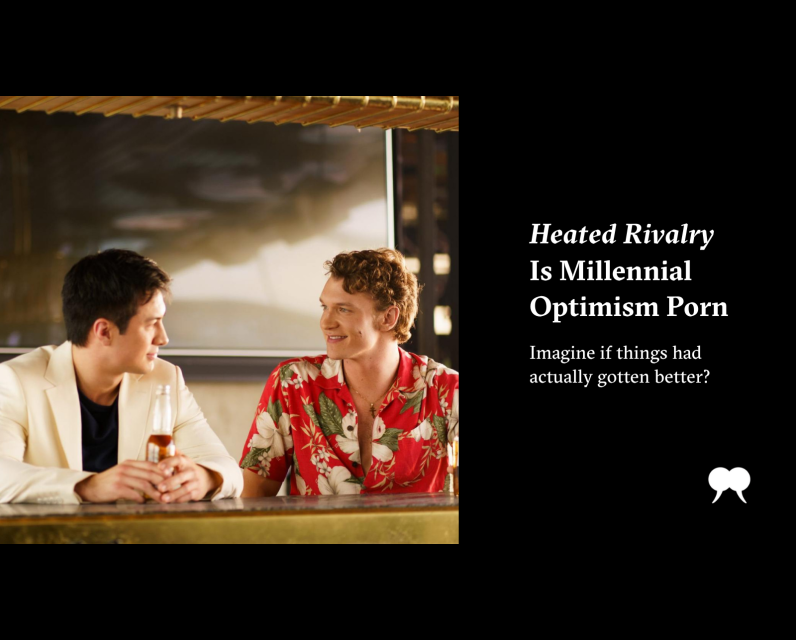
The year is 2008. The banks are failing, a confident ingenue named Lady Gaga is taking over pop radio, and Barack Obama is riding a wave of hope to the American presidency. And, in director Jacob Tierney’s world, a teenage Shane Hollander approaches Ilya Rozanov at the International Prospect Cup. The rest is history.
This is where Heated Rivalry begins its decade-spanning first season—though if you blink, you’ll miss the timestamps. Fans and critics alike have poked fun at the show’s disorienting timeline, which rapidly jumps from 2008 to 2017 as it chronicles Hollander and Rozanov’s journey from opponents to boyfriends. Aside from choice shots of Hollander in boat shoes, the show’s contained world means that it doesn’t have to pay particular attention to historical accuracy.
But those timestamps tell a story of their own: Heated Rivalry is a 2010s period piece. In particular, it taps into and revives the optimism that pervaded that decade’s first half, from the It Gets Better campaign to Gaga’s chart-topping “Born This Way.” Beyoncé’s 2014 VMAs performance in front of a giant “FEMINIST” sign symbolized an era when celebrities and Tumblr teenagers were at the vanguard of popularizing social justice politics. There was an earnest sensibility in this period, now known as millennial optimism, that things could and would get better.
Heated Rivalry’s first season plays out against this backdrop. It concludes in 2017—just as the backlash to these movements was beginning to gain steam, curdling into the anti-woke discourse of the 2020s. But, watching it, you can imagine a world where millennial optimism instead kept forging ahead, where hockey culture—like North American culture at large—steadily became a safer place for marginalized people. Through that lens, the triumphant conclusion to episode five, where New York team captain Scott Hunter comes out on live TV by kissing his boyfriend after a victory, is the logical climax of its cultural moment—rather than the alt-universe fantasy it really is. The kiss is soundtracked by aughts indie band Wolf Parade, with a bombastic track that sums up the show’s hopeful thrust: “I’ll Believe in Anything.”
That ethos helps explain Heated Rivalry’s intense hold over its fans. As abortion rights are rolled back, and the brief victories of #MeToo give way to the reactionary manosphere, Heated Rivalry provides a steamy escape. For queer viewers, and even hockey fans, it also offers a near-utopic vision of professional sports: an openly gay MVP, only brief references to problematic language, and no mention of hockey players standing trial for sexual assault. Here, the National Hockey League has not (yet) banned pride jerseys and tape—as it would in 2023—and corporations haven’t turned their backs on diversity and inclusion. When Hollander comes out to his parents, his mother begins cooking up potential brand collabs.
Heated Rivalry premiered amidst a cresting wave of 2010s nostalgia. The “2016 trend” on TikTok and Instagram displayed a yearning for tropical house, Canon DSLR photoshoots and the moment right before that American election. Like those TikToks, Heated Rivalry is not a faithful recreation of that time but a projection of collective desire for something other than the culture we have right now. But, like with any object of obsession, Hollander and Rozanov’s fantasy world will never be completely satisfying. Eventually, we all have to leave the proverbial cottage and face reality.
Read more from our Heated Rivalry Series:
• Heated Rivalry Holds Up a Mirror to My Deepest Self • Heated Rivalry Proves Hockey Has Basically Always Been Gay • The Queer History Behind the Heated Rivalry Soundtrack • Just How Big Is Heated Rivalry? Really Big • The US Is Trying to Annex the Ultra-Canadian Heated Rivalry
The post Heated Rivalry Is Millennial Optimism Porn first appeared on The Walrus.
Unpublished Newswire


Comments
Be the first to comment