
Stay informed


How to Close a Diamond Mine in the Northwest Territories
.main_housing p > a { text-decoration: underline !important; }
.th-hero-container.hm-post-style-6 { display: none !important; }
.text-block-underneath { color: #333; text-align: center; left: 0; right: 0; max-width: 874.75px; display: block; margin: 0 auto; } .text-block-underneath h4{ font-family: "GT Sectra"; font-size: 3rem; line-height: 3.5rem; } .text-block-underneath h2{ font-size: 0.88rem; font-weight: 900; font-family: "Source Sans Pro"; } .text-block-underneath p { text-transform: uppercase; } .text-block-underneath h3{ font-family: "Source Sans Pro"!important; font-size: 1.1875rem; font-weight: 100!important; }
.flourish-embed { width: 100%; max-width: 1292.16ppx; }
.th-content-centered .hm-header-content, #primary.content-area { width: auto; } .entry-content p, ul.related, .widget_sexy_author_bio_widget, .widget_text.widget_custom_html.widget-shortcode.area-arbitrary { margin-left: auto; margin-right: auto; } .hitmag-full-width.th-no-sidebar #custom_html-45.widget { margin: auto; } @media only screen and (max-width: 768px) { .img-two-across-column{ flex-direction: column; } .img-two-across-imgs{ width: auto !important; max-width: 100%!important; padding:0px!important; } .main_housing, .text-block-underneath { margin-left: 25px !important; margin-right: 25px !important; } .text-block-underneath h4{ font-family: "GT Sectra"; font-size: 35.2px; line-height: 38.7167px; } } @media only screen and (min-width: 2100px) { .main_housing, .text-block-underneath { /* margin-left: 32% !important; margin-right: 32% !important; */ } } @media only screen and (max-width: 1200px) { .main_housing, .text-block-underneath { /* margin-left: 25px !important; margin-right: 25px !important; */ } } @media only screen and (max-width: 675px) { .main_housing, .text-block-underneath { margin-left: 10% !important; margin-right: 10% !important; } } .hero-tall {display: none;} .hero-wide { display: block; } @media (max-width:700px) { .hero-wide { display: none; } .hero-tall { display: block; } } ENVIRONMENT / MAY 2026 How to Close a Diamond Mine in the Northwest Territories After shutting commercial operations, Diavik wants to disappear without a trace WORDS AND PHOTOS BY PAT KANE
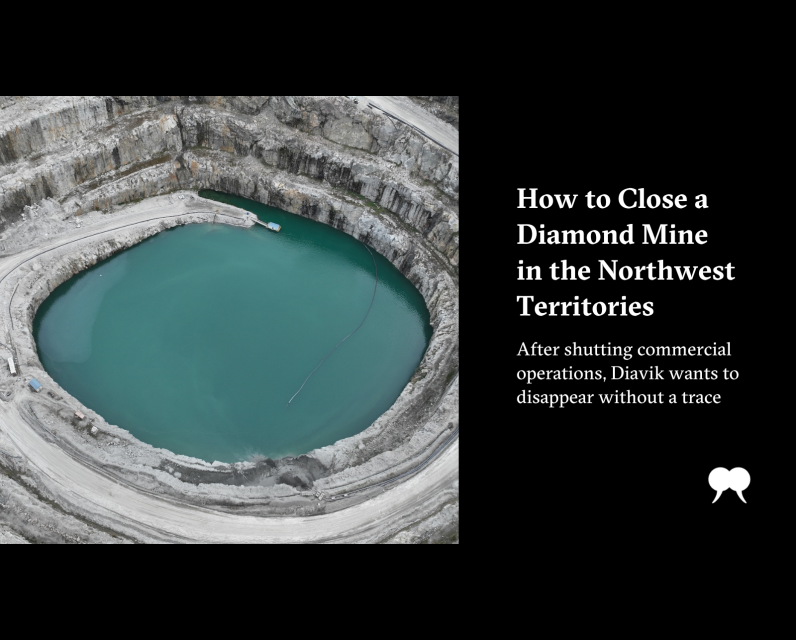
Published 6:30, FEBRUARY 25, 2026 A view of the A418 pit at the Rio Tinto Diavik Diamond Mine on Lac de Gras, Northwest Territories, in August 2025. The pit was closed to mining activity in 2022 and is currently being filled with processed kimberlite and water.
THE DIAVIK DIAMOND MINE sits on an island in the middle of a lake, which itself is surrounded by hundreds of other lakes and the barren lands of the Northwest Territories. From above, three human-made craters look like God Herself started drilling giant, threaded holes into the landscape.
But a more detailed scan over the tundra reveals a bustling collection of trucks weaving along gravel roads toward, and away from, buildings of all shapes and sizes. From the air, it looks like a town was plopped down among the rocky outcrops of the unforgiving Arctic terrain. It’s fascinating to see such a place and hard to imagine that this will all vanish—as if nobody ever set foot here—in just a few years’ time. That’s the plan anyway.
All commercial diamond mining was scheduled to stop in March, marking the beginning of the end of the mine’s life. Joe Blandford, one of the superintendents, remembers when there were only a couple of trailers on site and a small construction crew plotting out the mine’s future.
“Not everybody says they enjoy coming to work, but you make friends over the years, and I’ll miss the people,” he says. “It’s going to be hard to keep in touch with all of them.”
Tyler Black, an underground miner, in the A154 mine. Reaella Diego, an underground miner, at the A154 mine.THE MINE OWES its beginnings to an eccentric fortune seeker named Chuck Fipke. In 1991, Fipke was a young (and, by all accounts, hare-brained) geologist with his own company, called Dia Met Minerals Ltd. He and his partner, Stewart Blusson, found eighty-one small diamonds at Lac de Gras, roughly 300 kilometres northeast of Yellowknife.
The discovery didn’t come by bumbling around the Arctic. Well, not really. The pair staked the area for about a decade prior, looking for minerals linked to kimberlite, the type of rock that can contain diamonds, and driven by a hunch that the minerals were pushed away from the actual diamond deposit by glaciers. When they finally found the gems at Lac de Gras, the theme song to The Beverly Hillbillies played from the heavens (unconfirmed), and Fipke’s little company went from pennies a share to almost $70 a share. The duo soon partnered with Broken Hill Proprietary (later BHP Billiton Diamonds Inc.) to create the Ekati Diamond Mine in 1998 and be forever enshrined as legends in the mining world. A view of the processing plant where diamonds are sorted from kimberlite. Another view of the Diavik processing plant. An operator keeps watch of the processing plant.
The creation of Ekati led to other mines nearby. In 2000, global mining giant Rio Tinto began construction on the Diavik Diamond Mine roughly thirty kilometres from Ekati and officially opened it for commercial mining three years later. Diavik has since extracted 150 million carats of diamonds.
Gord Stephenson has spent most of his adult life flying between Yellowknife and Diavik for work. His current job involves overseeing a series of complicated engineering tricks to essentially turn the mine back into a seemingly untouched landscape. Think of it like washing the dishes while cooking: several parts of the mine are closed and cleaned up while regular mining continues.
Stephenson, senior manager of surface operations and closure, holds some of the crushed kimberlite that now has the texture of sand. Dave Hill, an underground miner, sets an explosive charge in the A154 mine.Once mining stops, it will take another three to four years of remediation work, followed by up to ten years of post-closure monitoring to make sure the site is safe for wildlife and people. Those giant craters will be filled with processed kimberlite and flooded with lake water, eventually getting swallowed up into Lac de Gras. Some of the mine’s materials will be buried in the permafrost under a blanket of rock, while other material will be repurposed: the solar panel farm might be distributed to communities in the NWT. Of course, there are downsides to the mine’s hand-me-downs; hazardous waste, for example, will be trucked to Yellowknife and Alberta for disposal.
This is a massive cleanup project in a part of Canada where mining companies have a dirty track record. Giant Mine, a gold mine outside of Yellowknife, is the most famous example of a company that fled, leaving 237,000 tons of arsenic trioxide waste behind. The federal government is spending around 4.38 billion taxpayer dollars to clean up the mess, which will take until at least 2038 to finish. Indigenous communities have pushed the territorial government to ensure that wouldn’t happen again with the diamond mines.
For NWT residents, Diavik’s closure is a significant loss to the territory’s economy and people’s livelihoods. A 2023 report says that diamond mining alone contributed $1.2 billion to the gross domestic product, and the NWT’s three diamond mines spent nearly $755 million on goods and services from NWT-based businesses.
What happens after all three of the NWT’s diamond mines close is anyone’s guess. Speaking to the New York Times, NWT premier R. J. Simpson said mining opportunities in critical minerals (like lithium, cobalt, and zinc), along with major nation-building infrastructure projects, could help sustain the economy post-diamonds.
Deep underground in the A154 mine, workers blast all the kimberlite they can. It’s impossibly dark—and wet, considering they’re underneath a lake. Greg Segal navigates a modified Toyota Land Cruiser through twists and turns in the rocky cavern. It is one of the more exciting places at Diavik, but if you’re claustrophobic, it’s probably your worst nightmare.
Melanie Rabesca has no problem this far underground. She’s been a miner here since 2010, and it’s where she met her husband, Charles, whom she works with every day. She is one of several employees enrolled in a program that helps employees transition into another career or to further education. Rabesca recently got her class three driver’s licence to be able to operate heavy-equipment vehicles in Yellowknife.
A welder works inside the mechanics garage. A mechanic replaces the tire of a haul truck. Mechanics performing maintenance on a haul truck.“Being a woman, it was a challenge. You got loud guys that come in with big personalities, and they get the positions before you do,” she says. “But as the years went on, I would have guys on my crew that would say, ‘Come on, Mel needs a chance.’ I appreciated that because they kind of helped me build up my personality to speak up for myself. It took me a while to own that.”
For Rabesca and most others, the closure of Diavik is more than the end of a job; it’s a final goodbye.
“It’s a family that you build over fifteen years, and you meet so many people from so many cultures from around the country,” says Rabesca. “I’ve been able to do good things for my family and our home by working here.”
Segal, an underground miner, drives his truck at the A154 mine. A grader moves underground in the A154 mine.With thanks to the Gordon Foundation for supporting the work of writers from Canada’s North.
The post How to Close a Diamond Mine in the Northwest Territories first appeared on The Walrus.
Comments
Be the first to comment