
Stay informed
Unpublished Opinions


Just Ban Surveillance Pricing Already
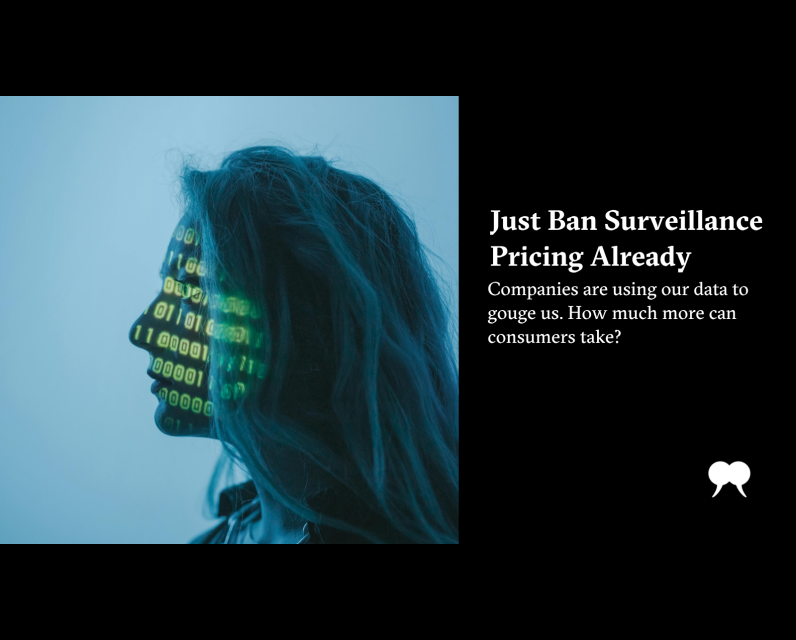
People hate being surveilled, taken advantage of, or treated differently than their peers. Surveillance pricing—the individualized, algorithmic practice of charging one person more than another based on data harvested from them—hits the trifecta. Governments ought to ban the practice. It’s insane we must even debate the question.
The New Democratic Party has been on the case of late throughout the country—both nationally and sub-nationally. Manitoba led the charge, introducing a bill to restrict algorithmic pricing in March. The Ontario NDP, under leader Marit Stiles, followed suit. So too did the federal party under new leader Avi Lewis, who called surveillance pricing “creepy” as his party introduced a motion in Parliament to ban it.
Lewis’s anti-snitch pricing advocacy put the issue on the national agenda, boosting provincial efforts that, in turn, helped make the federal case. Now, if you’ll pardon the pun, all eyes on the matter.
Spying on people to rip them off is bad. Ontario premier Doug Ford prefers to call it capitalism and the free market, but it’s anything but. Even on terms set by capitalist theory, surveillance pricing isn’t capitalism. Economist Adam Smith would have hated the practice, which is not a free exchange of goods and services, but the leveraging of a power imbalance by one party that is able to collect asymmetrical amounts of information in markets that are effective monopolies or oligopolies, like grocery retail.
Surveillance pricing is inherently exploitative on its face. No need to dig out any well-thumbed copies of Das Kapital. Not only are consumers unable to make informed decisions about their purchases in these cases, they have few other places to go or the time and energy to go there—if they’re even aware they’re being ripped off in the first place.
Writing for the National Observer, Supriya Dwivedi gives a perfect case study of the problem:
If, for example, a retailer knows you’re looking at an item from within the parking lot, then they can charge you more for it using the logic that . . . you’ve already travelled all the way to the store and are looking up the item in the parking lot, so chances are you’d be willing to pay more for an item compared to someone who still needs to actually make their way to the store.
Dwivedi is characteristically right on the mark as she summarizes and analyzes the problem and argues that Lewis is right to highlight the issue and frame it as a problem. The power imbalance between consumers and sellers in our “free” market is such that practices like snitch pricing exacerbate relationships that are already inherently exploitative. Moreover, there is no personal action that can balance the scales. That’s why it’s up to the state to intervene to ban the practice.
Banning surveillance pricing is morally correct, but it’s also smart politics. Facing down yet another affordability crisis—just as the post-pandemic struggle was abating—is going to drive people quite simply beyond mad and past the breaking point.
Decades of persistent and compounding financial crises from the 1970s onward have taught anyone willing to pay attention that state intervention and regulation are necessary to discipline and control a “free” market that will otherwise run wild and operate as anything but free. Left to its own devices, capitalism devours the ecosystem it requires to exist until it collapses. Nothing is ever enough, and there is no such thing as too much. For more on that, you can turn to Marx, but you shouldn’t have to.
During an affordability crisis, especially one that follows on the heels of a rough several years, people become frustrated, anxious, and unpredictable. Tack on to that a recent surge in populism, and what do we even need to talk about here? While relieving human suffering is an inherent good that politicians ought to pursue, it’s also a good way to keep your approval numbers in check and maximize your chances of election or re-election in the face of an electorate that doesn’t love being pushed around for too long. I prefer that people do the right thing for the right reasons (see: Aristotle), but I’m plenty fine if they do them for the wrong reasons if the outcome is the same.
In the long run, maintaining confidence and trust in our institutions is critical to maintaining the legitimacy of the government and state and to preserving order. Better than a mere ban on surveillance pricing would be a ban accompanied by a thorough rethink of the economic system, including who gets to control the workplace and reap the benefits of the profits workers create.
The latter is a heavier lift and a spicier debate; I’ll give you that. But the former ought not to be. Indeed, a ban on surveillance pricing is a no-brainer that every government ought to enact immediately.
Originally published as “I Can’t Believe I Have To Say This: Banning Snitch Pricing Is A No-Brainer” by David Moscrop (Substack). Reprinted with permission of the author.
The post Just Ban Surveillance Pricing Already first appeared on The Walrus.
Unpublished Newswire
Comments
Be the first to comment