
Stay informed



The idea of Alberta separatism is closer to mainstream than ever before
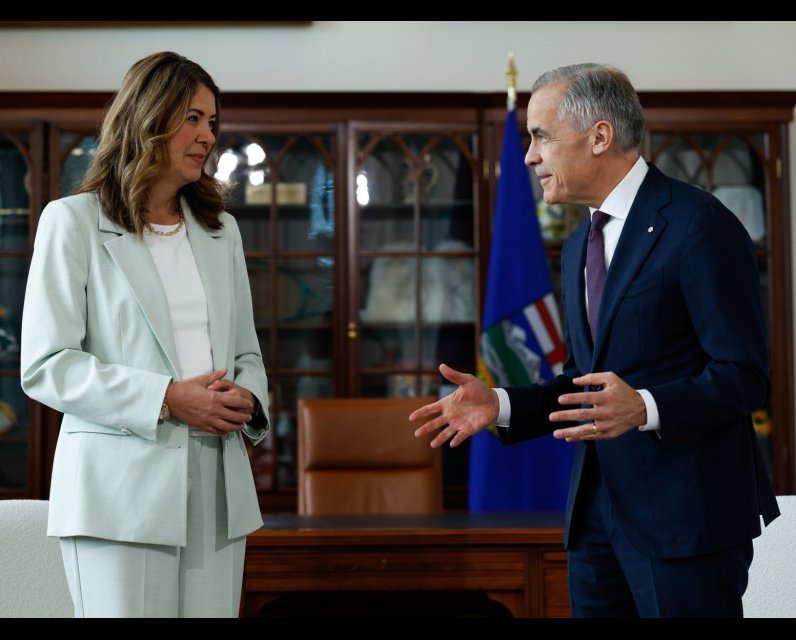
In his timely new book The Republic of Alberta: An Idea That Won’t Go Away (out now with Sutherland House), journalist Tyler Dawson examines the long history and renewed force of Alberta separatism, and traces how a province that remains overwhelmingly Canadian has nonetheless developed a deep and durable sense of alienation from Ottawa, and the rest of the country. In this exclusive excerpt, Dawson reveals the political tensions that followed the 2025 federal election and explores why, for many Albertans, the question is not simply whether Alberta should leave Canada, but whether Canada has ever truly understood what Alberta contributes — and what it expects in return.
In the weeks before the April 2025 federal election, Alberta Premier Danielle Smith took to the stage at the Strong and Free Network conference in Ottawa. After giving a speech, she sat down for a discussion with Toronto Sun columnist Brian Lilley and remarked that she recently had a new pedicure.
“I’m Team Canada right down to my toes,” said Smith. She slipped off her shoe, pointed her foot, and showed her red nails to the audience.
The day was April 10. At the time, angst was circulating in Canada about the forthcoming federal election. What would it mean for the West, which had been frustrated for years under a Liberal government, if the same party were returned to power? Alberta has voted overwhelmingly Conservative for as long as anyone can remember, and it was set to do so again.There were murmurings of increased support for secession in the province should the Liberals prevail. But with Canadian nationalism experiencing a resurgence thanks to U.S. President Donald Trump’s annexation threats, Smith clearly staked her position: she stood for Canada.
A little over two weeks later, Canadians re-elected a Liberal federal government. This version was led by Prime Minister Mark Carney — an Alberta boy who grew up in Edmonton — and not Justin Trudeau, the much-reviled son of Pierre Trudeau, who, 26 years after his death, probably still edges his son for the title of most hated man in the western province.
The re-election of the Liberals re-ignited a generations-old conversation about Alberta, the province’s place within Canada, and whether, in the face of yet another Liberal government widely perceived here to be hostile to Alberta’s interests, the province should bother sticking with Canada at all. Smith found herself caught up in the debate. While still professing to support a united Canada, she has hardly been as full-throated in her defence of federalism as her predecessor, Jason Kenney.
Her critics have accused her of pandering to the separatists with her bullish anti-Ottawa talk and amendments to legislation in 2025 that made it easier for separatists to push for a referendum on secession.
“(Smith’s) entire political career has been focused on grievance politics with Canada, and now the chickens have come home to roost. As much as she’d like to blame the federal government for this, it is she who has been pandering to separatists,” NDP leader Naheed Nenshi said in the Alberta legislature in early December 2025.
Alberta independence — and its cousin, alienation — are not new ideas. They’re not even recent ones. Writers in the 19th and early 20th centuries railed against their rulers out east. Sir Frederick Haultain, who was the first and last leader of the North-West Territories from 1897 to 1905, led the fight for responsible government on the Prairies and was constantly at odds with Ottawa over spending issues.
The birth of Alberta and Saskatchewan as proper provinces in 1905 did nothing to smooth relations with Ottawa. The grievances and tensions have simmered for decades, occasionally boiling over; subsequent premiers of Alberta fought with Ottawa over banking rules and pushed to wrest control of Alberta’s resources from the federal government.
But never before has Alberta come close to holding a referendum on leaving the country. After Carney was sworn in as prime minister, pollsters immediately went back to the question they’ve been asking occasionally for years: Would you support Alberta separating from Canada? In May 2025, 29 per cent of poll respondents said yes. Other polls netted similar results.
Separatism was back, baby.
Of course, it doesn’t have majority support. Almost one-third of Albertans may say they want to leave Canada, but that means around 70 per cent say they want to remain. Yet even if a separatist referendum fails, the process could be profoundly destabilizing to Alberta and Canada. It could affect the investment climate in the province for years to come. It could permanently reshape, for better or for worse, the relationship that Alberta has with other provinces, as they see one province actively working to break up the country instead of trying to make it work. If a substantial percentage of Albertans voted to leave, it would send a strong signal to Ottawa, potentially boosting the Alberta government’s position in negotiations for more powers. Or, alternatively, as some within the governing United Conservatives fear, a vote to stay in Canada could give Ottawa needed cover to steamroll provincial rights, undoing what progress Alberta has made in standing up for itself.
In recent years, separatism has come closer than ever to becoming mainstream. Although it’s still likely a largely fringe idea, at least in terms of those who are fully committed to leaving Canada, the average Albertan is probably at least a little curious about what separatism might mean. Separatism is openly discussed in the legislature. It featured prominently at the 2025 annual general meeting of Alberta’s governing United Conservative Party. It is all over the news. And separatism is a potent force: its true believers are influential within the governing party and appear on the verge of pushing the provincial government to hold a referendum.
“What’s really different at this moment is not even necessarily that there is higher support for separation … but I think it’s that you have people in more prominent positions showing a little more comfort to have the conversation about it in a way — it just would have been absolutely shut down in the past,” said Calgary Liberal MP Corey Hogan.
At least part of the reason why there hasn’t been potent mainstream appeal in the past is because the political parties and proponents of an independent Alberta didn’t have the tools to generate much influence.
Now, with social media connecting people, separatists have greater reach than ever before. As well, modern separatism’s proponents have put serious efforts into presenting their arguments, honing the debating points to a fine edge.
Not everyone is persuaded by the arguments that Alberta would be far better off outside Canada. Still others are put off by the political complexion of those advocating secession. Attend any separatist event, and you’ll find a volatile mix of genuine grievance about Alberta’s place in the country and the respect it’s afforded alongside conspiracy theories about the World Economic Forum and unhealed wounds over the COVID-19 pandemic. Add in some anger over the ostrich farm in B.C. (where federal officials ordered the slaughter of hundreds of sick ostriches in 2025), fears over immigration, and a generalized dislike of the Liberal government in Ottawa, and it’s a confusing, sometimes off-putting scene. Even some who are open to the idea of an independent Alberta are liable to look askance at the collection of grievances that animate the separatist movement.
“Since COVID ended, a lot of those people who got mobilized from the hard right have been looking for other things to be angry about. Their natural setting is perennial anger,” said Jason Kenney. “And so I think they took the anger they had over COVID policy, and now many of them have redirected that at Canada and separation.”
It’s a challenging road the separatists have charted for themselves. They have no charismatic leader like René Lévesque, the suave, smoke-wreathed Quebec separatist who took his province to its 1980 secession referendum. There is no culturally entrenched canon of nationalist literature to fill Alberta bookshelves. The province has no unique language or race or faith that binds its residents together. There is a not-insignificant pro-independence media presence, but none of the province’s major media outlets — not even any individual writers — have come out firmly on the side of separation.
So, why does it capture so much attention? It’s at least partly because of Canada itself. There’s always the risk that the idea of Canada won’t work out. “Confederation has always seemed like a rather rickety, precarious endeavour, perpetually on the verge of fragmenting into a handful of region-states or surrendering to outright absorption or annexation by the United States,” writes McGill professor Andrew Potter in his 2007 introduction to George Grant’s Lament for a Nation.
Quebec has tried to leave twice, in 1980 and 1995, provoking genuine national unity crises. In both cases, the secessionists lost, although in 1995 by a razor-thin margin. While unsuccessful, Quebec’s independence movement has provided its provincial brethren something of a blueprint on how to attempt an exit.
While many Albertans don’t believe their province should leave Canada, there is nevertheless a widely held view that Alberta is treated poorly by the rest of the country: its major industry is denigrated; the earnings of its people are siphoned off to support less-prosperous parts of the country; and its people are viewed as slack-jawed yokels by denizens of the Toronto-Ottawa-Montreal corridor of power.
Despite being underrepresented and underappreciated, many Albertans believe their province is an outsized contributor to the country’s economy and national tax revenue, and they wonder what they get in return.
Our website is the place for the latest breaking news, exclusive scoops, longreads and provocative commentary. Please bookmark nationalpost.com and sign up for our daily newsletter, Posted, here.

Unpublished Newswire



Comments
Be the first to comment