
Stay informed



Premier Susan Holt Is Spending Big in New Brunswick. Will She Regret It?
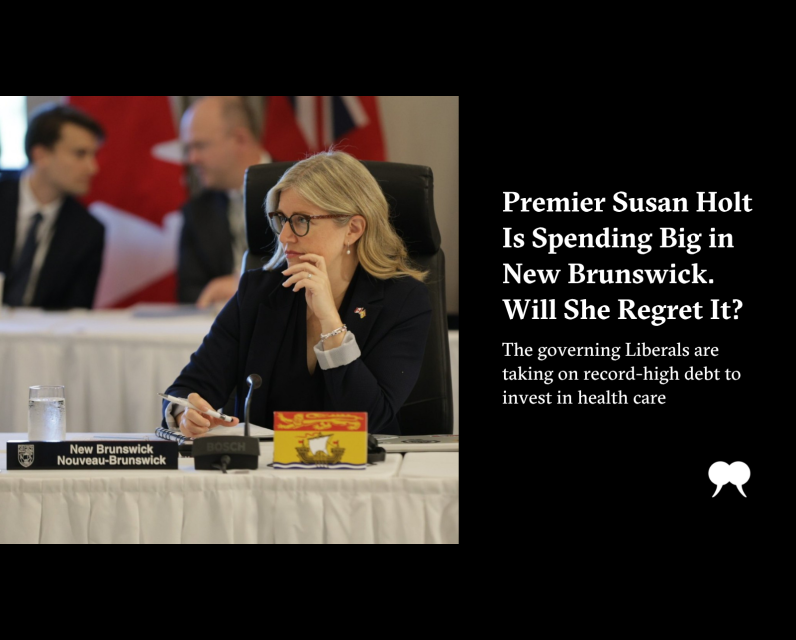
In 2024, Susan Holt’s resounding election win was a breath of fresh air for many New Brunswickers. The Liberal leader’s empathy and optimism stood in stark contrast to the dour and divisive governing style of outgoing Progressive Conservative premier Blaine Higgs. During his tenure, Higgs faced criticism for refusing to fund abortions at the province’s only clinic and introducing an education policy critics say targeted trans and gender-diverse students. With a laser-like focus on health care and affordability, Holt swept to power, becoming the province’s first female premier. Higgs lost his seat and resigned as Conservative leader.
Key points- This year, New Brunswick’s provincial government projects a $1.39 billion deficit
- Provincial leaders across Canada often choose deficits over social service cuts in the hopes debts will sort themselves out in the future
- Critics warn tariff threats, reduced federal transfers, and clampdowns from bond markets could eliminate New Brunswick’s fiscal wiggle room
Since then, the premier has enjoyed an enviable honeymoon period, continuing to ride high in public polling. But in a province grappling with slowing economic growth and a rapidly aging population, Holt’s March budget backtracked on a key election pledge to balance the books in each year of her mandate. Instead, her government now projects a record-breaking $1.39 billion deficit this year alone, growing the province’s debt to historic levels and causing one major credit agency to downgrade the province’s financial outlook.
While many New Brunswickers might have been relieved by the lack of major spending cuts and a huge investment in health care, Mario Levesque, a political scientist at Mount Allison University, believes that by banking on future growth in areas like mining and federal defence spending, Holt’s government is reading the numbers through rose-coloured glasses. “There’s a thinking that perhaps the economy will change,” says Levesque. “But it’s a huge gamble.”
Holt’s tricky balancing act is symptomatic of the tough choices facing Canadian premiers. In the face of exploding health care costs, a burgeoning demand for social services, and ongoing global uncertainty, provincial leaders are choosing deficits over cuts in the belief that ballooning debts will sort themselves out once economic conditions improve. It’s an approach some experts say risks financial disaster.
Herb Emery, an economist at the University of New Brunswick, believes the current generation of premiers have become accustomed to justifying higher spending as a way to cushion Canadians from economic shocks, like the COVID-19 pandemic and the current trade war with the United States. Spending huge sums on supports like CERB-type benefits or one-time affordability measures like electricity rebates soon becomes normalized, leading to rapid and unsustainable debt growth.
For Emery, it’s a problem when the spending doesn’t stop. “One of the big questions we’ve had for a long time is, ‘Can governments behave responsibly in the absence of a crisis?’”
Emery says that, in most cases, governments begin to cut only when they are forced into a corner: sooner or later, debts must be paid. Canadian financial history has shown that years of high deficits are generally followed by periods of austerity.
In the 1990s, during a recession, federal and provincial governments slashed social programs and raised taxes to try to slay the deficit beast when capital markets made it clear they were turning off the tap of cheap credit. The federal government became reliant on revenue from the Goods and Services Tax and eliminated funding for public housing. Early in that decade, debt-laden Saskatchewan was nearly shut out of borrowing from Canadian banks and other debt lenders due to its poor credit rating. As its New Democratic Party government stared down the spectre of bankruptcy, the province raised taxes, eliminated its children’s dental program, and consolidated fifty-two rural hospitals. In the same era, Prince Edward Island cut salaries for all civil servants by 7.5 percent.
In 2014, New Brunswick—facing what was billed a “lost decade” in the aftermath of the financial crash of 2008—faced a similar fate. It had extremely high debt, and its population had flatlined. Former premier Brian Gallant revealed he’d had discussions with the federal government on a contingency plan should New Brunswick find itself insolvent, though the federal finance minister at the time, Joe Oliver, has disputed this claim.
Through a combination of stronger fiscal discipline, good luck with increased federal spending during the COVID-19 years, and an uptick in population growth, the province produced budget surpluses and was able to reduce its debt under Blaine Higgs, who served as premier from 2018 to 2024. This gives Holt’s government a little more breathing room—for now.
The past few years have not been kind to provincial budgets. The pandemic, trade wars, and the current fuel crisis due to the conflict in Iran are just the beginning. Canadians are aging quickly, and Atlantic Canadians are older and sicker than most. As demands for health care skyrocket, provincial leaders of all political stripes have been forced to make massive investments in areas like long-term care and home support, even as tanking immigration numbers and tariffs shrink revenue forecasts.
In February, Alberta announced record-breaking spending and a whopping $9.37 billion deficit. Ontario is planning a $13.8 billion deficit, with overall debt rising to $485 billion. Even tiny PEI, with roughly a fifth of New Brunswick’s population, announced an astonishing $410 million deficit. Like New Brunswick, Nova Scotia and PEI are dependent on transfers from the federal government.
But while New Brunswick is not alone in choosing deficits over cuts, Emery says Holt and her government may come to regret baking transitory revenue—like limited-time federal supports and the impact of a population boom—into long-term budget projections, rather than curbing spending. He says that makes the province particularly vulnerable should Ottawa decide to scale back federal equalization payments, which account for over 23 percent of the provincial budget. “We don’t have the same kind of fiscal responsibility as part of the culture of New Brunswick anymore.”
Outrage in neighbouring Nova Scotia in response to Premier Tim Houston’s February budget may have served as a warning to Holt. Houston made wide-ranging cuts to education, arts, and community organizations, including reduced funding for programs that support Indigenous and Black Nova Scotians. Thousands rallied in the streets of Halifax, and the government closed the public gallery of the provincial legislature. In recent months, Houston’s approval ratings have dropped precipitously.
Such blowback suggests that many Canadians don’t seem particularly concerned with all this debt. Levesque says that budgets are abstract for most people. On the whole, he says, Canadians prefer governments to invest in services rather than to cut. “What’s impacting them directly? And so, if you can say to them, ‘We’re going run a deficit, but we’re going to give you more health care,’ people will say, ‘That’s okay.’”
For the time being, it seems Holt might be striking the right political balance. She remains one of the most popular premiers in the country and is known for her transparency. At the annual State of Province address, Holt did not shy away from admitting more work needs to be done when her government had missed the mark, such as failing to increase the number of New Brunswickers with access to primary health care.
This approach is apparent across Holt’s government. Last year, according to the CBC, empathy guidelines were introduced for senior government staff, providing templates for how public servants should respond with clear, compassionate language to constituent concerns.
Holt’s government also has a habit of floating policy ideas as a kind of public thought experiment, even when they provoke controversy. In the lead up to this year’s budget release, many were shocked by a discussion document circulated by the post-secondary education minister suggesting the New Brunswick government could possibly privatize or merge some of the province’s universities. Holt swiftly backtracked, promising she would never consolidate University of New Brunswick and St. Thomas University, both located in her hometown of Fredericton. Levesque says that, while some may interpret the move as flip-flopping, this tactic may also cushion Holt to some extent from criticism of her government’s fiscal performance. It lets her demonstrate that she is learning from public feedback.
All this political capital will be needed if the province’s economy goes south and deeper cuts become unavoidable. “People feel like they are being listened to,” says Levesque, noting that this only works if there’s follow through. “If she keeps that up, and people keep responding, it puts her in a better position than most.”
Nevertheless, political dangers loom. Levesque warns that economic drivers the government is banking on to reverse its fiscal course—like $1 billion of federal defence investments at a military base in Gagetown—might not materialize in time for the next provincial election, which must take place by 2028. More ominous for Holt’s government is the triple threat of more tariffs, reduced transfers from Ottawa, and a clampdown from bond markets, which could squeeze revenue through higher borrowing costs. Any of these would quickly eliminate the province’s fiscal room to manoeuvre.
Emery has followed the cyclical peaks and valleys of government debt throughout his career. He is deeply concerned by what he sees coming down the pipeline for New Brunswick. “Is it fiscally sustainable and likely to end well? My prediction would be no. But I don’t deny that the government has a right to place a bad bet and hope for the best.”
The post Premier Susan Holt Is Spending Big in New Brunswick. Will She Regret It? first appeared on The Walrus.
Unpublished Newswire


Comments
Be the first to comment