
Stay informed



The Sims Is Objectively a Terrible Game. But I Adore It
I WAKE FULLY RESTED, not a hair out of place. Pushing off my leopard-print duvet, I gingerly hop out of bed, onto a floor immaculate beyond conception. I do a couple of crunches (I love exercise) before heading downstairs to prepare breakfast for my three beautiful children. I’m late for work—I can sense the plants wilting as I step out the door. Not to worry, my commute takes seconds: I simply evaporate into thin air.
An energetic, exercise-loving, widowed homeowner supporting three children on a freelance botanist’s salary, in this economy? You’re right to be suspicious. This woman, Margot, is not real. She exists in a world of my own making, one familiar to many a millennial gamer: she is a Sim.
For the uninitiated, The Sims is a life-simulator video game franchise, released by Electronic Arts (EA) in the shadow of Y2K. Its premise is, well, Simple: build a character, maybe a house, and play God. For me, it’s an aspirational game. My Sims have traits, habits, and goals that I hope to embody, develop, or attain. They’re almost always artistically driven; they maintain deep, loving relationships with ease; and they prioritize mind–body connection. Margot, for example, is a master painter, an expert cook, and an accomplished jeweller, and can wield a wrench or hammer effortlessly. Life hasn’t always been easy for her (Margot’s first husband died of rage, and her lover was crushed when a meteor fell from the sky), but she soldiers on, missing nary a workout nor deadline.
Growing up, television and the internet were novelties in my household, the latter swiftly disconnected after the computerized woosh and high-pitched squeal of dial-up interrupted my now-deceased mother’s favourite pastime: hours-long phone calls. The Sims was my first real taste of the zeitgeist, arriving at a time when I cared so desperately and so deeply about everything—above all, how much I hated every part of myself. In my best friend’s bedroom, GameCube controller in hand, I discovered a way to be anyone and do anything, everything, that I wanted—change my hair every five minutes, kiss girls, even set myself on fire—without real-world consequences or explanation. Be still, my preteen heart. Two decades later, the game remains a place where I can escape, express, and explore the parts of myself not yet ready for public consumption. The poor man’s drama therapy, if you will.
Unlike my Sims, I have little balance in my waking life. As I write, a week’s worth of dirty dishes and empty takeout coffee cups are stacked in, out of, and around the sink: a monument to dysregulation and depression (undiagnosed, naturally—I live in Quebec); to events from my past I’m not yet equipped to face; and to the daily horrors of our present. And so it goes. I log into The Sims, to a world where the impossible is made real-ish; where dishes can be cleaned with the click of a button and a life can be saved by pleading with the Grim Reaper—something I couldn’t do for my mother.
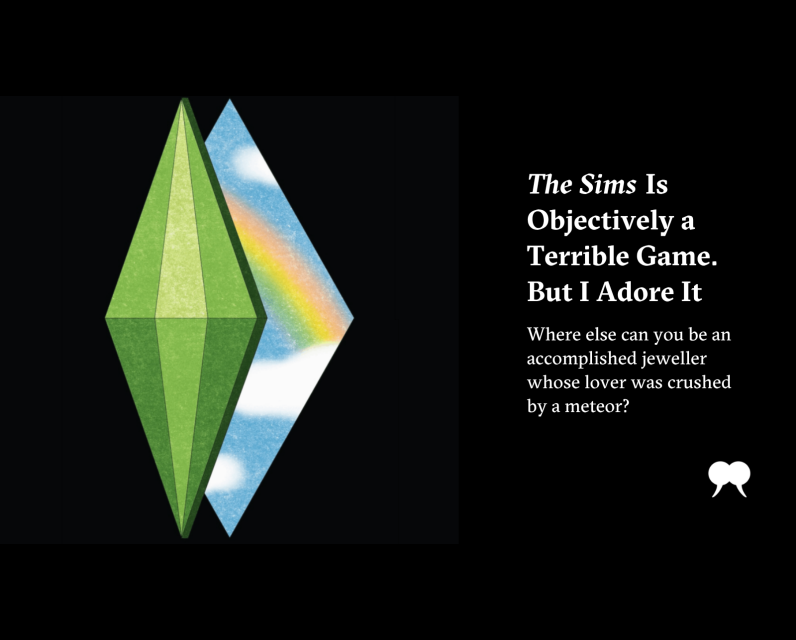
My partner visits and, seeing the game’s iconic green spinning diamond on my TV, shakes his head. I get it—The Sims is, objectively, a bad game: it can take twenty minutes to load; it lags and glitches; its expansion packs are exorbitantly expensive. Last September, EA was sold for $55 billion (US) to private investors, including in Saudi Arabia, a concerning development for the future of the franchise, particularly regarding its inclusive LGBTQ+ content.
The thing is, I’ve started a new storyline: Aleah has broken free from the suffocating expectations of her nuclear family, and she’s on a mission of self-determination. Despite swearing an oath of independence, she’s fallen in love with a carefree musician, and they’ve just moved in together. An ocean of opportunity extends before her: maybe now she’ll fulfill her lifelong dream of becoming a classical pianist. Just thirty more minutes, I promise my partner, then I’ll get my life together. He doesn’t respond, but I hear the water running and the clatter of dishes being rearranged in the sink. I smile; he gets it too.
The post The Sims Is Objectively a Terrible Game. But I Adore It first appeared on The Walrus.
Unpublished Newswire


Comments
Be the first to comment