
Stay informed

The Venice Biennale Parties On Despite Protests, Policing, and Pushback
.main_housing p > a { text-decoration: underline !important; }
.th-hero-container.hm-post-style-6 { display: none !important; }
.text-block-underneath { color: #333; text-align: center; left: 0; right: 0; max-width: 874.75px; display: block; margin: 0 auto; } .text-block-underneath h4{ font-family: "GT Sectra"; font-size: 3rem; line-height: 3.5rem; } .text-block-underneath h2{ font-size: 0.88rem; font-weight: 900; font-family: "Source Sans Pro"; } .text-block-underneath p { text-transform: uppercase; } .text-block-underneath h3{ font-family: "Source Sans Pro"!important; font-size: 1.1875rem; font-weight: 100!important; }
.flourish-embed { width: 100%; max-width: 1292.16ppx; }
.th-content-centered .hm-header-content, #primary.content-area { width: auto; } .entry-content p, ul.related, .widget_sexy_author_bio_widget, .widget_text.widget_custom_html.widget-shortcode.area-arbitrary { margin-left: auto; margin-right: auto; } .hitmag-full-width.th-no-sidebar #custom_html-45.widget { margin: auto; } @media only screen and (max-width: 768px) { .img-two-across-column{ flex-direction: column; } .img-two-across-imgs{ width: auto !important; max-width: 100%!important; padding:0px!important; } .main_housing, .text-block-underneath { margin-left: 25px !important; margin-right: 25px !important; } .text-block-underneath h4{ font-family: "GT Sectra"; font-size: 35.2px; line-height: 38.7167px; } } @media only screen and (min-width: 2100px) { .main_housing, .text-block-underneath { margin-left: 32% !important; margin-right: 32% !important; } } @media only screen and (max-width: 1200px) { .main_housing, .text-block-underneath { /* margin-left: 25px !important; margin-right: 25px !important; */ } } @media only screen and (max-width: 675px) { .main_housing, .text-block-underneath { margin-left: 10% !important; margin-right: 10% !important; } } .hero-tall {display: none;} .hero-wide { display: block; } @media (max-width:700px) { .hero-wide { display: none; } .hero-tall { display: block; } } ARTS & CULTURE The Venice Biennale Parties On Despite Protests, Policing, and Pushback The jury resigned and dozens of artists have withdrawn, but the Russian pavilion is still slinging vodka BY ARIELLA GARMAISE, GRETA RAINBOW PHOTOS BY GRETA RAINBOW
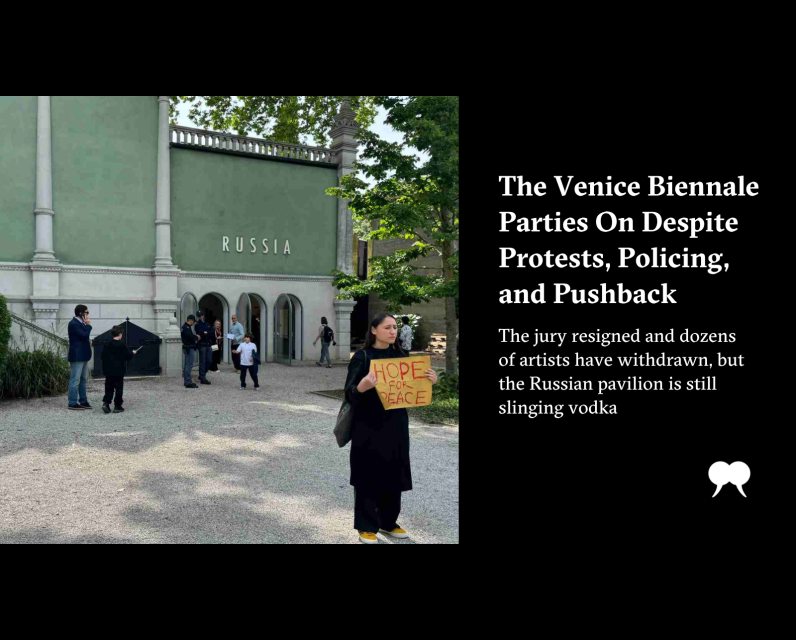
Published 6:30, MAY 15, 2026 The exterior of the Russian pavilion at the Venice Biennale.
Often referred to as “the Olympics of the art world,” the Venice Biennale, which was founded in 1895, is one of the oldest, most storied exhibitions of its kind. This year, controversy has imploded its sixty-first iteration: on April 30, the five-person jury resigned in protest of the inclusion of Russian and Israeli pavilions, citing the International Criminal Court’s decision to charge Russian president Vladimir Putin and Israeli prime minister Benjamin Netanyahu with war crimes. And while exhibition, and award recognition, at the Biennale can be the peak of an artist’s career, over eighty artists, curators, and exhibition staff have withdrawn from prize consideration in solidarity with the judges’ resignation.
The Biennale has always reflected the politics of its time: in 1968, the festival was consumed with student protests; in 1974, the Biennale director dedicated the festival to Chile and protests of the Augusto Pinochet regime; in 1977, the “Biennale of Dissent” featured unauthorized Soviet art, prompting the director to temporarily resign. The last iteration of the Biennale, in 2024, was even the subject of a Harper’s Magazine cover: “The Painted Protest: How politics destroyed contemporary art.”
Art critic, and frequent contributor to The Walrus, Greta Rainbow is currently in Italy reporting on the Biennale. I spoke with her about the geopolitics at play in the Giardini in Venice, how protests have shaped the festival and the work being shown, and why the Russian pavilion is still blasting music.
A protest demonstration organized by the Art Not Genocide Alliance at the Venice Biennale on May 8, 2026.What has the mood at the festival been in light of the news of the jury’s resignation?
The Italian press dubbed this Biennale the “Biennale of Discord,” and you do really feel that. The resignation of the jury is just one of many hardships the Biennale has faced. It started a year ago, in May 2025, when Koyo Kouoh, the director and curator of the main exhibition called In Minor Keys, died suddenly of cancer. That was the beginning of the discombobulation, the confusion.
People are really horrified by Russia’s presence. Because Israel’s exhibition is tucked away, you’re not so immediately confronted with it. But Russia is blaring music out of their pavilion. They are intentionally being provocative, and they want you to stop and stare. People also feel awkward about how to talk about In Minor Keys, given the curator’s death. And the pall of war is hanging over everything.
How have the controversies played out at the pavilions themselves?
The American pavilion and the Israeli pavilion have police circling them. You see police permanently stationed at the Russian pavilion, which is very gross and uncanny. The Russian art is basically these big bouquets of flowers that have been slowly dying throughout the week, alongside fifty musicians, poets, and thinkers. And there’s an open bar.
Is it typical to have an open bar?
No. Other pavilions will pop champagne at an opening. But at the Russian pavilion, they have someone slinging free vodka. It feels like a statement. They’re saying: “We are allowed to be here. We are being protected.” Because it’s not about the art. They closed the pavilion when the press previews ended and the Biennale opened to the public. To me, that signals that they care about pissing certain people off, and they can achieve that by doing their stunt during the press days.
What about the Israeli pavilion?
Not many people have seen the Israeli pavilion because it is constantly closed from protesters blockading entry—or out of fear that they will.
After a few days, I was finally able to see it. The exhibition directly evokes death. There’s a foyer area with a single rose floating in a chest freezer. In the next room, a system of agriculture-industry-grade pipes hangs suspended above a pool of black water, dripping rhythmically. The curatorial text references the “Kabbalistic notion of creation as a cyclical process of rupture and rectification” and the tidbit that modern drip irrigation was an Israeli innovation.
The geometry and the monochrome reminded me of twentieth-century American minimalists, like Richard Serra and Walter De Maria. But while those artists were dedicated to upending the conventions of materiality and form, introducing a new way to relate to art, Belu-Simion Fainaru’s Rose of Nothingness feels like a gotcha. There is a clear, predetermined agenda, and that’s where the mind wanders to in the meditative space between the water drops. He’s taunting viewers to dare to criticize him when he includes a mezuzah on the wall and locks engraved with the commandment to “love thy neighbor.” It’s antagonistic art in disguise, and I do not appreciate being lied to. Rose of Nothingness by Israeli artist Belu-Simion Fainaru.
Have you felt these tensions between what you describe as “commerce and consciousness”?
Absolutely. The American pavilion is, I think, an absolute embarrassment. There are crazy long lines across the festival—there’s a two-hour line for the Austrian pavilion—but you can just waltz into the American pavilion. It’s a bunch of pretty bland sculptures that were originally created for a desert space and are now in a sparse, white gallery.
You can overhear other visitors chatting with the gallerists about the process of collecting work. But there’s nothing in the art that makes you think. It’s not even particularly nice to look at. I actually find it pretty ugly. So, it becomes exclusively about the market at that point.
There’s a common belief that artists shouldn’t be punished for the crimes of their governments. But I think a lot of people don’t realize that these are state-sponsored artists that the government puts forward. Can you speak to how that impacts the art?
The idea behind the Russian pavilion, which is funded by the government, is that it’s a “folk music festival.” It’s attempting to create a spectacle.
You can’t talk about the work without talking about the curation and how these shows come together and them being representative of the countries that fund them. Part of the reason the American pavilion is so disappointing is because they lost the funding thanks to President Donald Trump cutting the National Endowment for the Arts.
It was announced that they would instead be sponsored by something called the “American Arts Conservancy.” Jenni Pardio, the woman behind it, is not in the arts. She’s the founder of a high-end pet food company. When you think about who the president is, it’s like, “of course this is the show.”
Throughout the festival, the Biennale has maintained that it will be “following the principle of inclusion, equal treatment among all participants.” Have you felt that to be true?
This is the hierarchy of the world in miniature. There’s the fact that only certain pavilions have these police guarding them. Countries have different resources, and not every country is represented. It’s all inherently unequal.
Police presence at the Venice Biennale in 2026.Because of the jury’s resignation, the main Biennale prizes will be voted on by visitors instead. Has this changed the tenor of the festival?
Certainly. Previously, there would have been discourse around who would win the Golden Lion. But without the jury, it’s easy to see what’s getting the most buzz. People are going to vote for the most spectacular stuff. Everyone’s talking about Florentina Holzinger’s SEAWORLD VENICE, which I loved and which is a kind of climate change performance where you can contribute to water tanks with your pee. There were problems because people are apparently also pooping in there, and the filtration system can’t handle it. (I’d say that bodily fluids are a big part of this Biennale.) I don’t think people will care about a popular vote like they would a jury selection, because we can already see who has the longest lines.
The European Union withheld 2.3 million euro in funding to the Biennale because of their inclusion of Russia. Why do you think the Biennale is insisting, despite the economic pushback, on keeping the Israeli and Russian pavilions?
The party line is that the Biennale Foundation doesn’t have the power to refuse. The rules say, “Any country recognized by the Italian Republic may ask independently to participate.” Well, asking isn’t the same as granting. The Italian government is maybe changing its tune regarding Israel; in April, the prime minister suspended a long-standing defence pact, as she’s seeking re-election. But it appears that the Biennale organizers think that, for them, the political cost of exclusion would come at a higher cost than money can buy. Or it’s that the 2 million euros the European Union took away is a drop in the bucket in the grand scheme of funders they need to keep happy. Belu-Simion Fainaru, the artist representing Israel, threatened the Golden Lion jury with legal action after they announced they wouldn’t consider countries whose leaders are currently charged with crimes against humanity. Not exactly the point, but there’s no way in hell that Fainaru would be winning that prize anyway for his lifeless exhibition literally titled Rose of Nothingness.
I’m curious what the protests have been like?
May 8 was a pretty big day. Over a dozen of the ninety-nine pavilions were closed for at least part of the day in solidarity with Palestine. That culminated in a massive march. You’re surrounded by people on terraces drinking Aperol spritzes, and they’re suddenly confronted with thousands of people. The sentiment is no art-washing genocide. But it’s difficult for artists, because inclusion in the Biennale is a career height that they can only dream of.
The strike was organized by the Art Not Genocide Alliance. There was a joint statement: “No artist or cultural worker should be asked to share a platform with this genocidal state.”
The Pussy Riot demonstration, which shut down the Russian pavilion, expressed outrage at how Russia can be here considering the war that they have waged on Ukraine, who is at the very same festival. Part of Ukraine’s presence is orange safety vests with the title of the show, Security Guarantees, that you see people wearing around. There’s a lot of people using their bodies to make their politics known; there are lots of keffiyehs and pins. Art Not Genocide’s protest march on May 8, 2026.
Have the protests been effective?
Effective is really hard to say. I think that the protests have been really visible. You cannot attend the opening of the Biennale this year without thinking about the ongoing genocides. And so, it is effective in that sense. But also, people continue on, and the Russian and Israeli pavilions are still here.
There’s so much dissonance. I stopped by an aperitivo for the Toronto Biennale, in a lovely little garden. We’re being served champagne. And then I ran to the protest for a free Palestine and it’s obviously a completely different feeling there. You’re constantly flip-flopping between settings.
Do you get the sense that artists themselves are questioning their participation? It’s obviously such a huge milestone in an artist’s career, but has it become less so?
A lot of artists are taking part in these demonstrations. The Austrian pavilion was completely closed today, and that was because the work uses live performers, and some of the performers wanted to participate in the action for Palestine.
Being featured in the Biennale is still one of the highest honours in the art world, but I think a lot of people are considering, what is the power of the art world anymore? Not the power of art, but of the system it lives in.
How do you think this tension (of the protests but also between consciousness and commerce more broadly) is symptomatic of the art world writ large?
Great artists make work reflective of the actual world, or they bring to life the specific things going on in their crazy little genius brain. Meanwhile, the gallerists, museum directors, and presidents of the organizations that fund the work can get stuck in the muck of the art world bubble. They’re not part of the proletariat, nor on another planet of paint and plaster and poop. (For the Luxembourg pavilion, Aline Bouvy presents a film starring “anthropomorphic excrement”; the Japan pavilion invites viewers to change baby dolls’ diapers that are actually filled with poetry via QR code.)
The tensions come from the fact that art wants to thrive for its own sake, but at a high level, it needs the support of megabillionaires who, say, created the opioid crisis. You have artists who might be vocal about wanting the genocide of Palestinians to end, and then they’re in bed with a tear gas manufacturer. Maybe they didn’t even realize they were. We’re all complicit in the West. That’s palpable when you’re in this Epcot kind of place.
The post The Venice Biennale Parties On Despite Protests, Policing, and Pushback first appeared on The Walrus.
Unpublished Newswire
Comments
Be the first to comment