
Stay informed



Cory Doctorow on Why the Internet Feels So Broken
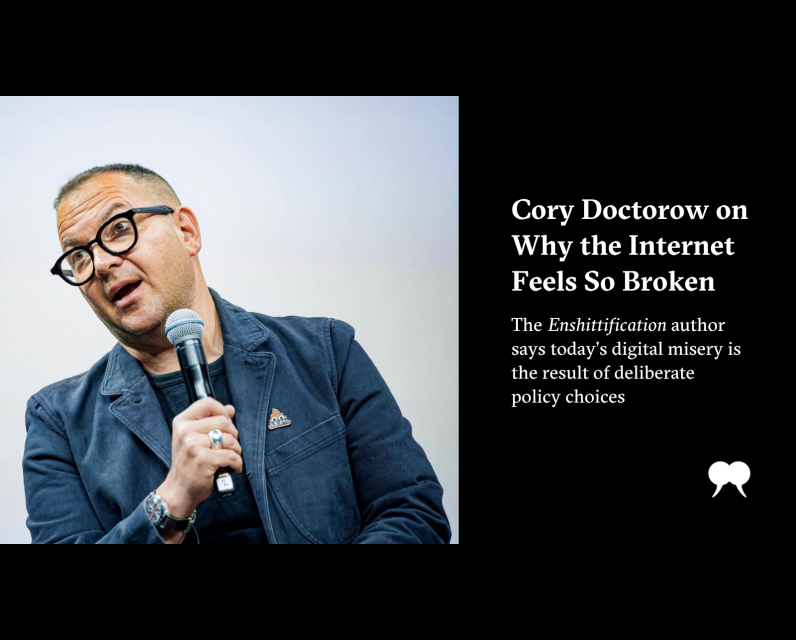
At this year’s DemocracyXChange summit, executive director of The Walrus Jennifer Hollett sat down with writer and digital-rights activist Cory Doctorow for a conversation about the internet and the decay of public trust online.
Doctorow has become one of the sharpest critics of what he calls the “enshittification” of digital platforms—the process by which tech companies systematically degrade their products in pursuit of profit and control. But the discussion ranged far beyond Silicon Valley. Together, Hollett and Doctorow explored the failures of regulation and the growing sense that citizens are trapped inside systems designed to extract from them rather than serve them.
Read Cory Doctorow’s keynote lecture here.
The interview has been edited for length and clarity.
How did you come to the word enshittification?
I’ve worked for the Electronic Frontier Foundation for the majority of my adult life. And getting people to care about tech issues is hard. They’re very abstract, and the things we worry about are a long way in the future. For extremely good reasons, people are mostly interested in things that are concrete and happening right now. So, you can wait and do nothing, and eventually, those issues will become very concrete, and they will be on your doorstep, but it’ll be too late to do anything about it. The trick, as with environmental activism, is to find ways to raise the salience of these issues for people before it’s too late.
I’ve spent twenty-five years coming up with framing devices and metaphors and similes and parables. I came up with this dirty word, and it caught on. It caught on, I think, for a lot of reasons. I think people appreciate a minor licence to vulgarity. It feels nice to have permission to be a bit sweary. I also think that there’s a kind of killer combination with the right to be sweary and a good technical, economic, and political analysis of how we got here.
When did you discover your interest for technology and for science fiction?
My dad was a computer scientist. We had computers in the house before computers had screens. We had teletype terminals in the 1970s. But science fiction is down to one person: a woman named Judith Merrill. If you don’t know her, you’ll know her library on College Street, the Merrill Collection, which is the largest science fiction reference collection in the world. Judy was a force of nature. She went into voluntary exile in 1968 after the Chicago police riots. She decided she didn’t want to be an American. Or bring her kids up in America. She had recently divorced from another science fiction writer, Frederick Pohl. She got the books in the divorce. She brought them here, and she gave them to the Toronto Public Library. And they became the nexus of that collection.
I first encountered Judy on TV, though; she was on TV Ontario. She used to come on every week and introduce Doctor Who. She was great. She was a tough old broad. She was a chain-smoker, grey hair. Took no nonsense. She’d come on every week and introduce the show with notes from the way that these ideas are developed. And so, she’d come out, and she’d be like, “Tonight’s episode is about time loops. I remember we invented time loops in 1948 at a spaghetti potluck dinner at the Futurion House in New York. I will never forget, because Isaac Asimov was there, and he wouldn’t stop grabbing C. M. Kornbluth’s girlfriend’s ass. We wrote thirteen stories about time loops that night. I took the A train to Rockefeller Center. I threw them over John W. Campbell’s transom at Amazing Stories. He published them all in the following year. And that is where we get our time loops.”
She was great. We took a school trip to her library when I was about ten, when it was back up at Spadina and Bloor. She said, kids, if you write stories, you can bring them to me. This is like Wayne Gretzky offering to help you work on your slapshot. And so, I had a MetroPass. I started taking the subway down to her with my little stories. She eventually put me in a writing workshop with a bunch of other writers. And she let us use the back room to meet.
Many years later, I became a student at the SEED alternative school at College and Yonge, where we had an incredible writing workshop. I found out that that had been founded ten years before I got there by Judy. I then worked on a TVO show called Prisoners of Gravity that was started by alumna of the program that brought Judith in. I was also part of a network of potlucks that Judy put together called Toronto Hydra. I published my first story in a magazine called On Spec that Judy bullied two fans from the Prairies into starting—Canada’s first national science fiction magazine. I worked at Bakka Books, the science fiction bookstore that she, again, bullied a local science fiction fan into opening.
I mean, really, she was the founder of the feast. There is a generation of us in science fiction in Canada who owe it all to Judith Merrill.
What’s the view like right now on democracy when you’re in the United States versus when you come back to Canada?
I think that Americans are frightened and angry. No one can miss that. I think even the Trumpists are frightened and angry. No one’s happy with the situation that Donald Trump has put us in. There’s one thing you can say about living in a trollocracy. It is exhausting. Every day there’s just another goddamn crisis. Some are manufactured, but a lot of them are real—that’s your neighbour being grabbed off the street. Americans are afraid because they think their political leadership sucks, because it does. And they’re worried the democrats won’t take the democracy crisis seriously, because they aren’t. And that we’re going to go into an election cycle that’s going to be nakedly stolen, and the democrats are going to show up with little ping pong paddles with protest messages on them, and that’s going to be their answer.
Here in Canada, I think we’re justifiably worried about austerity. I think firing tens of thousands of civil servants and replacing them with chatbots is a recipe for making things much worse and making people much angrier and for ultimately voting for the kind of politicians who thrive in that kind of anger.
You have been on the front lines of the internet from the good old early days. I think something a lot of us wonder about, especially with the rise of generative artificial intelligence, are the gaps or lag time. When we’re introduced to new technology, there’s often resistance in the general public—which I think is healthy. Then there’s the adoption, maybe the falling in love stage. That’s followed by the enshittification, which you laid out in your speech. And then often, at the end, comes policy development—unfortunately not earlier. So, I’m just curious at the speed that big tech companies become big versus the rest of us being a part of the journey, and then when government comes in. It seems mismatched.
I would find that account a lot more credible if I wasn’t there when people were loudly warning policymakers about the foreseeable outcomes of the policies they were taking. It’s not like anti-monopoly policy was a mystery in the Brian Mulroney–Ronald Reagan years when we decided to stop enforcing it. What’s remarkable is you have economists today who counselled drawing down anti-monopoly enforcement. They said monopolies are efficient. If 90 percent of us use Google as our search engine, they said, then Google is pleasing to 90 percent of us, and it would be perverse to use public money to smash Google for making us so happy. So, we should just leave them alone, and the market will sort it out.
The result is that we now have monopolies in every field. We have monopolies in glass bottles and vitamin C and professional wrestling and glasses. All glasses are owned by one company, which also owns LensCrafters and Sunglass Hut. I don’t care what it says on the temple of your lens. It’s owned by Essilor Luxottica. They’ve raised the price of glasses 1,000 percent in the last year. We look at these monopolies, and we ask the economists, “What’s up with that?” And they say, “How can you affirmatively connect our pro-monopoly policies with the rise of monopolies? That’s ridiculous.”
I was there, in 2010, when we told Tony Clement and James Moore that an anti-circumvention law for Canada would be a bad idea and would lead to Americans exporting defective technology to us that we couldn’t correct. In response, 6,132 of us wrote into the consultation to say no, and fifty-three wrote in to say yes. Moore went to Toronto—this was for the International Chamber of Commerce, where he gave the keynote—and he said, everyone who disagrees with me is a “babyish radical extremist.” They threw out the results of the consultation and passed it after whipping the caucus in 2012. This was Bill C-11.
This wasn’t a case of technology outrunning our regulators. This was a case of our regulators deciding to do enshittigenic things. Now there’s different reasons people do different things. In this case, I don’t think Moore and Clement were committed to the idea that if you own something, you shouldn’t be able to decide how to use it. I think they did it because they were worried about US tariffs. They wouldn’t say it. But we knew it was the case.
Before Viktor Orbán rose to power, I used to teach summers at Central European University. I was a guest lecturer in the PhD program in international relations. One year, I’d been talking about this stuff. A lot of my students were ex-politicians, and one of them had served as the information minister of a Central American nation. And they told me that during the CAFTA negotiation—or the Central American Free Trade Agreements—they briefed their trade negotiator, and they said, under no circumstances should you give the Americans an anti-circumvention law that bans us from modifying our technology. And then they got a call from the negotiator saying the Americans have told us that if we want to export our coffee, we have to take anti-circumvention. So, I’m sorry, you’re going get it.
So, sure, our own policymakers may have felt cornered. Maybe they were cornered. But it wasn’t like the speed of technology outran the policymakers. The policymakers made bad choices that had the foreseeable and foreseen effect of creating the situation we’re in now.
What has the reaction been from big tech and government? You highlight in your book that you have been invited over the years to speak at Google, and you also shout out tech workers, because they’re doing the good work.
It’s interesting with policymakers. I went to the chief information officer of Canada’s annual summit, where the CIO and chief technology officer of every ministry in Canada were in attendance, along with a lot of their senior functionaries. My speech was not too dissimilar to the one I gave today. And then afterwards, tons of them came up to me, and they said, “I’m so glad you said that because I knew it. But everyone else here needs to hear it too.”
That is one of the reasons we go out on demonstrations, right? It’s not because we’ll change our politician’s mind. It’s because we’ll find out what each other is thinking. How many people agree with us. So, I think that there’s a lot of policy favour for this. I think a lot of people would like to do something bold.
I do hear from a lot of tech workers. I had this experience of tech that I think is not unusual in that I sat in our spare bedroom, in North York, with a modem in the early 1980s connected to this wide world that just got wider and wider and wider. My bulletin board system got what was called FidoNet, which is a way of talking to other bulletin board systems—first in Canada, then around the world, and then that got joined to something called Usenet, which was the internet. And then that got turned into a graphical user interface, and so on and so on.
It’s like being in a Powers of Ten movie: the world keeps getting bigger and bigger. Our lives were changed profoundly. We found economic opportunities. We learned words to describe who we were and what we thought. We escaped our milieu. We found ways to do more than we ever thought we could.
Tech is full of these people. And they really want to help everyone else have that liberating experience too. I call them Tron-pilled. They want to fight for the user.
How is enshittification changing us as people and our behaviour?
I think enshittification is the end product of forty years of reducing politics to individual choice. If there’s a thing I find very disheartening when I talk about this, it’s people who’ve read my book or heard me speak, and they say, well, “I’ve devoted my life to making very careful consumption choices. I’m trying to not use the platforms; I’m trying to not be enshittified.” Sure, use the platforms you want to use. Stop using the ones that make you angry. Buy your groceries from the local guy. That’s fine. But don’t kid yourself that you’re going to change the world with your consumption choices. It’s like recycling your way out of a wildfire.
These are social problems. They’re not individual choice problems. A boycott is not you waking up and shopping very carefully. A boycott is a social movement. We’re not using social networks, which are the best organizing tools we’ve ever seen, to mobilize people. We’re using these tools to chide each other for our consumption choices. Where you shop is way less important than what you do. Zephyr Teachout, in her remarkable book Break ’Em Up, has this chapter at the end where she says, look, if there’s a giant demonstration at the Amazon warehouse, and you miss it because you drove around looking for someone who isn’t Jeff Bezos to buy markers and cardboard from so you could make a sign, Bezos wins that round.
So, buy your books at Bakka, buy your groceries at the Big Carrot. That’s great. But you’re not going to change the structural forces that way. You change the structural forces by forming big social groups that act on the structures by demanding political change.
This is an adapted version of a Q&A with Cory Doctorow that occurred at the DemocracyXChange summit on April 16. DemocracyXChange is Canada’s democracy summit, a partnership between OCAD University, the Dais at Toronto Metropolitan University, and the Open Democracy Project. It appears here with permission.
The post Cory Doctorow on Why the Internet Feels So Broken first appeared on The Walrus.
Unpublished Newswire


Comments
Be the first to comment